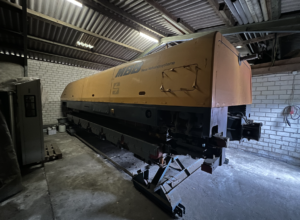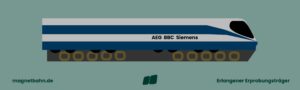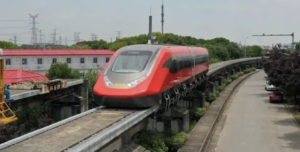
Erlangen Test Vehicle
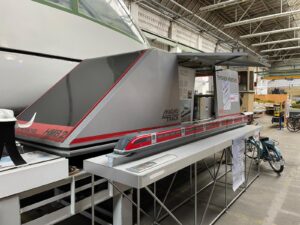
The Erlangen test vehicle took a different path from the Transrapid: it levitated electrodynamically using cooled superconductors. From 1973 it ran on a circular track in Erlangen.
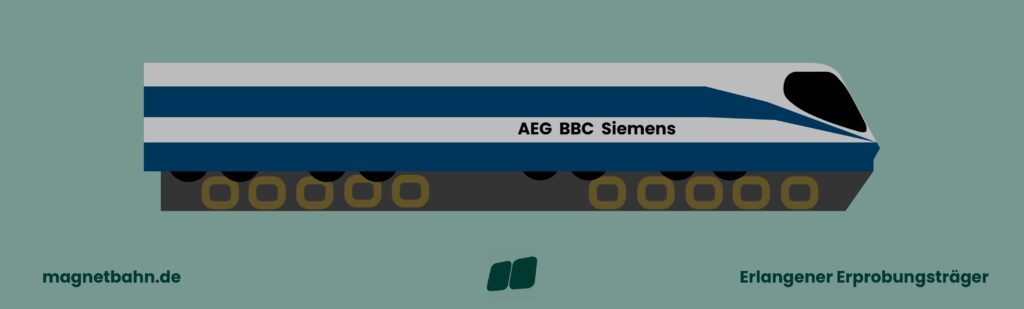
Levitation with superconductors
Erlangen was Germany's counter-design to the Transrapid: levitation without control electronics.
In May 1972, specialists from AEG-Telefunken, Siemens and BBC began developing a different levitation technology: electrodynamic levitation with cooled superconductors.
This system did not fit the existing test tracks. So in 1972 a new test track was built in Erlangen, a circular track about 900 meters long made of U-shaped guideway girders. At the end of 1973, the EET01, the first "Erlangener Erprobungsträger" (Erlangen test vehicle), entered service there.
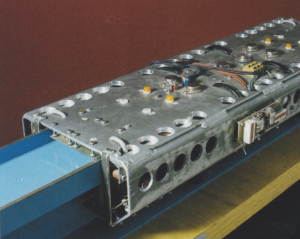
The advantage of this technology: it needed no electronic control. Up to 50 km/h the vehicle rolled on 16 pneumatic tires; above that it lifted off and levitated. This was made possible by superconducting magnets cooled to very low temperatures.
Key facts EET01
- Year built
- 1973
- Operation
- 1973–1977
- Company
- Projektgruppe Magnetschwebebahn (maglev project group)
- Route
- 880 m circular track at the Siemens research center in Erlangen
- System
- Asynchronous short-stator linear motor
- Air gap
- none
- Rated speed
- 140 km/h
- Top speed reached
- 230 km/h
- Vehicle units produced
- 1
- Empty weight
- 12 t
- Payload
- 5 t
- Seats
- –
- Standing places
- –
- Length
- 12.3 m
- Width
- 3.8 m
- Height
- 1.75 m
EET02: drive in the guideway
At first the EET01 ran with an asynchronous short-stator linear motor, with the drive located in the vehicle. Later it was converted to an ironless synchronous long-stator linear motor and was now called EET02. The drive was thus located in the guideway.
The drawback of the short stator: to receive drive power, the vehicle needs mechanical contact with the guideway, which causes noise and wear. Reaction rails, often in the middle of the guideway, are typical of short-stator vehicles.
After the conversion of the EET02 and the circular track, the motor windings were laid along the entire guideway instead of the reaction rail. Excitation magnets were not needed, because the vehicle did not levitate electromagnetically: the superconducting magnets lifted it from 50 km/h, and the long-stator linear motor propelled it. Unlike the Transrapid, this long stator did without iron.
Key facts EET02
- System
- Synchronous long-stator linear motor
- Air gap
- 100 mm
- Rated speed
- 130 km/h
- Top speed reached
- 175 km/h
- Empty weight
- 11 t
- Payload
- 3 t
Fate
- Location
- scrapped