
Language
Language
High-speed maglev · China

Superconducting maglev in China

Alongside its Transrapid-based train, China is developing two superconducting approaches: an electrodynamic prototype from CRRC Changchun and a high-temperature superconducting vehicle from Southwest Jiaotong University. Both are still at the research stage.

CRRC Changchun

A Chinese answer to the SCMaglev

CRRC Changchun first showed its 600 km/h superconducting maglev in July 2024 and presented the lead car again at the UIC World Congress in Beijing in July 2025. Like Japan's SCMaglev, it uses electrodynamic suspension, here with high-temperature superconducting magnets.

The train runs on rubber wheels at low speed and lifts off above about 150 km/h. Reported gaps are 100 mm for levitation and 70 mm for guidance, in a U-shaped guideway. CRRC describes it as a supplement to the existing network for point-to-point connections. No high-speed test results have been published.
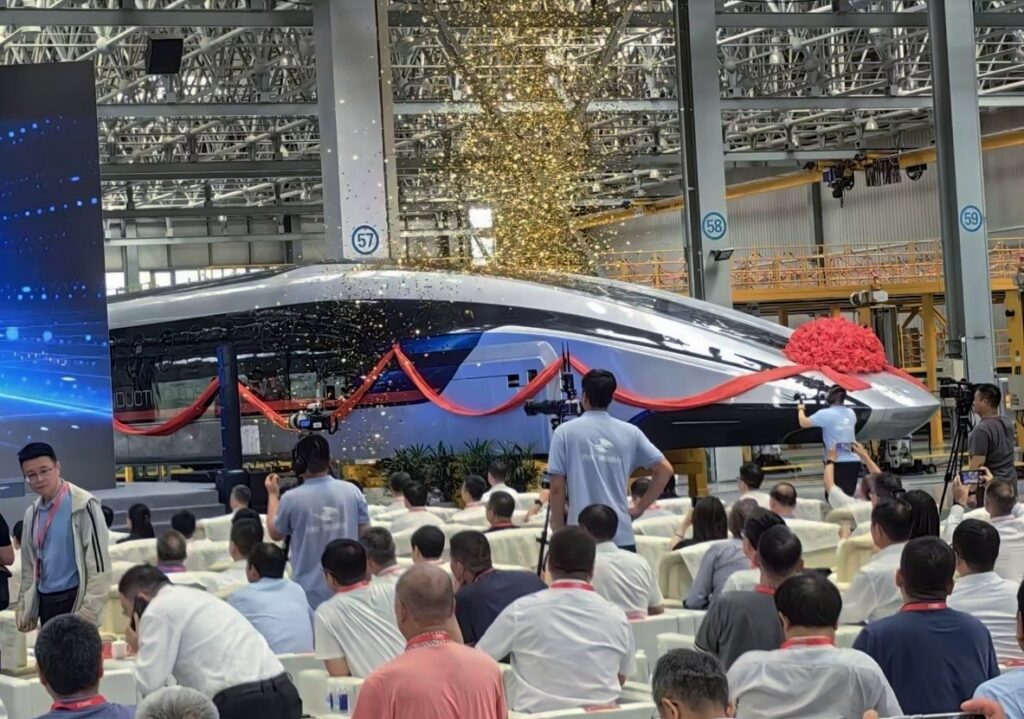
EDS_China_2
Superconducting maglev prototype in China
Southwest Jiaotong University

Floating on frozen magnets

HTS levitation is passive: once cooled, the vehicle simply stays where it floats.

On 13 January 2021, Southwest Jiaotong University (SWJTU) in Chengdu presented an engineering prototype and a 165 m test line, with a design speed of 620 km/h. Partners included CRRC and China Railway Group.

The principle is flux pinning. High-temperature superconductors in the vehicle are cooled with liquid nitrogen and lock themselves above a track made of permanent magnets. No control electronics are needed to keep the vehicle stable. The test line is far too short for high-speed runs and is used for demonstrations; students from the United States rode it in July 2026.

Fact sheet

CRRC Changchun principle
Electrodynamic suspension, high-temperature superconducting magnets
CRRC Changchun design speed
600 km/h
CRRC Changchun gaps
100 mm levitation, 70 mm guidance (reported)
SWJTU principle
HTS flux pinning above a permanent-magnet track
SWJTU design speed
620 km/h
SWJTU test line
165 m, Chengdu (2021)
Status
Research and prototypes, no line planned
Assessment

Strengths and challenges

StrengthsLarge levitation gaps, as with Japan's SCMaglev. HTS levitation needs no active control and works with cheap liquid nitrogen instead of liquid helium.
ChallengesReliability of cryogenic systems in daily service, the cost of a permanent-magnet track over long distances, and no test track long enough to prove high-speed claims.
Join the team

Help build maglevhub.com

maglevhub.com started in 2026 as the international offshoot of magnetbahn.de and is now growing on its own. We are looking for writers, translators, researchers, video makers and developers from all over the world.