
Urban maglev in China
Four of the world's seven commercial maglev lines run in Chinese cities and tourist regions, at 100 to 120 km/h. A 160 km/h intercity line is under construction. This is where maglev is actually growing.
Medium-low speed maglev
Short-stator EMS: the motor rides on the train, the guideway stays simple.
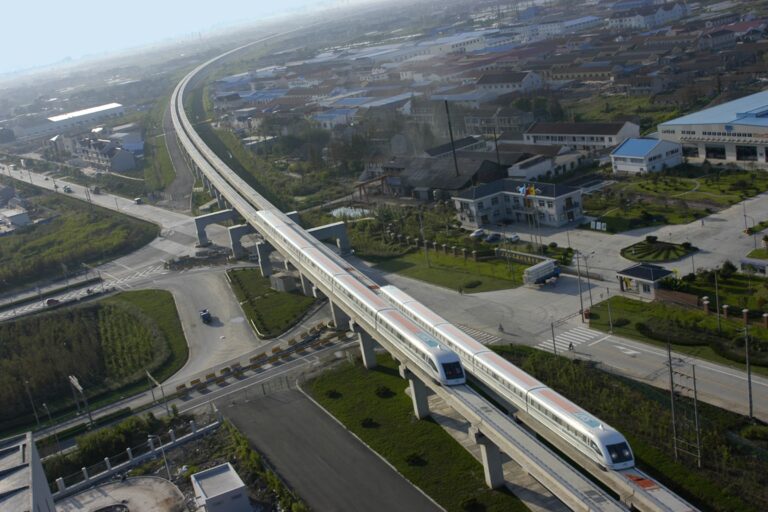
China's urban maglev lines use electromagnetic suspension with a linear induction motor on the vehicle, a design family that goes back to Japan's HSST. The main builders are CRRC Zhuzhou, CRRC Tangshan and CRRC Changchun.
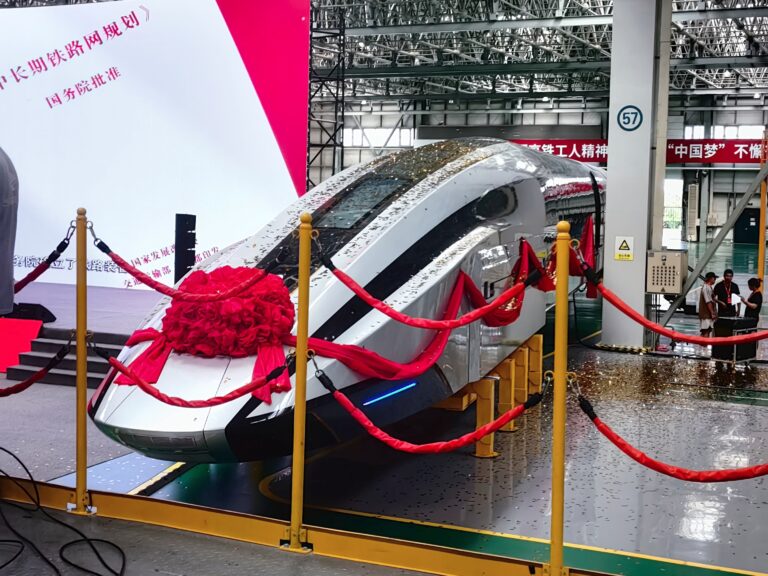
Typical service speeds are 100 to 120 km/h. In 2018 CRRC Zhuzhou delivered a 160 km/h version, and a 200 km/h variant is in development. The trains are quiet, climb steep gradients and run on elevated guideways that fit into dense cities.
Four lines in service
Changsha to Liuyang: the first intercity maglev
The next step is a regional line. The Changsha to Liuyang maglev will be 48.7 km long with 12 stations and a design speed of 160 km/h. Phase 1, 39.5 km from Huanghua Airport to Jili, costs 10.44 billion yuan and is due to open in 2029. It would be the first intercity line of this maglev class anywhere.
Fact sheet
- Principle
- Electromagnetic suspension (EMS), short-stator linear induction motor
- Main manufacturers
- CRRC Zhuzhou, CRRC Tangshan, CRRC Changchun
- Service speed
- 100 to 120 km/h
- Tested speed
- 160 km/h (2018)
- Lines in service
- 4 (Changsha, Beijing, Fenghuang, Qingyuan)
- Under construction
- Changsha to Liuyang, 160 km/h, due 2029
Sources disagree on the top speed of the Changsha line (100 or 140 km/h). Ridership figures are from 2017 and event reports.
Strengths and challenges
Sources
- Changsha Maglev ExpressWikipedia
- China begins construction of inter-city maglevInternational Railway Journal
- Beijing's first maglev line S1Yicai Global
- Beijing Maglev Line S1Travel China Guide
- Fenghuang Maglev ExpressBaidu Baike
- Fenghuang maglev during Spring FestivalChinese government portal, February 2024
- Qingyuan Maglev Tourist LineWikipedia
- CRRC Zhuzhou 160 km/h maglevChina Daily, June 2018