
Transrapid
Levitating above its guideway at 500 km/h, the Transrapid can connect Germany's major cities in under two hours and bring Europe closer together as one network.
Flying without taking off
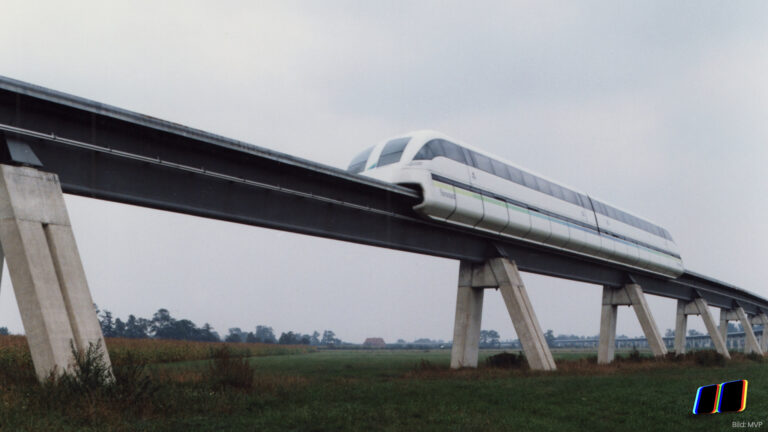
No wheel, no rail, no contact: the Transrapid levitates about 10 millimeters above its guideway.
The Transrapid is a maglev from Germany. Magnets keep it levitating and on track, and it is propelled by a linear motor in the guideway. Nothing rolls, nothing rubs. That is why it reaches 500 km/h, accelerates faster than any train and hardly wears out.
For decades it was tested at the test facility in Emsland, in northwestern Germany. Since 2003 it has run in daily passenger service in Shanghai. What is missing is its use where it was invented.
The Transrapid in 2026
One line, running every day for more than two decades: proof that the technology works.
The Shanghai line links Pudong Airport with Longyang Road in about eight minutes. Its record operating speed is 431 km/h; since 2021 normal service has been capped at 300 km/h. An extension to Hangzhou was suspended, and no second Transrapid line has been built anywhere.
In Germany, projects between Berlin and Hamburg (2000) and in Munich (2008) were cancelled, and the Emsland test facility closed in 2011. The technology lives on in China, where CRRC develops a 600 km/h successor under licence. How it compares with other systems is shown on our technologies overview.
The Transrapid worldwide
- Developer
- Transrapid consortium (Siemens, ThyssenKrupp and others), Germany
- Principle
- Electromagnetic suspension (EMS), long-stator linear motor in the guideway
- Levitation gap
- about 10 mm
- Speed record
- 501 km/h (Shanghai, test run); 450 km/h on the Emsland test track (TR07, 1993)
- In service
- Shanghai, about 30 km, since 2002; 300 km/h since 2021
- Test facility
- Emsland, 31.5 km, closed 2011, to be dismantled by 2034
- Derivative
- CRRC 600 km/h maglev, developed in China under licence
- Status
- One commercial line, no new project under construction
Germany in two hours. Europe in one network.
Imagine a network that connects all of Germany's major cities and continues across the borders: to Amsterdam, Brussels, Paris, Zurich, Vienna, Prague, Warsaw and Copenhagen. On its own guideway, with no traffic jams, no track works, running on a regular timetable.
Tap a city and see how much closer the rest move.
A vision, not a plan: guide values for a direct run at 500 km/h. Route = straight-line distance × 1.15, plus 4 minutes for accelerating and braking. Tap a city.
What a Transrapid network makes possible.
Faster, more economical, longer-lasting.
In direct comparison with the ICE (Deutsche Bahn's high-speed train), the Transrapid needs less energy, requires less maintenance and reaches cruising speed much faster.
Energy per seat at 300 km/h
Maintenance per seat-km
Distance to reach 300 km/h
Source: Schach, Jehle, Naumann: Transrapid und Rad-Schiene-Hochgeschwindigkeitsbahn (Transrapid and wheel-rail high-speed rail), Springer 2006, tables 5.14, 5.19, 5.40
Everything about the Transrapid.
 TechnologyLevitating, guiding, propelling: how it works.
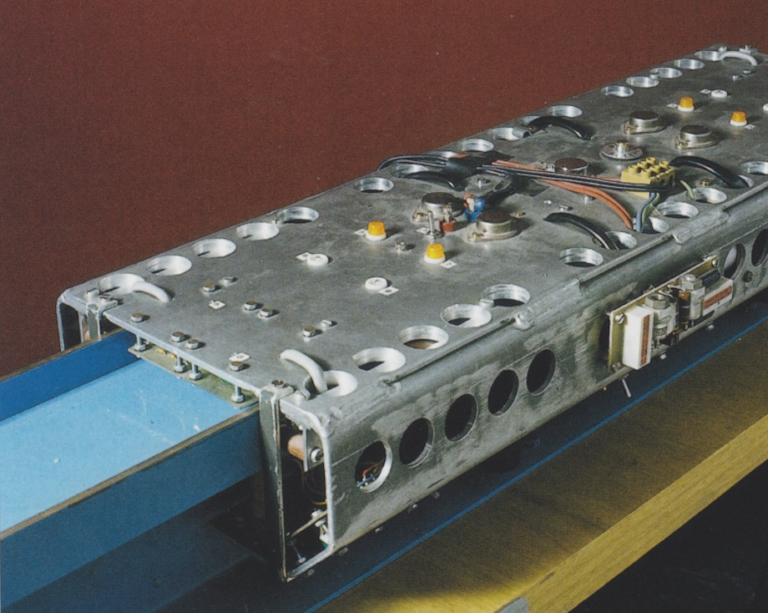 HistoryFrom Hermann Kemper's idea in 1922 to today.
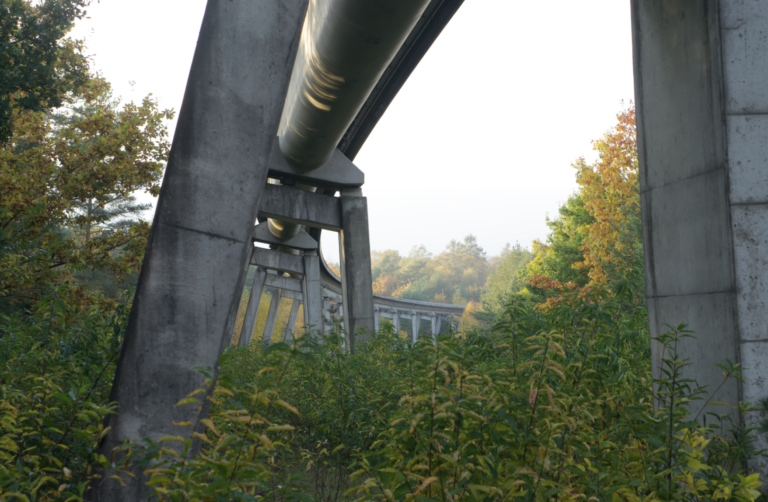 RoutesShanghai, Emsland and the abandoned projects.
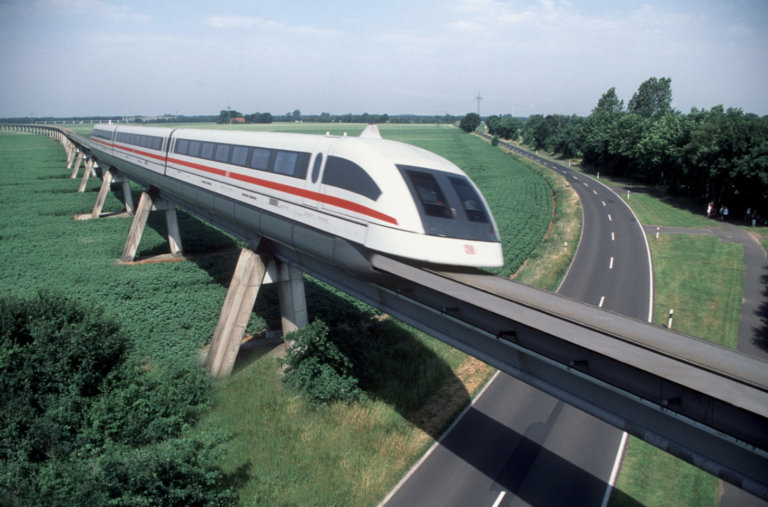 Transrapid Test Facility Emsland (TVE)The test track where everything was tried out.
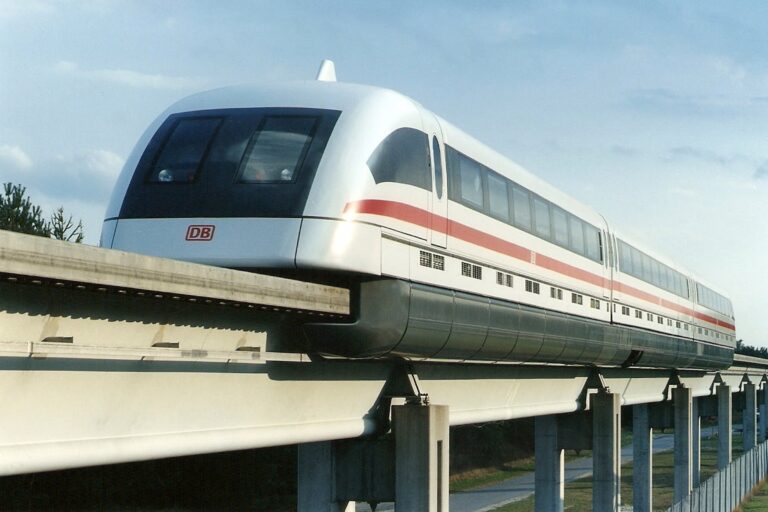 Vehicle overviewAll vehicles from the TR01 to today.
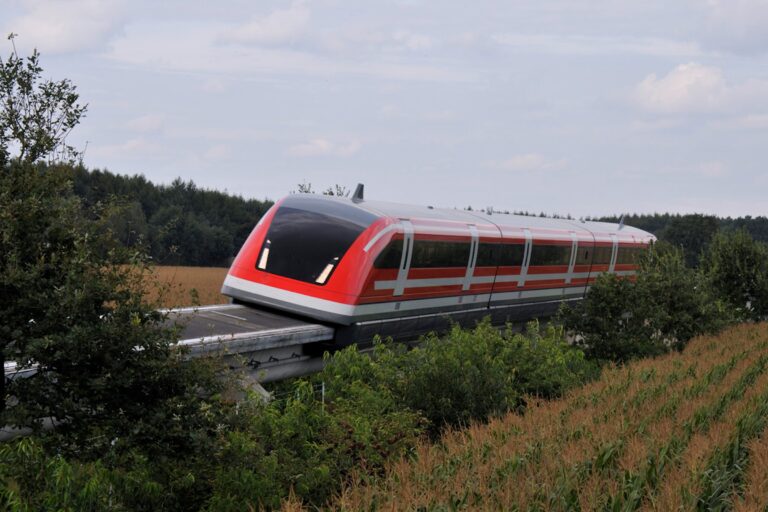 Fact checkCommon claims, put into perspective with sources.
Help make the vision happen.
maglevhub.com is looking for people who want to help build it: writers, translators, researchers and video makers from around the world. Get in touch at info@maglevhub.com.