
Language
Language
High-speed maglev · China

CRRC 600 km/h maglev

China's high-speed maglev is a direct descendant of the German Transrapid, designed for 600 km/h. It has been unveiled and shown to the world, but it has not yet run at full speed and has no confirmed route.

The system

Transrapid technology, taken further

At its core, the CRRC train is a Transrapid developed for higher speed.

The 600 km/h maglev was developed by CRRC Qingdao Sifang, leading a group of more than 30 companies, universities and research institutes. It uses electromagnetic suspension: magnets on the vehicle are pulled up toward the underside of the guideway, and a long-stator linear motor in the guideway drives the train.

The technical basis is the Transrapid. CRRC continues to develop the technology under licence from ThyssenKrupp, and core components were validated at up to 430 km/h on the Transrapid line in Shanghai.

Fact sheet

Developer
CRRC Qingdao Sifang and partners
Principle
Electromagnetic suspension (EMS), long-stator linear motor
Design speed
600 km/h
Tested speed
Not yet tested at full speed; components validated up to 430 km/h
Test track
Tongji University, Shanghai (about 1.5 km)
Commercial line
None confirmed
Status
Prototype
History

From prototype to showcase

  1. 2020

    First test runs

    A prototype section runs on Tongji University's test line in Shanghai.
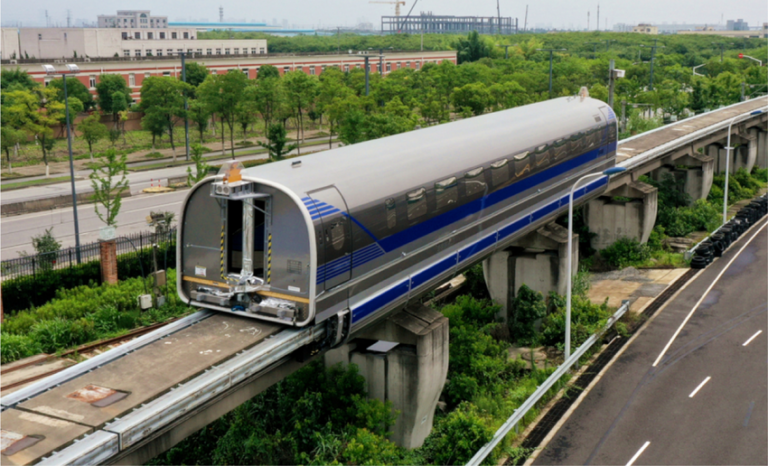
    Test-run-of-a-mid-section-prototype-at-Tongji-University-in-June-2020-image-from-CRRC
  2. 2021

    Production-standard train unveiled

    The first 600 km/h production-standard train rolls out in Qingdao.

  3. 2023

    Request for tests in Shanghai

    CRRC's chairman asks for permission to run night-time tests below 500 km/h on the Shanghai maglev line.

  4. 2025

    Shown at the UIC World Congress

    The train is exhibited in Beijing next to the CR450 high-speed train. CRRC says it will undergo several years of testing before commercial service, and that new maglev test tracks are being built.

  5. 2026

    Part of the national plan

    China's National Railway Administration lists 600 km/h maglev test validation in its technology plan for 2026 to 2030. That is a testing goal, not a commitment to build a line.

Routes

Corridors, but no project

Since 2021, several corridors have been mentioned, for example in Guangdong toward Hong Kong and between Shanghai, Shenzhen and Guangzhou. So far these are land-use reservations and studies, not approved projects. A test line of around 200 km proposed in 2019 was never built, and a Hong Kong network by 2030, floated by officials in 2021, has not materialized.

The biggest open question is a long enough test track. Without one, no train can show what it does near 600 km/h.

Assessment

Strengths and challenges

StrengthsBuilds on the only high-speed maglev technology with more than two decades of commercial service. Strong state backing and a large industrial partner network.
ChallengesNo verified run near 600 km/h, no test track long enough to do one, and no route decision. China's conventional high-speed network is expanding fast and competes for the same corridors.
Join the team

Help build maglevhub.com

maglevhub.com started in 2026 as the international offshoot of magnetbahn.de and is now growing on its own. We are looking for writers, translators, researchers, video makers and developers from all over the world.