Transrapid Travel Time Calculator
How long would your route take by Transrapid, and how much faster would you be than by ICE or car? Choose a route or enter the kilometers of your own route.
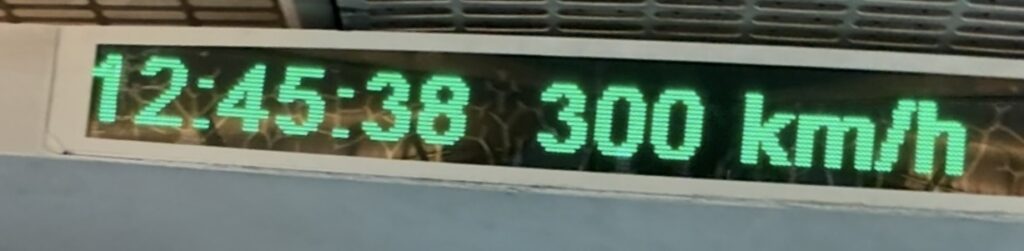
The display is modeled on the real speed display inside the Transrapid: on the left the travel time since departure, on the right the speed in real time.
The real display in the Transrapid
In the Transrapid's passenger compartment, an LED display shows the speed: black background, green lights. The animation above is modeled on it. On the left, the travel time runs from the start; on the right, the speed climbs as fast as the Transrapid actually accelerates.

What the calculator takes into account
For your route, the calculator works out the Transrapid's travel time and compares it with the ICE and with the car. It uses the Transrapid's real acceleration and braking values rather than just its top speed. It shows you the speed profile and the full calculation openly.
What speed we use for the ICE
We calculate with 130 km/h, the nationwide average of the ICE.
For the comparison, we calculate the ICE at 130 km/h. That is the nationwide average speed, in other words what the ICE actually manages on average from departure station to destination station, including all stops and acceleration and braking phases.
Why not calculate with top speed? An ICE can indeed run at up to 300 km/h, but reaches that speed only on a few sections. On most of the network it shares the tracks with regional and freight trains, runs on older lines with much lower limits and stops at several stations along the way. Anyone who calculates with top speed gets travel times that do not exist in real operation.

Often even longer in practice
The 130 km/h is the scheduled average. Delays and the low reliability of rail operations are not yet included in it. In everyday life they often extend ICE travel time considerably. The Transrapid's time advantage is therefore in reality usually even greater than the calculator shows.