
History of the Transrapid
An idea from university days, decades of development, a world record and the leap to China: how Hermann Kemper's vision became the Transrapid.
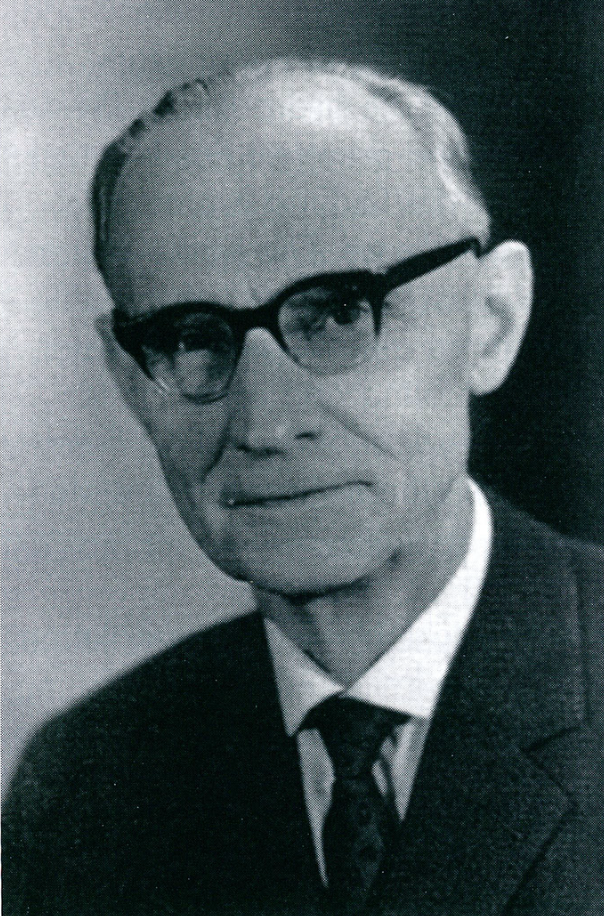
Hermann Kemper: the idea of levitation
Kemper's patent is the basis of all electromagnetically levitated trains.
In 1922, while studying electrical engineering, Hermann Kemper of Nortrup came up with the idea of replacing the wheels of locomotives with electromagnets. What bothered him most was the noise of the wheels. Alongside his studies he had no time to pursue it.
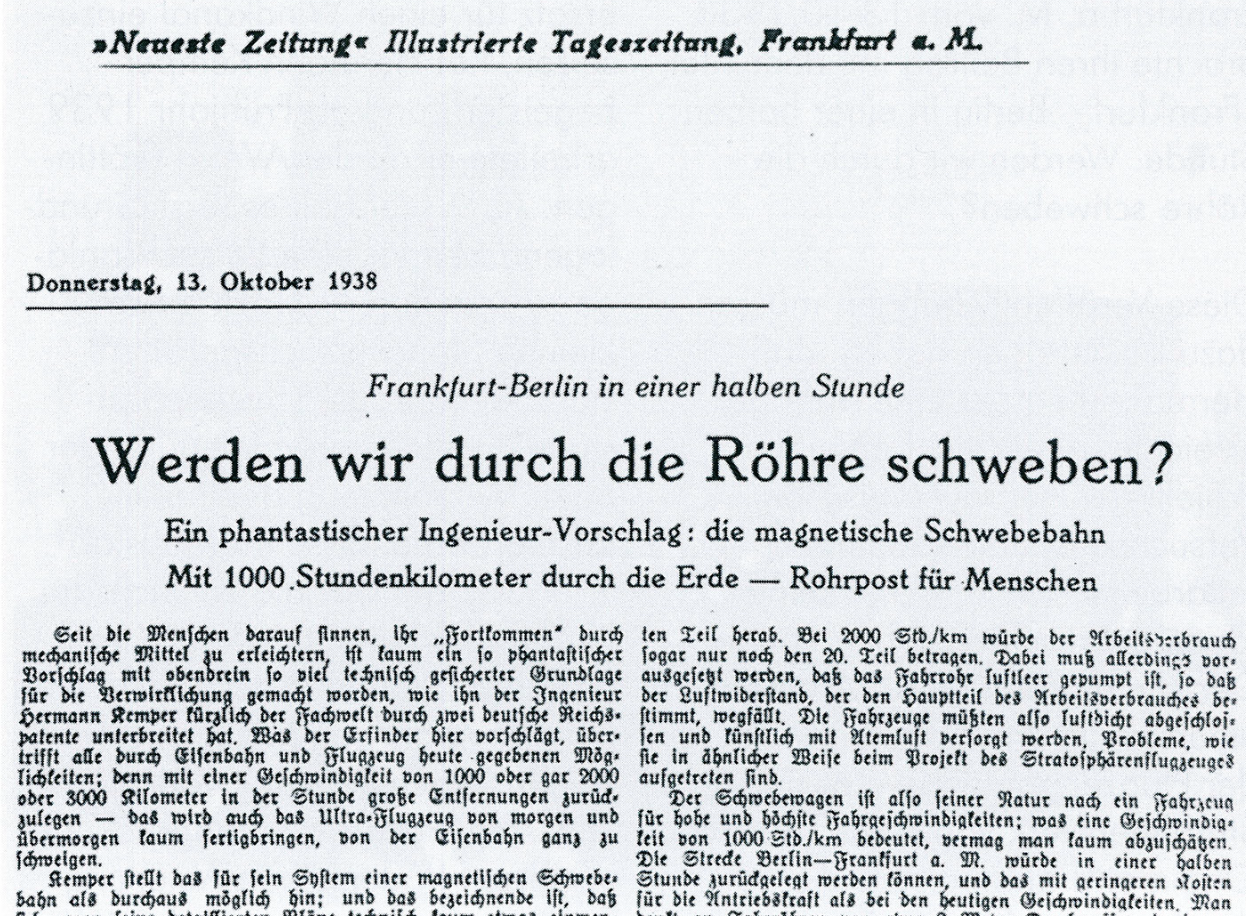
In 1932 he took over his father's meat-processing business and kept pursuing his idea. He filed a patent for the levitation function, which became the basis for the later Transrapid, and added lateral guidance in 1938. This laid the foundation for all maglev trains based on electromagnetic attraction (EMS).
Even then Kemper was thinking further ahead: in an evacuated tunnel he wanted to travel between Frankfurt and Berlin at 1,000 km/h. Today this principle is known as the Hyperloop.
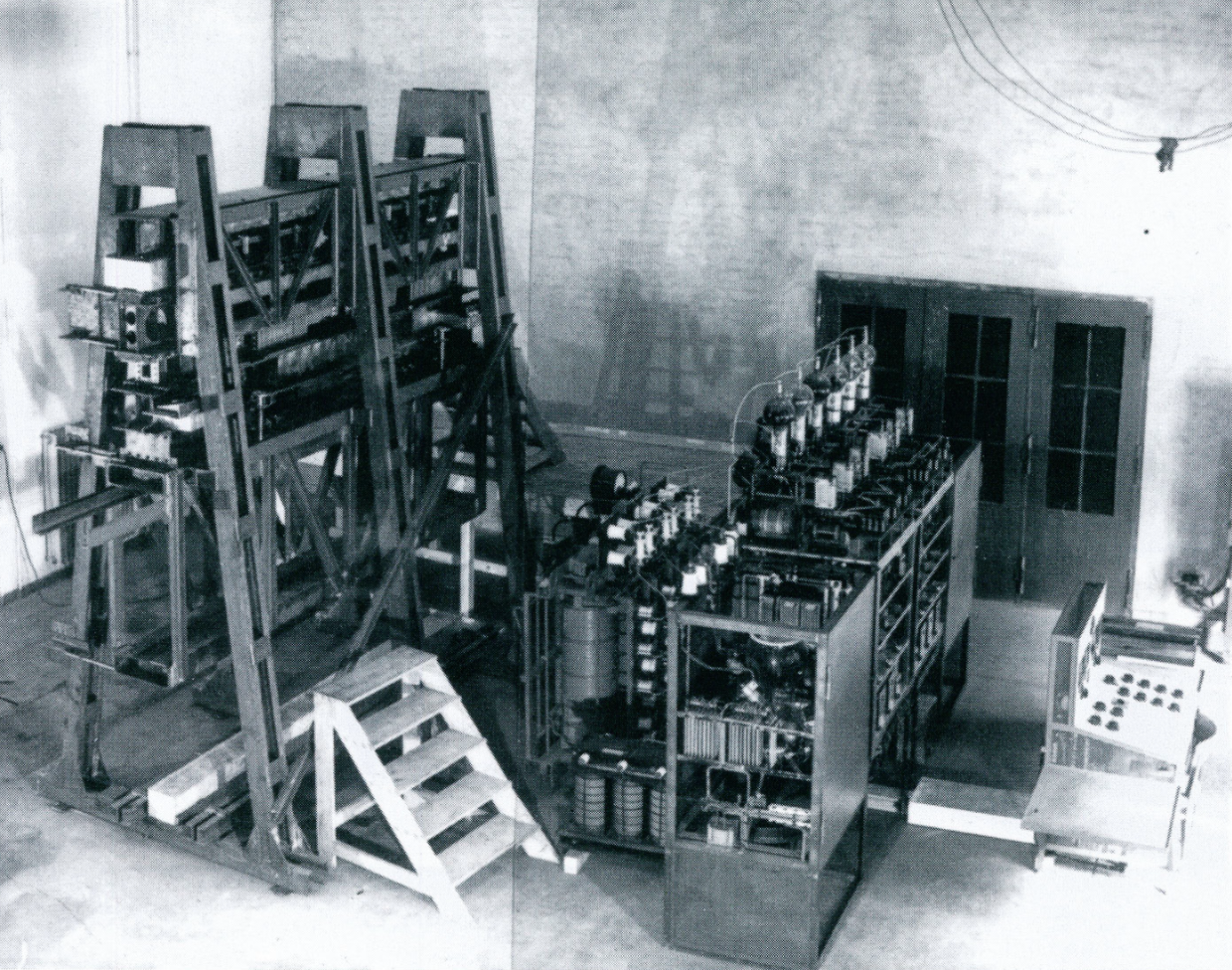
In 1939 the Aerodynamische Versuchsanstalt Göttingen (AVA, the Aerodynamic Research Institute in Göttingen) offered to build a maglev train for him. A 20 km test track in Landsberg was planned. In 1943, however, the German Reich stopped all spending not relevant to the war. Disappointed, Kemper gave up development. Only a test rig survives, which shows that the levitation technology was still impractically large at the time.
Kemper's patent and test rig
A fresh start and the first prototypes
- 1966
Kemper meets Bölkow
Kemper mostly met with ridicule for his idea. During a stay at a spa he met Ludwig Bölkow, who was immediately convinced and had the technology examined at his company Bölkow GmbH, later MBB. The result: feasible, with many advantages.
- 1969
HSB study and Transrapid 01
Bölkow launches the HSB feasibility study (high-speed rail) together with Federal Transport Minister Georg Leber. Krauss-Maffei presents the TR01: a model 60 cm long and weighing 50 kg with an asynchronous short-stator linear motor. At the demonstration, experts looked for hidden wheels.
- 1971
MBB principle vehicle
On May 6, 1971, MBB shows in Ottobrunn the world's first electromagnetically levitated train able to carry people: 7.6 m long, four seats, 90 km/h on a 660 m test track (dismantled in 1976). At the end of 1971 the HSB study confirms the high economic efficiency of levitation, and many companies get involved.
- 1971
Transrapid 02
On Krauss-Maffei's test track in Munich-Allach, the 11.7 m long, 10.7 t TR02 reaches 164 km/h.
- 1972
Transrapid 03 and the Erlangen test vehicle
Krauss-Maffei compares air-cushion and magnetic levitation using the TR03 air-cushion vehicle. Magnetic levitation wins. In Erlangen, the maglev project group tests electrodynamic levitation (EDS) with superconducting magnets on a 900 m circular track.
- 1973
Transrapid 04
The largest vehicle to date: 18.5 t, 20 seats, its own 2.4 km track in Munich-Allach. In 1977 the TR04 reaches 253.2 km/h.
- 1974
KOMET and the long stator
In Manching, MBB propels the KOMET test vehicle by rocket sled along a 1.3 km track to test magnet control at high speed. As KOMET M it exceeds 400 km/h. In Kassel, Thyssen-Henschel and TU Braunschweig test the long-stator linear motor, which makes the vehicles much lighter.
- 1977
System decision
At the end of 1977 the decision falls in favor of electromagnetic levitation (EMS), which is clearly superior to the electrodynamic system (EDS). The drive is still left open. In the same year the TR05 is commissioned, for the first time jointly by MBB, Krauss-Maffei and Thyssen-Henschel.
- 1979
Transrapid 05 at IVA Hamburg (International Transport Exhibition)
The TR05 is the first Transrapid approved for public passenger service. It combines the KOMET's individual magnet control with Thyssen-Henschel's long-stator drive: two sections, 26.2 m, 30.8 t, 68 seats, up to 75 km/h on 908 m of track. After the fair, part of the track moves to Kassel.
Why the Transrapid came to Emsland
What failed over protests in the Donauried was built in Emsland: the full-scale test track.
Originally a 57 km test facility was to be built in the Donauried between Dillingen and Donauwörth in Bavaria, jointly for maglev and wheel-on-rail technology. Despite far-advanced planning, the project was canceled after fierce protests by residents.
Gerhard Hugenberg, managing director of Emsland GmbH, then campaigned for Emsland in northwestern Germany, which at the time suffered from high youth unemployment. The test facility promised jobs and tourism. After a site review, Emsland was chosen.
From Emsland to China
- 1980
Construction of the test facility begins
First construction phase until 1983: the north loop with a connection to the test hall, 20.5 km. The second phase with the south loop follows by 1987, with more modern concrete and steel girders and supports up to 15 m high in places.
- 1984
Transrapid 06
The TR06 from Krauss-Maffei and MBB is the first vehicle in Emsland. A cable fire pushes the start planned for September 1983 back to early 1984. By 1991 it reaches 412.6 km/h.
- 1991
Transrapid 07 and technical readiness
The TR07, built in 1988 (car body by Krauss-Maffei, levitation and running gear by Thyssen-Henschel), brings improved running gear and aerodynamics. In 1991 it is declared technically ready for use.
- 1993
World record at 450 km/h
The TR07 reaches 450 km/h at the Emsland test facility.
- 1999
Transrapid 08
The pre-series vehicle with many innovations is the basis for the TR09, Shanghai and the CRRC CF600. At the test facility it reaches 420 km/h.
- 2001
Contract with Shanghai
After the Chinese premier's visit in 2000, China signs the contract in January 2001, and construction begins at the end of February. In 2002 the first vehicles arrive from Kassel.
- 2003
501.5 km/h and regular service
The Shanghai Maglev Train, an adapted TR08, reaches 501.5 km/h. At the end of 2003 commercial service begins on 29.9 km. By 2024 the vehicles have covered around 28 million kilometers.
- 2006
The Lathen accident
In the accident at the Emsland test facility, the TR08 is damaged.
- 2007
Transrapid 09
The last German Transrapid is designed for regional service and fully automatic operation: new air conditioning, inductive power transfer, wider electric doors, 400 km/h. Today it stands in Nortrup but is no longer operational.
- 2010
First Transrapid from China
The PV04 combines a Chinese car body with a German levitation and running gear. ThyssenKrupp grants licenses to China.
- 2011
End of the test facility
The technology is considered ready for the market, with no further need for testing. Operation in Emsland is discontinued.
- 2013
Joint research center
ThyssenKrupp and Chinese partners open a joint research center at Tongji University.
- 2019
CRRC CF600
CRRC unveils the 600 km/h maglev announced in 2016. Its levitation and running gear largely corresponds to the German systems.
- 2021
CRRC CF200
CRRC Zhuzhou builds a compact variant with two sections of about 12.5 m each and 200 km/h. It goes back to a German study on shorter, slower Transrapid vehicles and is tested on the Tongji track.
- 2023
CF600 from Changchun
Since the end of 2023, another 600 km/h vehicle from CRRC Changchun has been running on the Tongji track: a rounder, gray shape without front windows, with a front camera for fully automatic operation. It competes with the model from Sifang.
German technology, Chinese future?
What is being tested in China today at 600 km/h is, at its core, Transrapid technology.
China has been interested in the Transrapid since the 1990s and wanted to manufacture as many components as possible itself from the start. The guideway in Shanghai was built in China, while the design came from Germany.
Later vehicles were presented as China's own development but are largely based on German technology. Because Transrapid projects failed politically in Germany, German companies increasingly turned to cooperation with China.
At their core, CRRC's 600 km/h vehicles differ little from the German models of 20 years ago. For Transrapid technology this is a new opportunity, even if “Made in Germany” loses significance as a result.