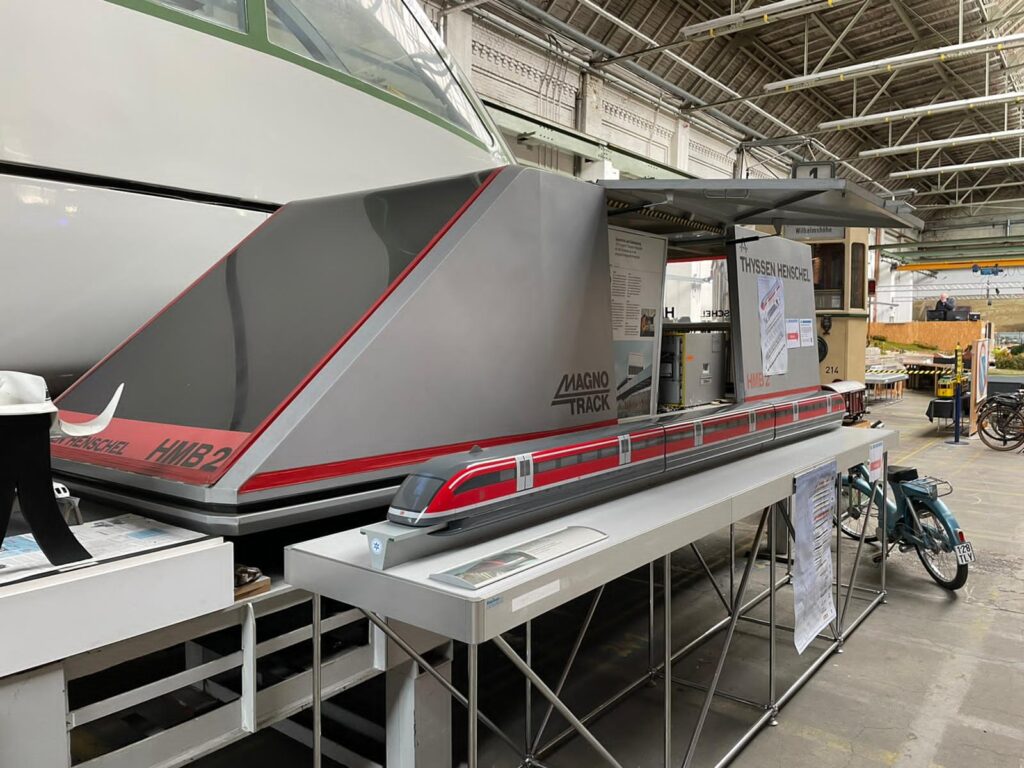
HMB2
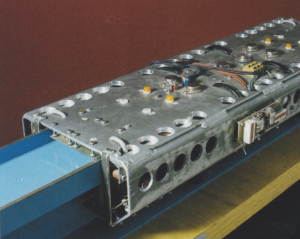
With HMB1 and HMB2, Thyssen-Henschel tested the long-stator drive in the guideway in Kassel from 1974. This technology became groundbreaking for all later Transrapid vehicles.
The drive moves into the guideway
The long stator from Kassel became the heart of the Transrapid.
Vehicles with short-stator technology had drawbacks. Because the drive sits in the vehicle, the propulsion power has to be transmitted via power rails, a kind of overhead line. This creates noise and mechanical wear. The vehicles also became too large and heavy because they had to carry the entire drive power on board.
In 1974, Thyssen-Henschel began developing an efficient long-stator drive system for the EMS system together with the Technical University of Braunschweig. The advantages: significantly lighter vehicles, the drive in the guideway, very high acceleration and high power peaks.
- HMB1: In 1974, the first 102-meter track for this system was built in Kassel. A 2.5 t frame was initially tested on it. It proved the advantages and the technical feasibility. The concern that the vehicle's magnetic field for levitation and guidance could disturb the guideway's traveling field for propulsion turned out to be unfounded.
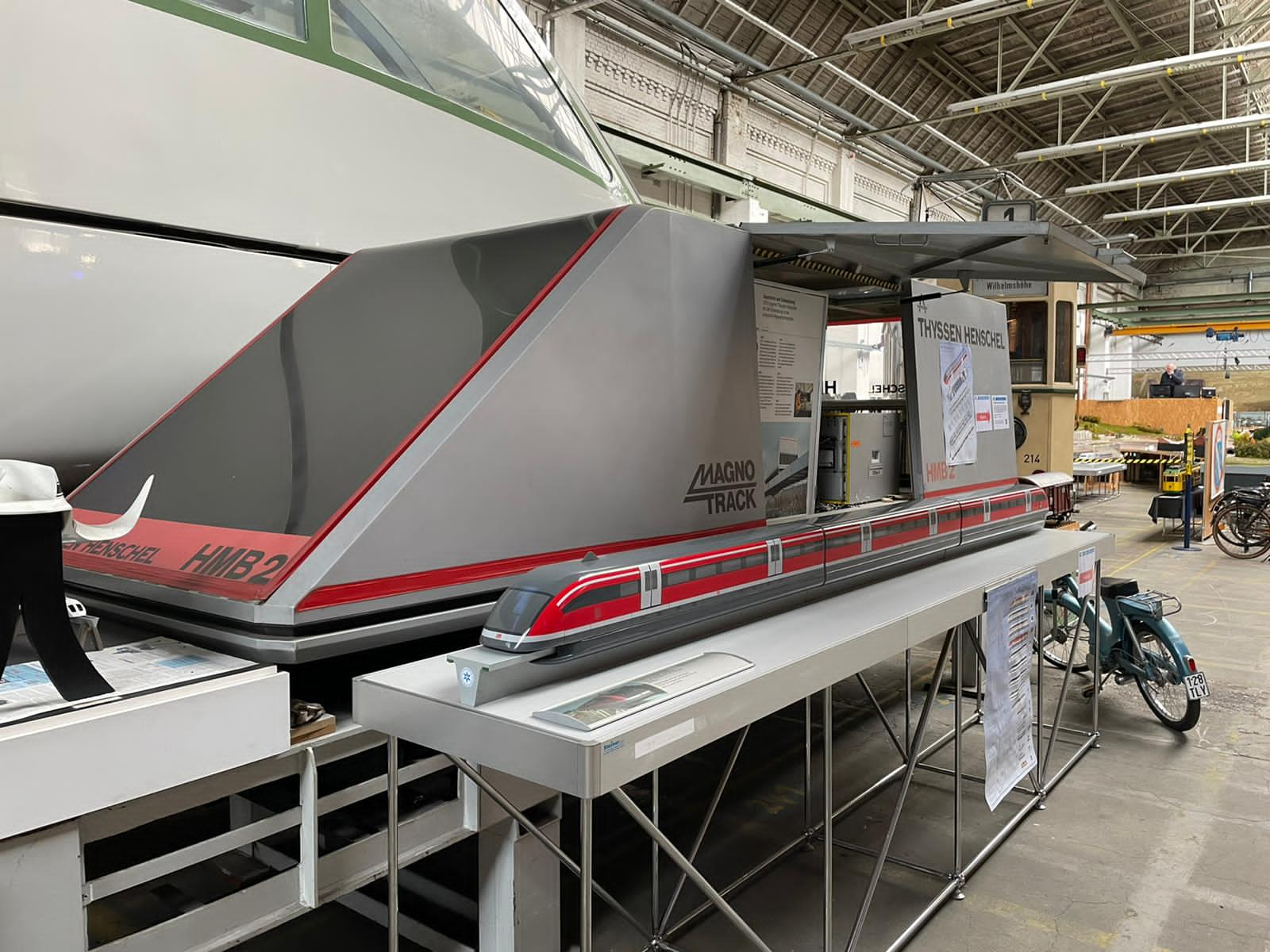
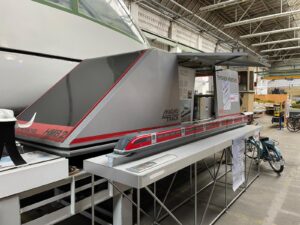
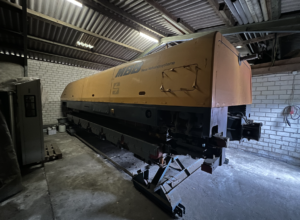
- HMB2: The levitation frame later became a vehicle, the HMB2. It reached 36 km/h and had room for up to four passengers.
Key facts
- Year built
- 1974 / 1976
- Operation
- 1974–1981
- Company
- Thyssen-Henschel
- Route
- 102 m test track at the Henschel plant
- System
- Synchronous long-stator linear motor
- Air gap
- 8.5 mm
- Rated speed
- 25 km/h
- Maximum speed reached
- 36 km/h
- Vehicle units produced
- 1
- Empty weight
- 1.6 t
- Payload
- 350 kg
- Seats
- 4
- Standing places
- –
- Length
- 5.3 m
- Width
- 1.65 m
- Height
- 1.8 m
Today in the Technik Museum Kassel
The HMB2 has been preserved and is on display at the Technik Museum Kassel, together with the Transrapid 05.