
Nuremberg Maglev Rejected!
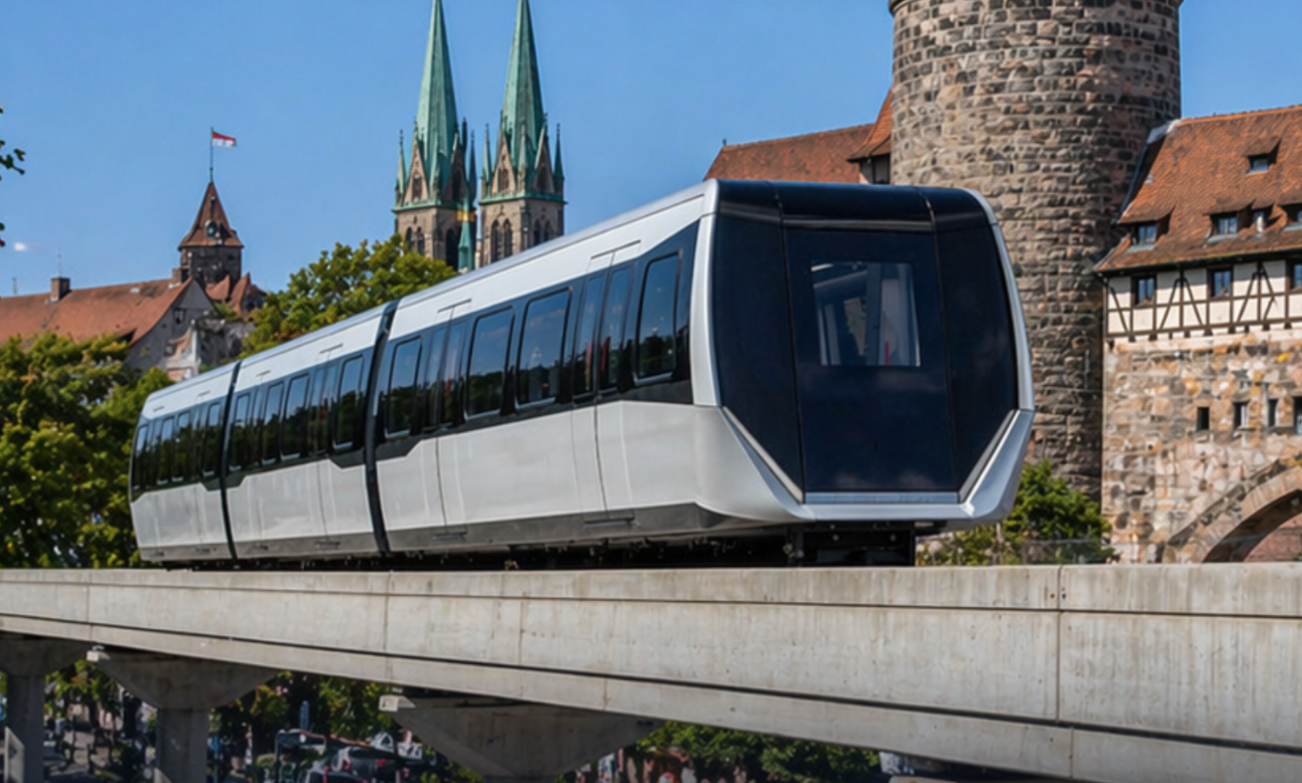
The decision has been made: Nuremberg will not get a maglev. What was announced as a flagship project for the public transport of the future is failing because of a combination of political opportunism and route planning that was questionable from the start.
A route that could never have worked
The basic idea sounded reasonable: the TSB (Transport System Bögl) was to run on a roughly four-kilometer route from Bauernfeindstraße past the trade fair grounds to Klinikum Süd (South Hospital). The only problem was that on exactly this route, the tram is the better mode of transport. Not because it is technically superior (it is not), but because it is already integrated into the existing network. Passengers from the main station reach their destination today without changing. With the TSB, they would have had to change at Bauernfeindstraße. That is not a detail; it is the decisive difference in everyday use.
That this forced transfer would push the maglev's benefit below the funding threshold was not a surprising finding of the feasibility study; it was foreseeable from the start. A maglev in regular service in Nuremberg would have been an important reference for Max Bögl, needed to make the technology marketable at all, after roughly 14 years of development and only two test tracks worldwide. Pursuing this reference success on a route where the system is structurally at a disadvantage was a strategic mistake. Technological advantages are discredited when they are forced into unsuitable contexts.
The TSB does have genuine strengths: as we reported earlier, at 3.3 kWh/km it uses significantly less energy than a tram (4.2 kWh/km), incurs massively lower maintenance costs at €0.27/km versus €0.87/km, and runs fully automated. But these strengths should have been demonstrated on a route that does not displace an existing direct connection and instead offers genuine new-access value.
Betting only on politics, and losing
What makes the failure in Nuremberg especially symptomatic is the strategy behind it: from the beginning, Max Bögl bet almost exclusively on political support. Minister-President Söder (of Bavaria) as an advocate, a letter of intent with the Free State of Bavaria, a CSU city council that backed the project: that was the basis on which the TSB was built up in Nuremberg. Citizens, commuters, residents: hardly any role.
The calculation is understandable, but it failed. Politics is fleeting. Coalitions change, priorities shift, and in the end the TSB was traded away in a single round of negotiations in exchange for approval of the 2030 garden show. A project that rests only on political goodwill and has no roots in society is vulnerable, and falls at the first headwind.
The alternative would have been clear: new transport infrastructure succeeds when the people who are supposed to use it also want it. Cycling referendums, tram projects, mobility initiatives: they all work because citizens recognize the benefit themselves and actively demand it. For the TSB, that never happened. No local citizens' events, no public rides at the Sengenthal test track, no active dialogue with local residents. The public image was thus shaped by superficial or flawed media reports, to which the manufacturer offered no public response, including on its own website. If you don't explain your system yourself, don't be surprised when others do it for you, usually less kindly.
Pointless routes ruin a technology's reputation
What is often overlooked: the failure in Nuremberg damages not just this one project. It damages the TSB as a technology overall, and unnecessarily so. When a maglev is discussed, examined and ultimately rejected in a German city, one thing above all sticks in the public mind: the maglev lost. That it competed on a route where it structurally could not win hardly interests anyone anymore.
Nuremberg is not an isolated case. In Berlin, too, the TSB was discussed with great publicity, and then disappeared again, accompanied by media mockery and political indifference. Each of these failed projects leaves traces. City councils that are to vote on a maglev in the future will point to Nuremberg. Transport planners will cite the study showing that the tram performed better. That the comparison was drawn on an unsuitable route will no longer play a role in that debate.
That is the real problem with the strategy of pushing the TSB onto every route where political support can be found: you risk not just a single project but the reputation of the entire technology. Every rejection makes the next persuasion effort harder. Every failed attempt entrenches the narrative that maglevs simply don't work in Germany, even though the truth is different.
Politics: prestige thinking meets opportunism
But politicians bear responsibility too. The CSU backed the TSB as a prestige project of Minister-President Söder without ever seriously working on the structural weaknesses of the chosen route. Loud and visible when making announcements, silent when it came to solving the actual problems.
The SPD then did not replace the project with a better proposal but simply negotiated it away: TSB cancellation in exchange for approval of the 2030 garden show. Innovative transport technology as a bargaining chip in coalition poker shows how serious the political will for a transport transition in Nuremberg really was.
The same pattern shows up at the federal level: the coalition agreement mentions that maglevs would be eligible for funding under the GVFG (Municipal Transport Financing Act), but the law remains unchanged to this day. Unlike conventional railways, the maglev is still not eligible for funding. The responsible federal transport minister let it be known that the topic is "not something that is a priority." A bold will to shape policy sounds different.
What remains
In November 2025, the Federal Railway Authority (Eisenbahn-Bundesamt) granted Max Bögl the operating license for maglev lines, as the only company in Europe. The technical and regulatory prerequisites for deploying the TSB in Germany would therefore be in place. What is missing is a strategy that brings the system to routes where it can actually prove its added value, far from existing direct connections that it cannot beat anyway.
Nuremberg-Langwasser was the wrong stage. The problem is that every lost debate makes the next one harder.
Sources
- BR24 – End of maglev project in Nuremberg (April 23, 2026)
- City of Nuremberg – TSB feasibility study (Dec. 2024)
- City of Nuremberg – Maglev project page
- t-online Nürnberg – Results of the feasibility study (Feb. 2025)
- t-online Nürnberg – TSB receives operating license (Nov. 2025)
- Zeitung für kommunale Wirtschaft – Can the maglev replace a tram line? (March 2024)
- magnetbahn.de – Transport System Bögl: Is Anything Still Coming? (Oct. 2025)