General ·
Maglevs Uneconomical? The Absurd Myth of the “Critics”
by David Harder
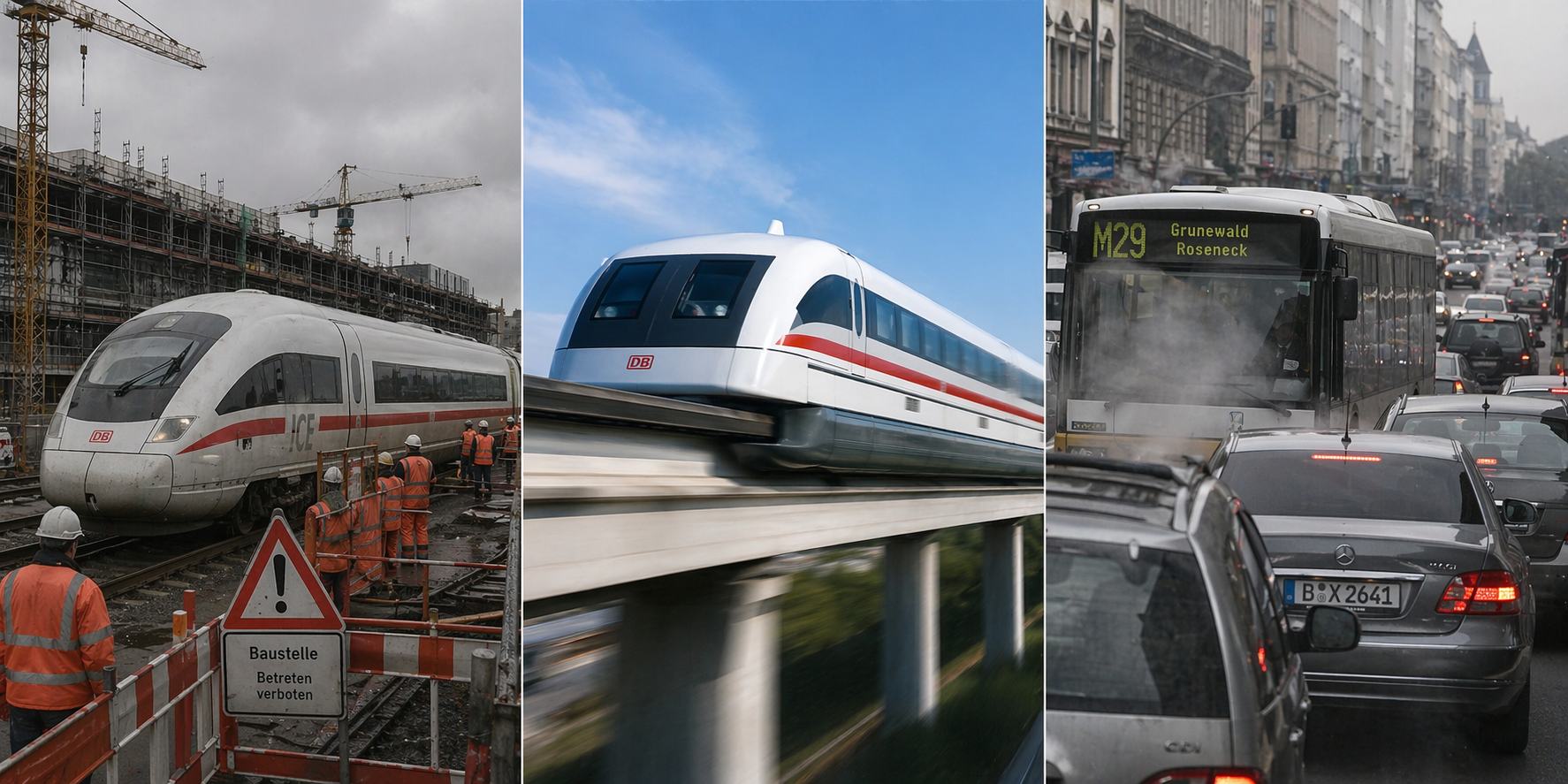
There is one phrase that turns up almost ritually in German debates about the Transrapid: "Too uneconomical." It is delivered like a law of nature, like a settled truth that cannot be argued against. And it is invoked - and this is the fascinating part - almost exclusively for maglev trains. Not for roads. Not for airports. Not for the regular rail network. Only for the Transrapid.
Yet it is worth looking at the sober numbers behind the German rail system. A look that quickly shakes this supposed matter of course.
€26 billion a year flows into public transport across Germany alone, according to the Association of German Transport Companies (VDV) - and rising. By 2040, public funding needs according to a VDV study could grow to as much as €80 billion per year. The basic financing of public transport rests on two pillars: ticket revenue and public subsidies - each about half.
At Deutsche Bahn AG, the figure in 2024 was around €22 billion in direct and indirect state funds - including investment grants from the federal budget (via LuFV, BSWAG and others), regionalization funds and equity increases. The result: an annual loss of €1.8 billion all the same. The group's explanation? The poor condition of its own infrastructure.
For comparison: DB itself puts its investment needs for the next ten years at around €290 billion. For less than half of that, a Transrapid network of around 2,800 kilometers could be built - a network connecting all of Germany's major cities.
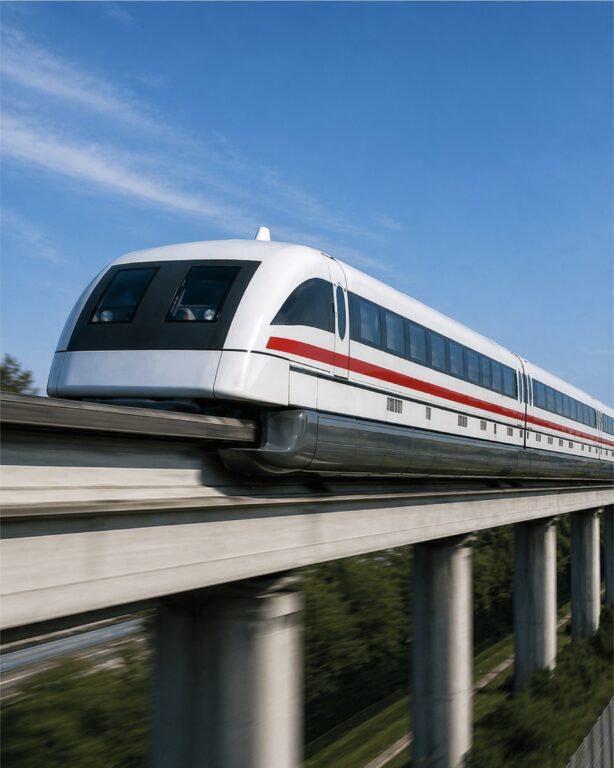
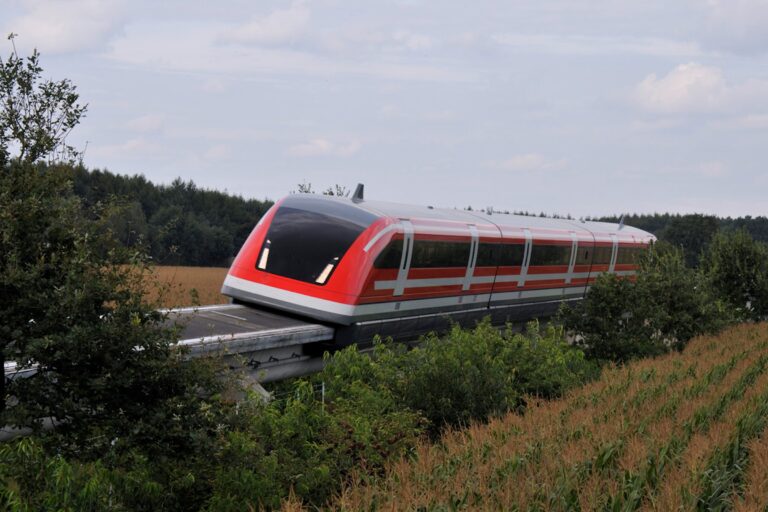
No wheels. No axles. No rolling resistance. The drive components sit in the guideway, so the vehicle itself is correspondingly lighter. That explains the drastically reduced wear - and with it the lower operating costs over the service life. The Transrapid is designed for speeds of 400-500 km/h, at which conventional trains become massively less efficient because of rising air resistance and energy consumption.
The road network is financed entirely from taxes, without anyone ever discussing the "uneconomical" nature of a federal highway. Air traffic benefits from tax-exempt kerosene and subsidized airports. Motorists enjoy company-car taxation and the commuter allowance. Suddenly a different standard is supposed to apply to the Transrapid alone.
Telling: a request to the Bundesrechnungshof (Federal Court of Audit) asking whether the multibillion-euro funding of DB AG violates the efficiency requirement under Section 7 of the Federal Budget Code has so far gone unanswered. The relevant audit documents from earlier periods have - remarkably - already been destroyed.
What the state actually puts into the rail system
Public transport (ÖPNV) in Germany is not an economic system - it is a state-subsidized one. That is not criticism, it is a simple fact that nobody seriously disputes. And the numbers behind it are impressive.
€26 billion
Public subsidies for public transport alone in 2024
€22 billion
Direct & indirect subsidies for Deutsche Bahn in 2024
€1.8 billion
Deutsche Bahn's annual loss despite this funding
"With the €22 billion that went to Deutsche Bahn in 2024 alone, around 550 kilometers of Transrapid line could be built at today's cost estimates." — magnetbahn.de
What the Transrapid actually costs - and saves
Anyone who calls the Transrapid "uneconomical" has to answer: compared with what? Because the technical data of maglev technology, gathered by TU Dresden among others, tell a different story.Conventional rail (ICE)
- Punctuality 2024: around 65%
- Enormous wear from wheel-on-rail contact
- Infrastructure: 20-30 year service life
- 0.986 tonnes per seat (ICE 3)
- High energy demand at high speed
- Investment backlog: €290 billion over 10 years
Transrapid (maglev technology)
The real joke: nowhere is rail transport "economical"
This is the core of the argument that Transrapid critics consistently ignore: in Germany, no public transport is profitable in the market-economy sense. Trams, S-Bahn suburban trains, regional trains - they all work only thanks to massive state cross-financing. That is entirely legitimate in terms of social policy, because mobility is part of public services of general interest.The double standard
For the ICE, for subways, for federal highways, state subsidy is taken for granted. For the Transrapid, it must finance itself and still be competitive. That is not a factual argument - that is cherry-picking.
Why did the Transrapid really fail?
Not because of the technology. Because of political will. The Hamburg–Berlin line failed after DB chief Hartmut Mehdorn lost interest - a group CEO whose interest in a competitor to his own ICE network was probably not particularly great. The Metrorapid in North Rhine-Westphalia failed because of budget deficits and coalition issues. No technical inadequacy. No objective uneconomic nature. Political decisions. State Secretary Rainer Bomba put it unusually openly in 2010: the technology had been "developed 50 years too early." That sounds like an admission - not about the technology, but about political readiness.Conclusion: the same standards for everyone
The debate about the Transrapid is not a technical one - it is a political one. Technically, the superiority in high speed, maintenance effort and energy efficiency is well documented. Economically, the comparison is distorted from the start, because the Transrapid is held to a standard that no other transport system in Germany would have to meet.Sources
- VDV: Deutschlandangebot 2040 – Financing public transport & shaping the transport transition
- VBB imPuls: How is public transport actually financed?
- Klimaschutz-Kommune: Deutschlandticket & Co.: Where does the money for public transport come from?
- Deutsche Bahn AG: Deutsche Bahn on course for recovery – Annual report 2024
- Deutsche Bahn AG: Investments and public grants
- magnetbahn.de: Deutsche Bahn Burns Billions – But the Transrapid Is Supposedly Uneconomical?
- magnetbahn.de: Advantages of the Transrapid
- magnetbahn.de: 12 important facts about the Transrapid
- magnetbahn.de: Maglevs significantly lighter than conventional trains
- VCD: True cost in transport
- FragDenStaat: Request to the Federal Court of Audit – Economics of Transrapid vs. DB
- Wikipedia: Transrapid – History, technology, failure
- Schach, Jehle, Naumann (TU Dresden): Transrapid und Rad-Schiene-Hochgeschwindigkeitsbahn – Ein gesamtheitlicher Systemvergleich (Transrapid and wheel-on-rail high-speed rail – a holistic system comparison). Springer Verlag.