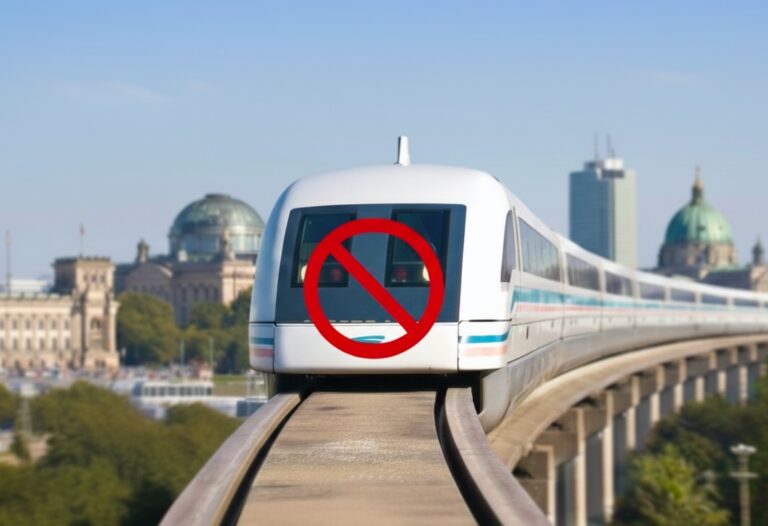
12 Key Facts About the Transrapid
The Transrapid is a serious solution for high-speed long-distance travel. It was developed to relieve the rail network and reduce air traffic. This article presents 12 key facts about the Transrapid.
The Transrapid is a serious solution for high-speed long-distance travel. It was developed to relieve the rail network and reduce air traffic. This article presents 12 key facts that everyone should know about the Transrapid.
Contents
1. Energy demand up to 40% lower than the ICE
2. Unsuitable for local transport
3. Construction costs not higher
4. The Transrapid is economical
5. Why the Transrapid failed
6. Technically feasible
7. The technology was not sold to China
8. The Transrapid is climate-friendly
9. See additional infrastructure as an opportunity
10. Germany is not too densely populated
11. Conventional trains are slower
12. The accident did not end the Transrapid
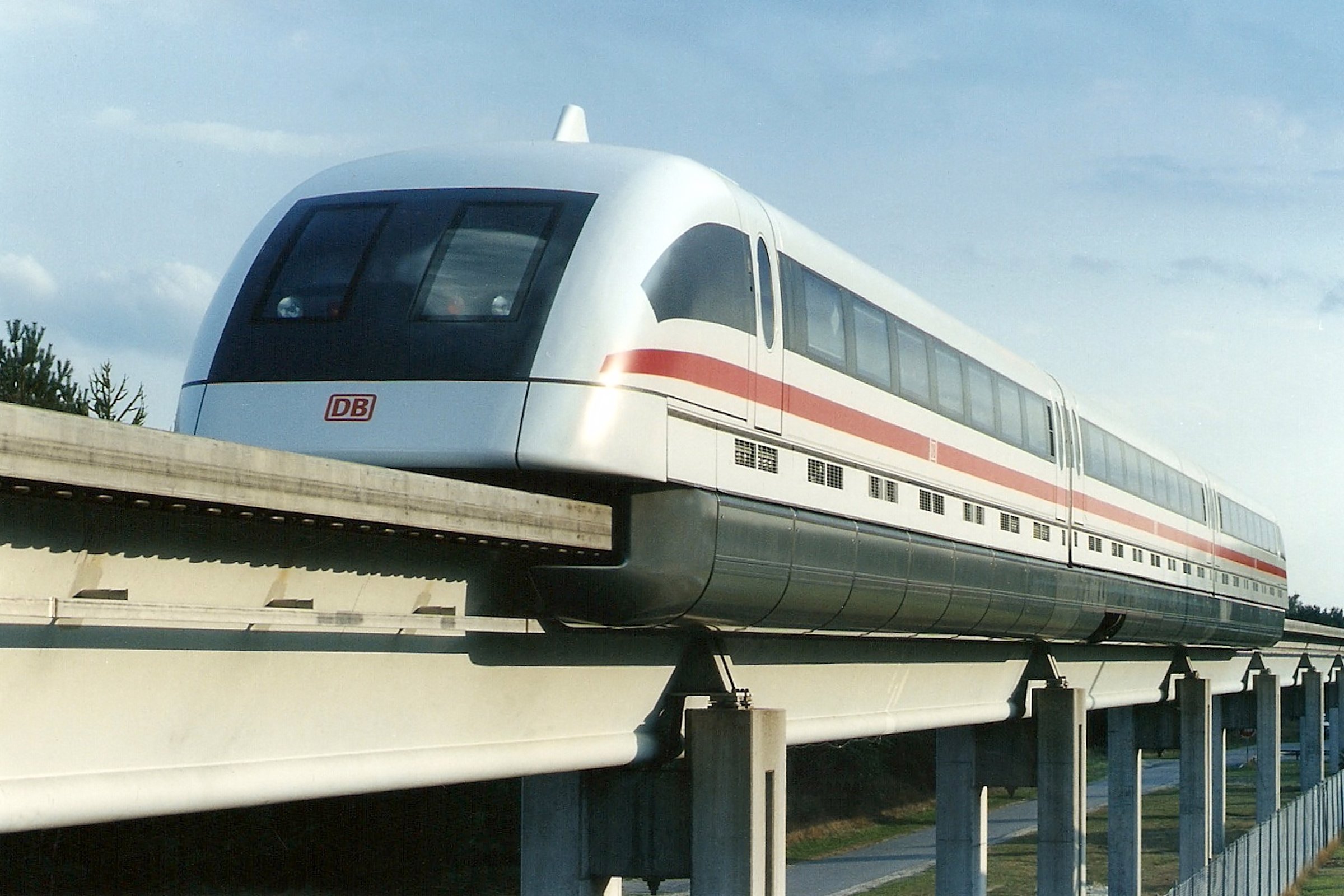
1. Energy demand up to 40% lower than the ICE
The electromagnetic levitation system eliminates rolling resistance.
Because the propulsion is built into the guideway, the Transrapid vehicle is only about half as heavy as a high-speed train of comparable capacity. While the ICE 3 (Deutsche Bahn’s high-speed train) weighs 0.986 tonnes per seat, the Transrapid weighs only 0.499 t.
Accordingly, the Transrapid consumes considerably less energy than an ICE:
| Energy demand in Wh per seat / kilometer | Transrapid | ICE |
|---|---|---|
| 200 km/h | 17.9 Wh (20% savings) | 22.3 Wh |
| 300 km/h | 28.1 Wh (37% savings) | 44.4 Wh |
| 350 km/h | 35.2 Wh (40% savings) | 58.4 Wh |
| 400 km/h | 43.5 Wh | – |
The figures were determined by TU Dresden. See: Schach, Jehle, Naumann: Transrapid und Rad-Schiene-Hochgeschwindigkeitsbahn, Ein gesamtheitlicher Systemvergleich (Transrapid and wheel-on-rail high-speed rail: a holistic system comparison). Springer Verlag / TU Dresden.
The result is clear: at 350 km/h the Transrapid needs 40% less energy than an ICE of comparable capacity.
2. Unsuitable for local transport
For various reasons the Transrapid is unsuitable for short-distance local transport. Under no circumstances should it be seen as a replacement for urban rail or subway lines. The Transrapid is designed for long-distance routes on which it is meant to reach up to 550 km/h. After all, an airliner isn’t used as an urban rail alternative either – though the reasons there are self-explanatory.
3. Construction costs not higher
The investment costs for the Transrapid guideway are no higher than for high-speed rail infrastructure.
A major advantage of the Transrapid is that it seals less land. Thanks to the elevated structure there are no level crossings, farmland can still be used agriculturally and wildlife crossings are not impeded. This makes the Transrapid far more flexible to route than rail infrastructure. It can also handle much steeper gradients (10% vs. 3-4% for the ICE), which reduces the need for (very expensive) tunnels. The Transrapid can also be built at ground level, as explained further later in this article.
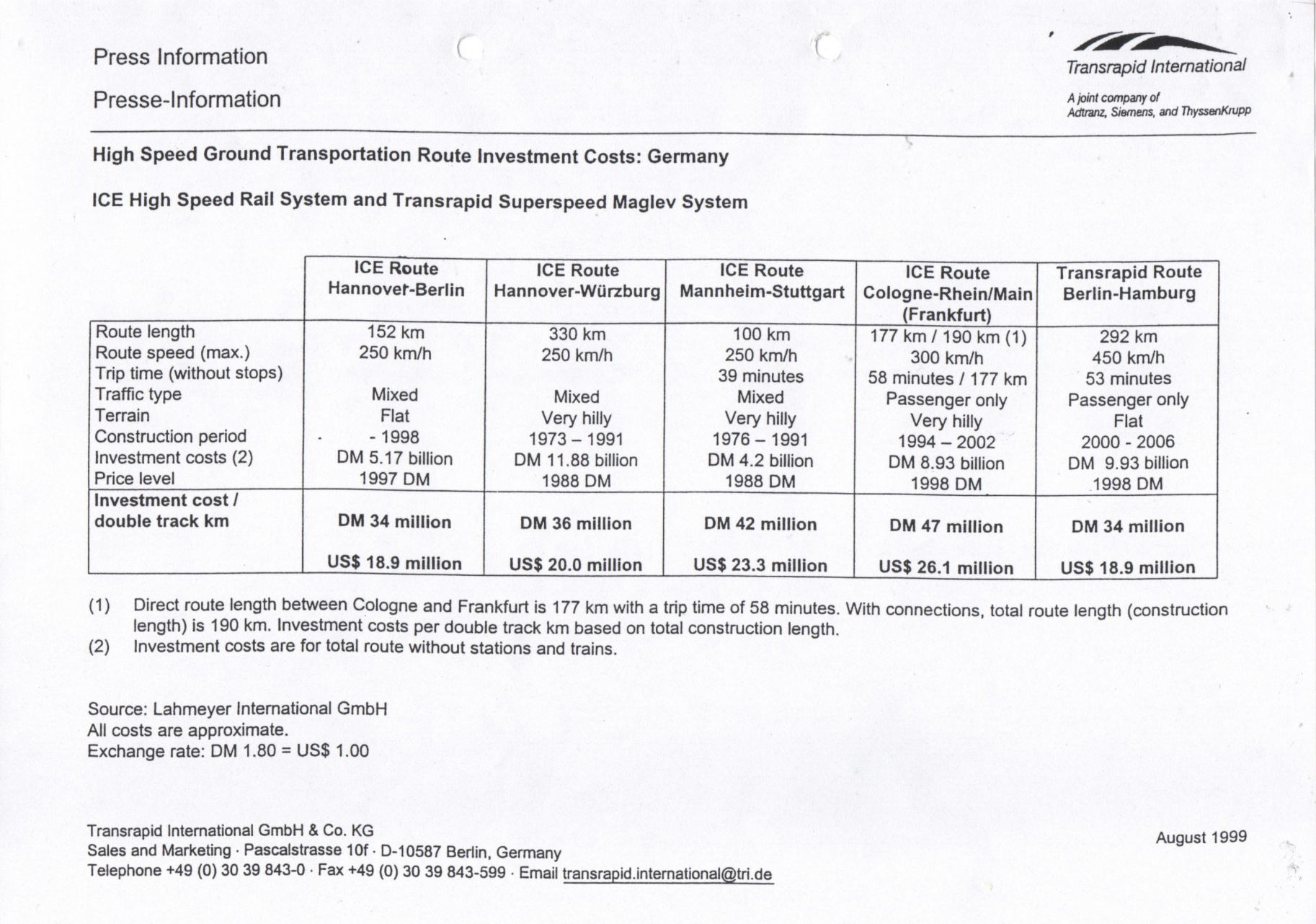
It should be added that the Transrapid infrastructure supports twice the speeds and lasts 80 years, many times longer than ICE infrastructure.
4. The Transrapid is economical
Arguments against the Transrapid often follow the motto “Because the Shanghai line is uneconomical, the Transrapid is uneconomical in general.” Unfortunately, this completely ignores what the Shanghai line actually means in terms of transport policy.
The Transrapid line in Shanghai was built as a demonstration line. There was never any intention of operating it profitably. That actually makes sense: a 550 km/h long-distance express train runs on a mere 29.9 km line from an airport to a suburb that passengers don’t really want to go to, since they need to get downtown. To reach downtown, a transfer to a taxi or the subway (metro) is necessary. That makes the Transrapid in Shanghai unattractive, so most people simply take the metro directly.
The low ridership doesn’t bother the Chinese, however. The Transrapid in Shanghai proves what the technology is capable of. No other railway reaches 431 km/h in daily regular service on such a short line. The only people who complain about the Shanghai line are those looking for reasons against it. It’s like blaming an airplane when it is deployed on low-traffic short routes and runs at a loss there.
In this case, the Transrapid technology is not to blame for being used in the wrong sector. The Transrapid can only unfold its advantages when used in long-distance travel.
As for economics, maintenance effort is up to 70% lower, energy demand is up to 40% lower, the investment costs (see point 3) are not necessarily higher, and the system lasts considerably longer (80 years) than ICE infrastructure.
| Maintenance costs in cents / seat-km | Transrapid | ICE |
|---|---|---|
| Guideway | 0.19 | 0.48 |
| Vehicle | 0.37 | 1.29 |
| Total | 0.56 | 1.77 |
The figures were determined by TU Dresden. See: Schach, Jehle, Naumann: Transrapid und Rad-Schiene-Hochgeschwindigkeitsbahn, Ein gesamtheitlicher Systemvergleich (Transrapid and wheel-on-rail high-speed rail: a holistic system comparison). Springer Verlag / TU Dresden.
5. Why the Transrapid failed
What failed was not the Transrapid technology but the realization of the line projects. They failed above all for political reasons. I can name two examples:
The Hamburg – Berlin line failed after Deutsche Bahn CEO Mehdorn lost interest in the Transrapid. He justified this by saying the time savings were too small, so he no longer saw a need for it. The line was planned in such a way that the Transrapid, twice as fast (500+ km/h), would have saved only a sixth of the time (20-30 min). The potential of the technology was ignored here. At the same time, Deutsche Bahn was preparing for its stock market flotation. Feel free to form your own opinion on that.
The Munich line was cancelled after costs “exploded” because the route was changed so that suddenly more tunnels were required. The system industry stuck to its figures, but the construction company did not. The altered routes with higher tunnel shares were initiated by politicians.
6. Technically feasible
The Transrapid was certified as technically ready for service in 1991. The vehicle has redundantly protected on-board power systems that make a failure extremely unlikely. After more than 25 million kilometers of Transrapid operation in Shanghai, there has never been a technically caused outage. The components installed on the guideway are also designed redundantly, and the lines are generally fed from both ends. If a substation fails, the vehicle continues at reduced power. Substations are installed roughly every 50 km.
7. The technology was not sold to China
“The patents were sold to China, we would have to buy them back at great expense” – No.
The core technology has always remained in Germany. Only licenses for individual guideway and vehicle components were sold to China, on the basis of which CRRC is developing a new 600 km/h vehicle. The Shanghai Transrapid line is German-made: the vehicles come from Kassel, and the propulsion infrastructure and operations control technology from Siemens.
8. The Transrapid is climate-friendly
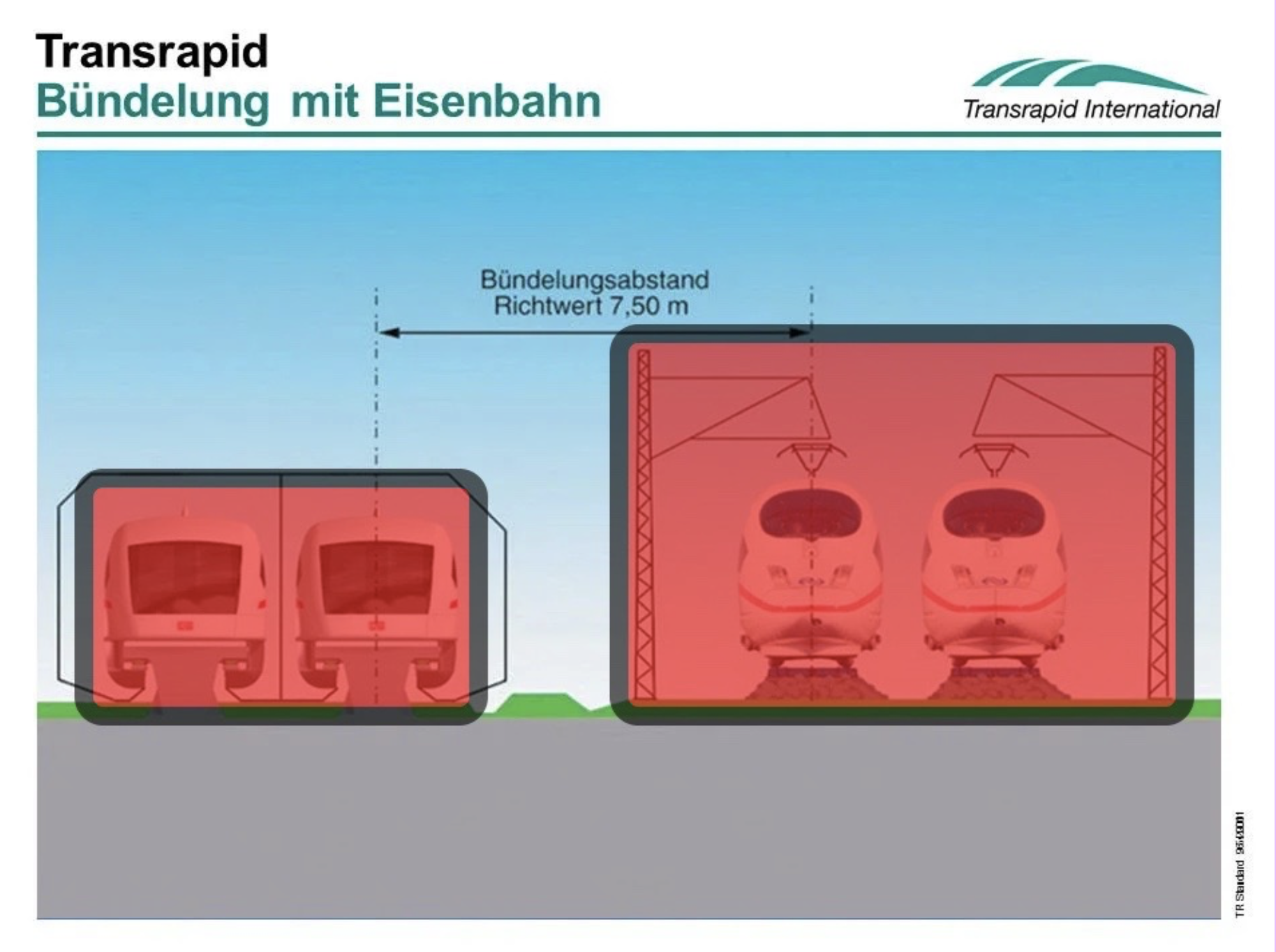
| Land required in square meters per meter of line | Transrapid | ICE |
|---|---|---|
| elevated | 2 | – |
| at ground level | 12 | 14 |
| Min. curve radius | Transrapid | ICE |
|---|---|---|
| 300 km/h | 1,973 m | 3,176 m |
| Pass-by noise level at 25 meters distance dB(A) | Transrapid | ICE | TGV |
|---|---|---|---|
| 300 km/h | 80 | 90 | 92 |
| 400 km/h | 88.5 | – | – |
9. See additional infrastructure as an opportunity
It is often criticized that additional infrastructure has to be built for the Transrapid.
Quite apart from the fact that every other transport infrastructure was also built as an addition one day, it is an advantage that the Transrapid is completely independent of the overloaded rail infrastructure. An independent Transrapid network ensures higher availability and helps relieve other infrastructure. More rail capacity is freed up for freight or local transport. The Transrapid is intended as an ideal complement to existing modes of transport, not as a replacement.
Japan’s Shinkansen is a good example of this principle. Because the Shinkansen network was built entirely independently of the existing rail network, it is known for the best punctuality in the world.
10. Germany is not too densely populated
| Acceleration | Transrapid | ICE |
|---|---|---|
| 0 – 300 km/h | 98 s (4.3 km) | 324 s (17.9 km) |
| 0 – 400 km/h | 156 s (9.9 km) | – |
| 0 – 500 km/h | 266 s (23.3 km) | – |
| Braking distance | Transrapid | ICE |
|---|---|---|
| 300 – 0 km/h | 87 s (3.6 km) | 168 s (6.9 km) |
| 400 – 0 km/h | 117 s (6.725 km) | – |
| 500 – 0 km/h | 147 s (10.475 km) | – |
| Min. curve radius | Transrapid | ICE |
|---|---|---|
| 300 km/h | 1,973 m | 3,176 m |
11. Conventional trains are slower
Modern high-speed trains run at 265 to 330 km/h. The Transrapid runs at up to 550 km/h.
Supposedly, high-speed trains can also run at up to 400 km/h or more. Can they? No: wear & energy demand would be far too high. The TGV did break 574 km/h under unrealistic conditions, but passengers never benefited from that, since in regular service the TGV runs at only up to 320 km/h.
12. The accident did not end the Transrapid
Most line projects had already ended before the accident (2006). The accident was caused by human error, and even after it there were no doubts about the Transrapid’s safety on the part of politicians. The test facility was still operated with a new vehicle generation (TR09) 5 years after the accident. Line projects (Munich, Tenerife, Brazil) were not abandoned either.
I hope this list of 12 facts has brought a little more clarity about the Transrapid.
Feel free to explore the other content on maglevhub.com, especially the advantages.