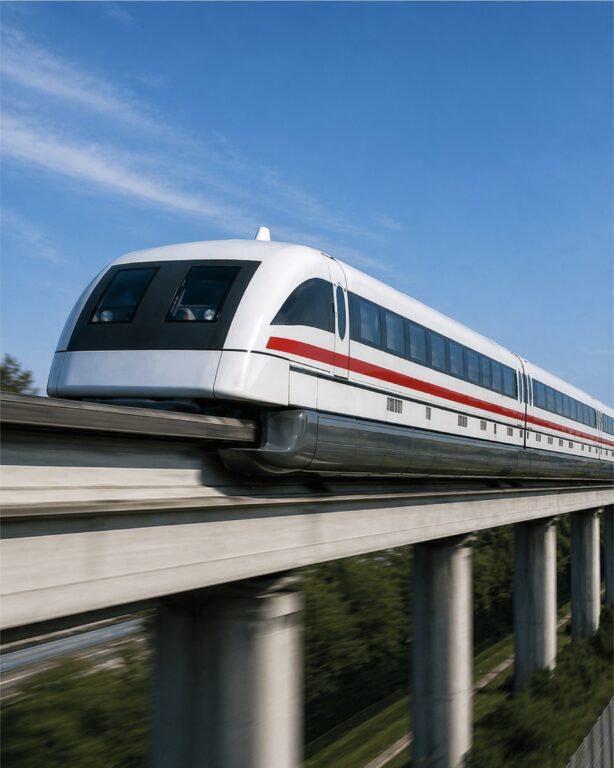
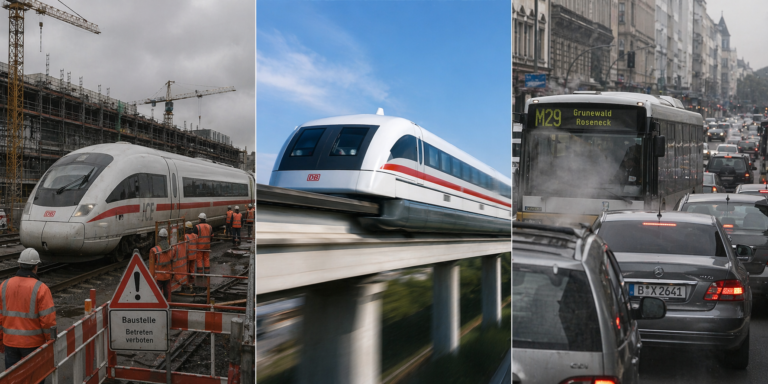
Maglevs Make More Sense for Long-Distance Than for Local Transport
It is with great pleasure that we learn from the daily press on March 14, 2026 that Federal Transport Minister Patrick Schnieder (CDU) wants to promote the use of maglev trains. Tagesschau reports that a spokesman for the minister praised, among other things, their better capabilities under more difficult topographical conditions.
To give the technology fair competitive conditions, it is necessary to upgrade the Gemeindeverkehrsfinanzierungsgesetz (GVFG, the municipal transport financing act) so that maglevs can also be built with up to 90% funding from the federal budget. This is not actually new information; it was already in the coalition agreement of the current federal government.
Wonderful news! But the problem is that maglev systems do exist in local transport, but they deliver by far not as many advantages as in long-distance travel. On the contrary: most of the arguments in favor of maglevs in local transport can be completely imitated by conventional systems.
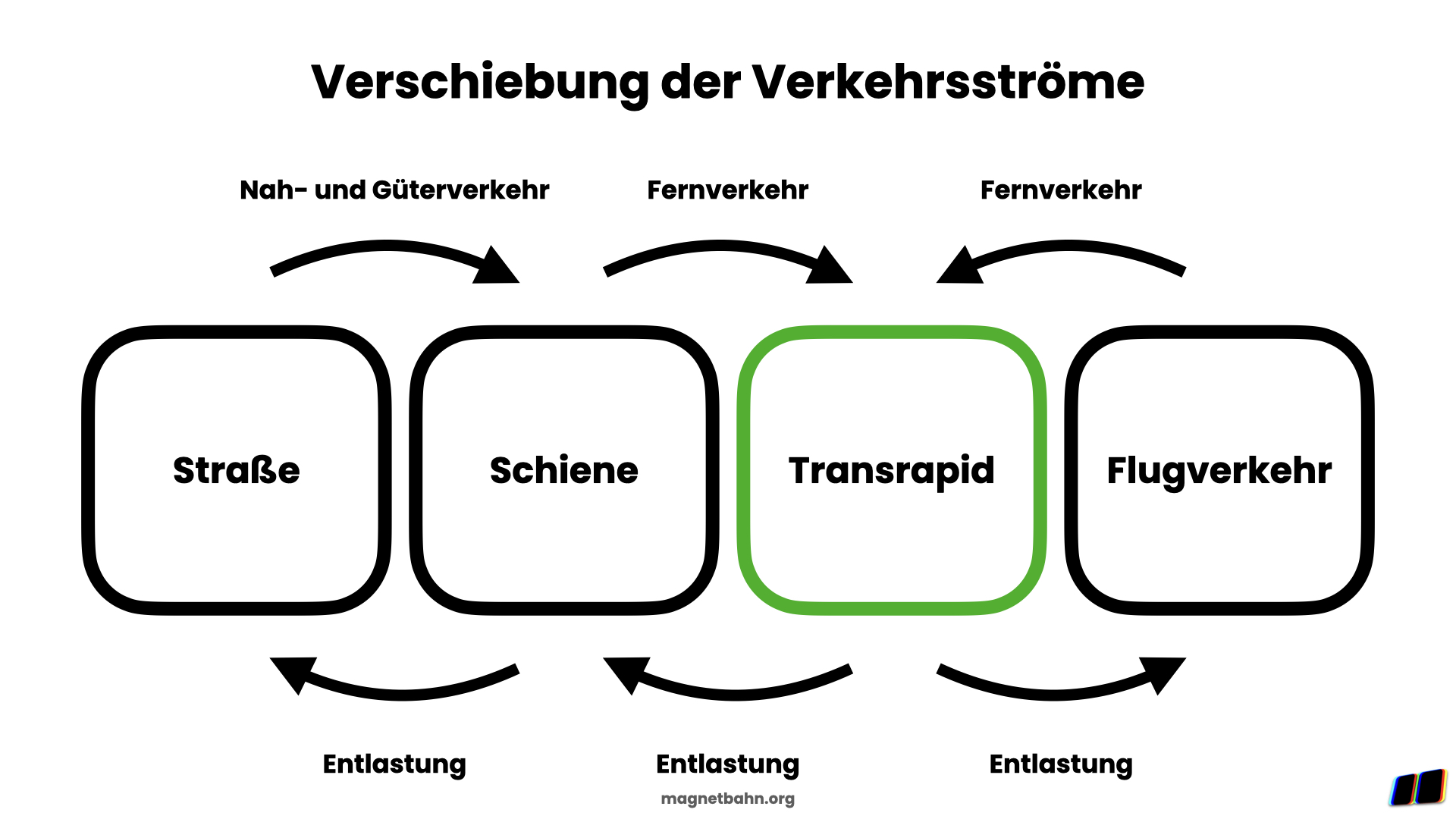
It looks different in long-distance travel. Here a 500 km/h high-speed maglev would enable entirely new mobility experiences, reduce travel times across Germany and Europe to a fraction, massively cut energy, maintenance and operating costs, run on its own infrastructure with maximum reliability and, above all, take enormous pressure off long-distance travel on roads, rails and in the air.
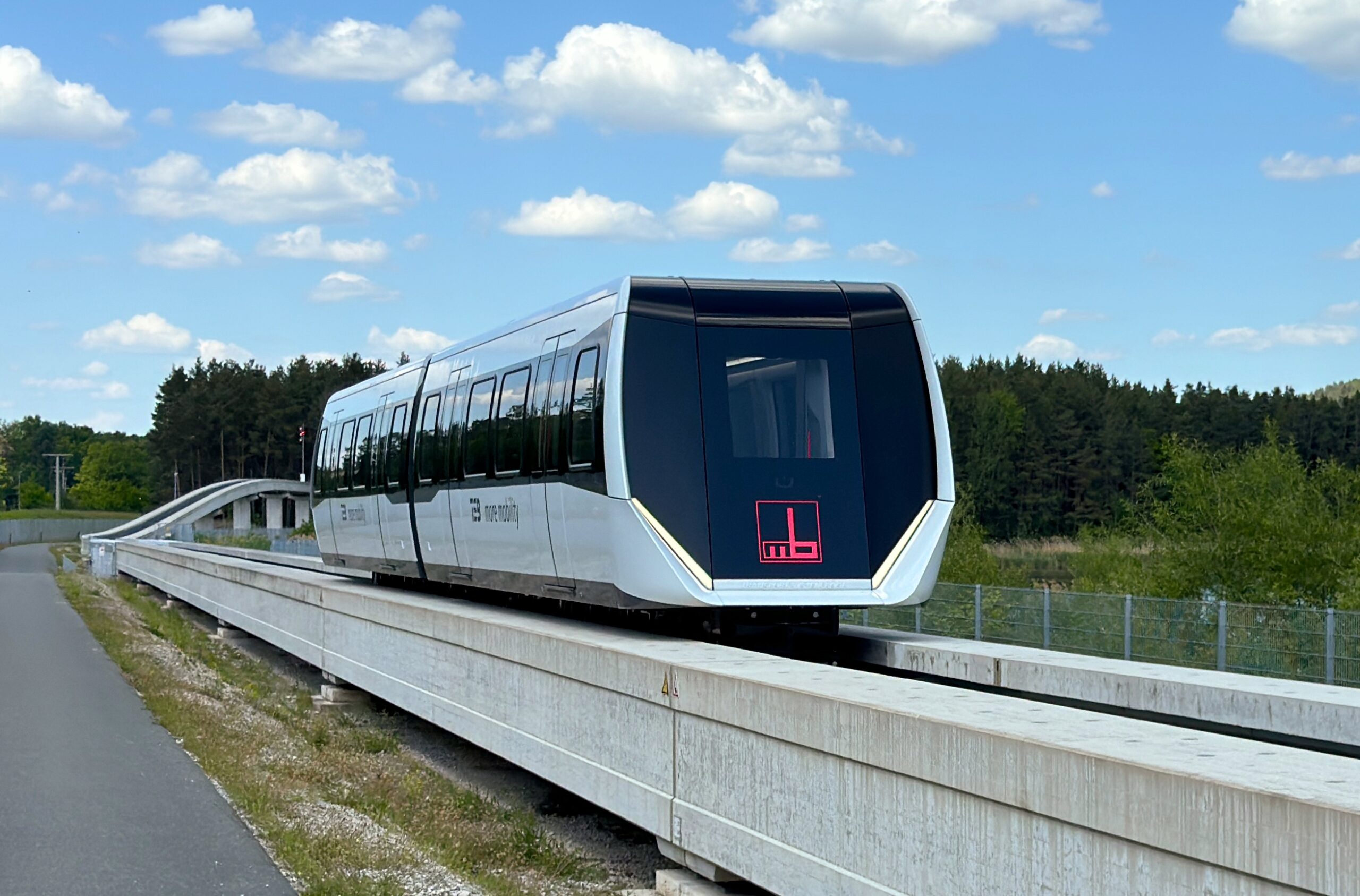
What do maglevs bring to local transport?
Compared with conventional rail systems, the problem at lower speeds is that the advantages of magnetic levitation cannot fully come to light. The Transport System Bögl (TSB) and the 2021 feasibility study by the Federal Ministry of Transport make this clear:
The TSB is designed for a top speed of just 150 km/h and thus operates in the speed range of S-Bahn (suburban) and regional trains. No noticeable travel time advantages are to be expected.
The study’s results are accordingly sobering: in many parameters, the system hardly differs from existing rail systems. According to the study, energy demand is of a comparable order of magnitude to trams, subways or S-Bahn. In terms of capacity, too, the system is in the same range as typical urban rail systems. At the same time, the investment costs for the guideway are at least comparable, in part even higher, for example compared with the tram.
Little is thus left of the technological advantages of maglev technology often expected in local transport. The TSB can certainly have advantages in individual respects. These include lower particulate and noise emissions and lower maintenance costs, since there is no mechanical wheel-on-rail contact. The design also allows greater banking of the guideway, which can bring planning advantages in tight alignments. For cities with existing rail networks and systems, however, these few advantages are negligible, especially given the need to build a completely new network.
Maglevs can certainly have sensible applications in local transport, such as automated shuttle or special-purpose connections. The technical advantages remain limited, however, for urban use as an everyday replacement for public transport in this speed range.
That does not make such a maglev any less sensible; rather, in cities that already have networks of a conventional system, it makes no sense to switch systems, simply because the “groundbreaking” advantages for passengers are missing. In long-distance travel it looks completely different. For cities that have no system at all yet, the technology could definitely make sense, but not necessarily much more than conventional systems.
The Transrapid offers massive advantages
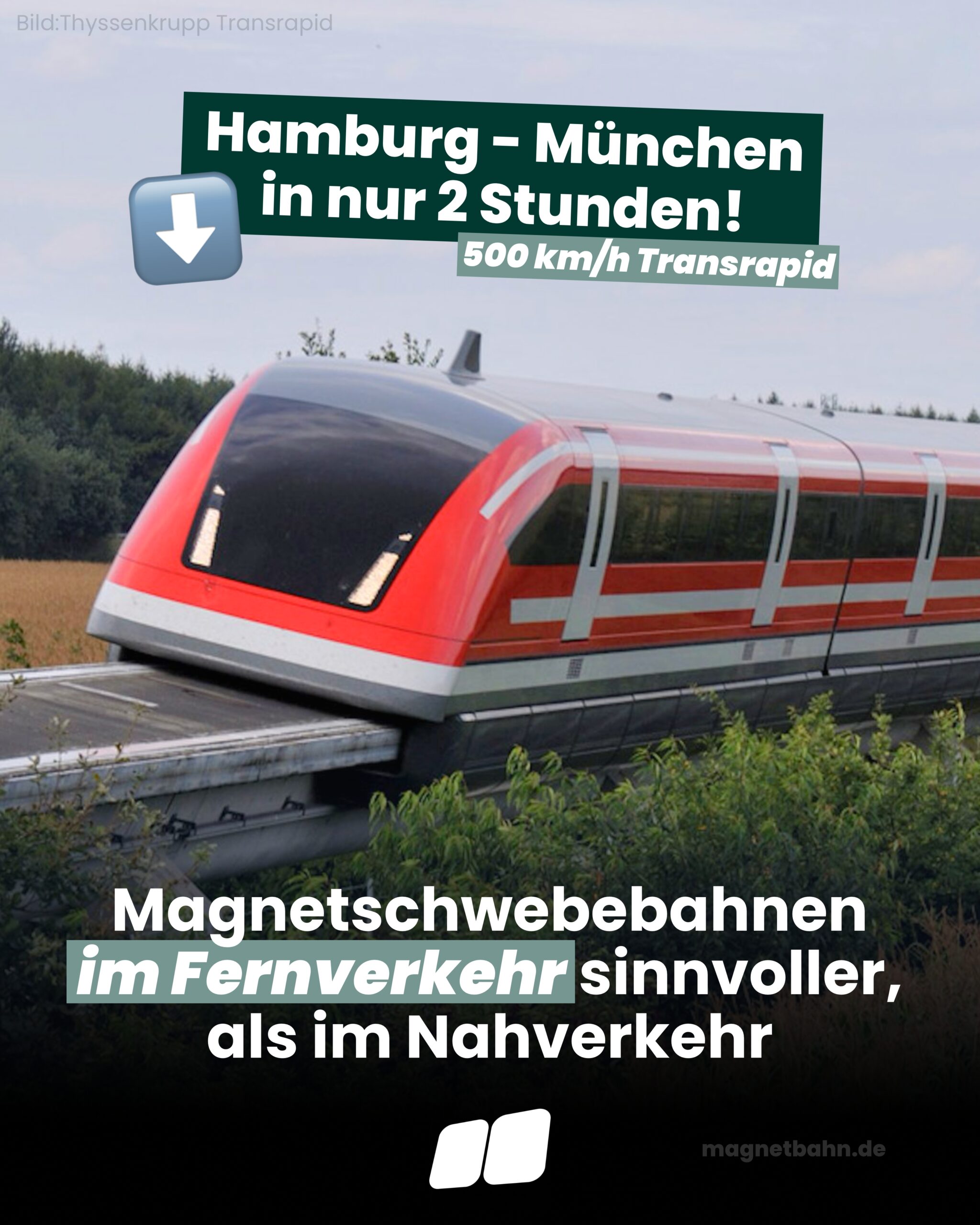
As a 500 km/h high-speed maglev that relieves short-haul air traffic and long-distance rail, the Transrapid creates mobility experiences that seem utopian to us today and would massively improve the everyday lives of millions of people in Germany.
From Hamburg to Munich in just 2 hours? Absolutely conceivable with the Transrapid. Arriving completely on time on your own, independent infrastructure that is not slowed down by local and freight trains? Total reality with the Transrapid. Simply traveling from city center to city center, without arriving hours ahead for security checks and first crawling for an hour by taxi or public transport from an out-of-town airport into the city? Welcome to the Transrapid.
The advantages are of course not only on the passenger side. The operator also benefits from the same investment costs per kilometer as for new ICE high-speed lines. And that despite double the top speed, 40% lower energy demand per seat at 350 km/h, 70% lower maintenance costs, a guideway that lasts 100 years without major repairs, and much more. All of this has a positive effect on ticket prices, which despite these advantages are far below the level of airline tickets or Deutsche Bahn’s saver/flex fares.
Transport Minister Patrick Schnieder only wants a public-transport maglev
The big press reports in March 2026 sketching a possible comeback of the Transrapid unfortunately miss the point entirely. Transport Minister Patrick Schnieder (CDU) is only arguing for the use of maglevs in local transport, of all places where they deliver the fewest advantages.
In summer 2025, David Harder, operator of magnetbahn.de, sent his Transrapid petition with almost 62,000 signatures by mail to the Federal Ministry of Transport (after personal appointments were declined). The response was sobering: They refuse an objective reassessment of Transrapid technology and merely refer to a rejection letter, several years old and full of misinformation, which I received in response to my first petition from 2020.