Berlin Wants to Build the Transport System Bögl
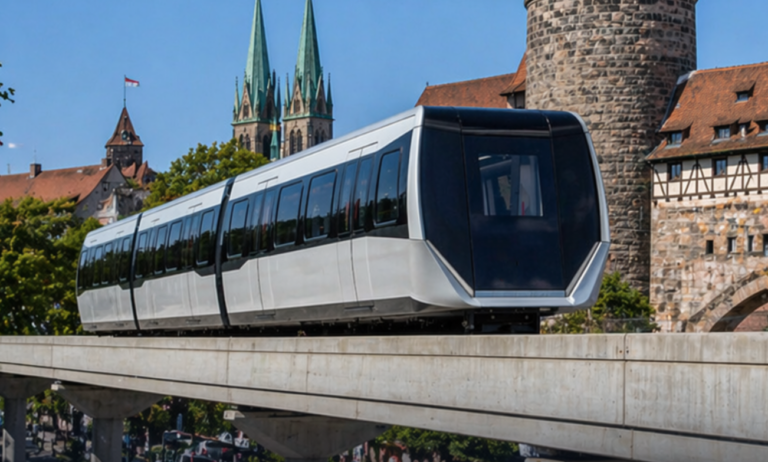
Berlin's coalition of the CDU and SPD has agreed to build a line for the Transport System Bögl (TSB) in Berlin. The TSB carries passengers and freight and can be built much more cheaply, quickly and compactly than conventional transport such as the subway or tram. The political will is there too, and the system's advantages are clearly recognized.
Berlin’s coalition of the CDU and SPD (the city’s two governing parties) has agreed to build a line for the Transport System Bögl (TSB) in Berlin. The TSB carries passengers and freight and can be built much more cheaply, quickly and compactly than conventional transport such as the subway or tram. The political will is there too, and the system’s advantages are clearly recognized.
Political will is in place
Political support for the TSB seems to be in place. As early as 2020, the Berlin CDU called for connecting BER airport to the city center with the TSB. For a long time nothing was heard of the plans, until the Berlin House of Representatives (the state parliament) was newly elected in February 2023 and Kai Wegner (CDU) won the vote for mayor in April.
Almost simultaneously, the Berlin-Brandenburg Transport Association (VBB) also showed strong interest in the TSB. Ute Bonde, the VBB’s managing director, visited the TSB in summer 2023 and expressed her enthusiasm on LinkedIn for the TSB’s fast implementation and environmental compatibility. In May 2023, in an interview with the Berliner Zeitung, she said Berlin could test a maglev.
It has now become known that the current coalition between the CDU and SPD has agreed to include the construction of a TSB line in the budget. Dirk Stettner, the CDU parliamentary group leader, recognizes the advantages and has clearly come out in favor of the TSB in comments to the Tagesspiegel. The project is to be financed from Berlin’s special climate fund.
A possible route
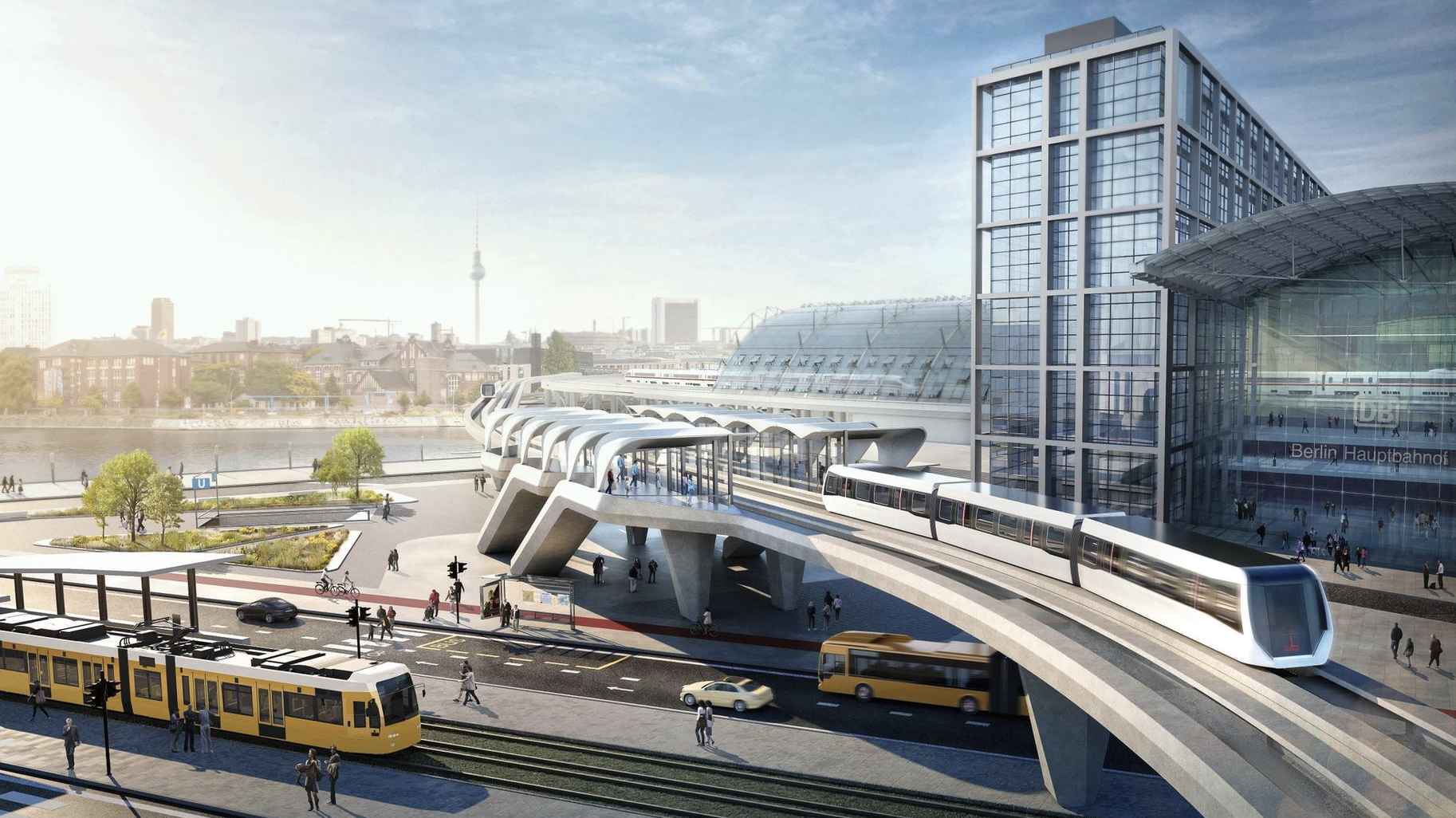
The planned line will be roughly 5 km long, running mostly on elevated guideway. According to Stettner, there is too little space in Berlin, so one has to “go either up or down.” Since building a subway would be extremely expensive and take a long time, the TSB is preferred: it can be built in just 3 years, costs only a fraction as much, and, being elevated, can be integrated ideally into the cityscape.
No exact route has been named yet, as various options are still being discussed.
Significant advantages
The TSB is a versatile maglev technology for local and urban transport. The vehicle is designed for operating speeds of up to 150 km/h and complements existing urban transport. Because there is no overhead wire and the guideway can optionally be elevated, the system can be routed flexibly, making integration into existing infrastructure particularly easy. It can be built over roads, rivers and other infrastructure without difficulty.
The technology is environmentally friendly in every respect. The electromagnetic levitation system eliminates all wheels and mechanical brakes that wear out. This maximizes the service life of components and raw materials.
The same goes for the guideway. For years the company has relied on Umweltbeton Bögl, an eco-concrete distinguished by its ecological composition and processing.
Umweltbeton Bögl takes short transport distances into account, uses regional building materials and reduces the cement content of the concrete, giving it on average a 39 percent lower CO2 footprint than conventional concrete.
Max Bögl’s eco-concrete is not only particularly durable but also allows reduced use of raw materials through optimized component cross-sections compared with conventional construction methods. The construction products are made in modern production plants using state-of-the-art technology.
Fewer mechanical components and an independent infrastructure also ensure high punctuality.