500 km/h Transrapid More Efficient Than 200 km/h Electric Car
The Transrapid is regarded as a technical showpiece for fast, clean long-distance travel. Yet its efficiency is often underestimated. New comparisons show that even at 500 km/h, the Transrapid uses less energy per seat than an electric car at 200 km/h on the Autobahn.
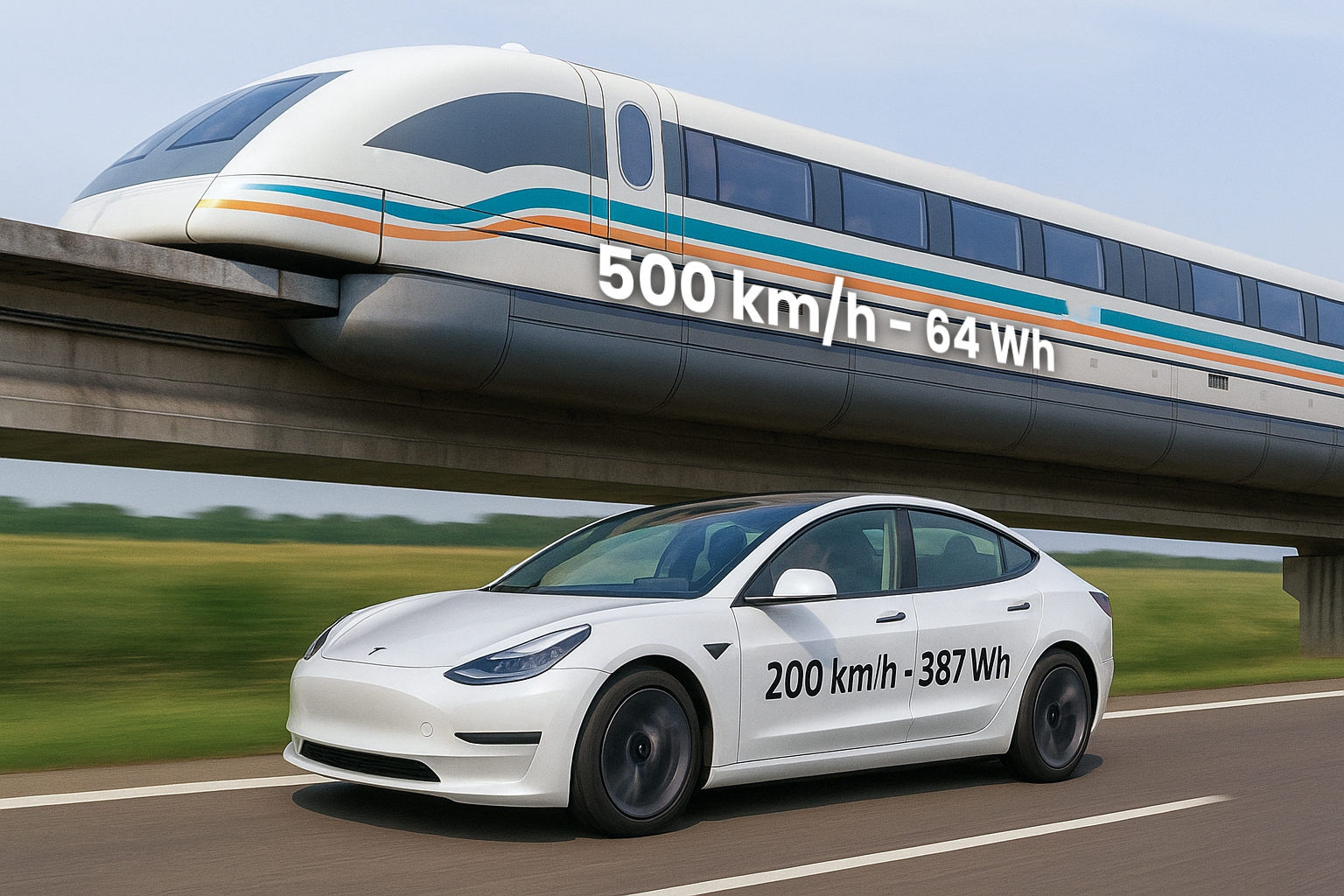
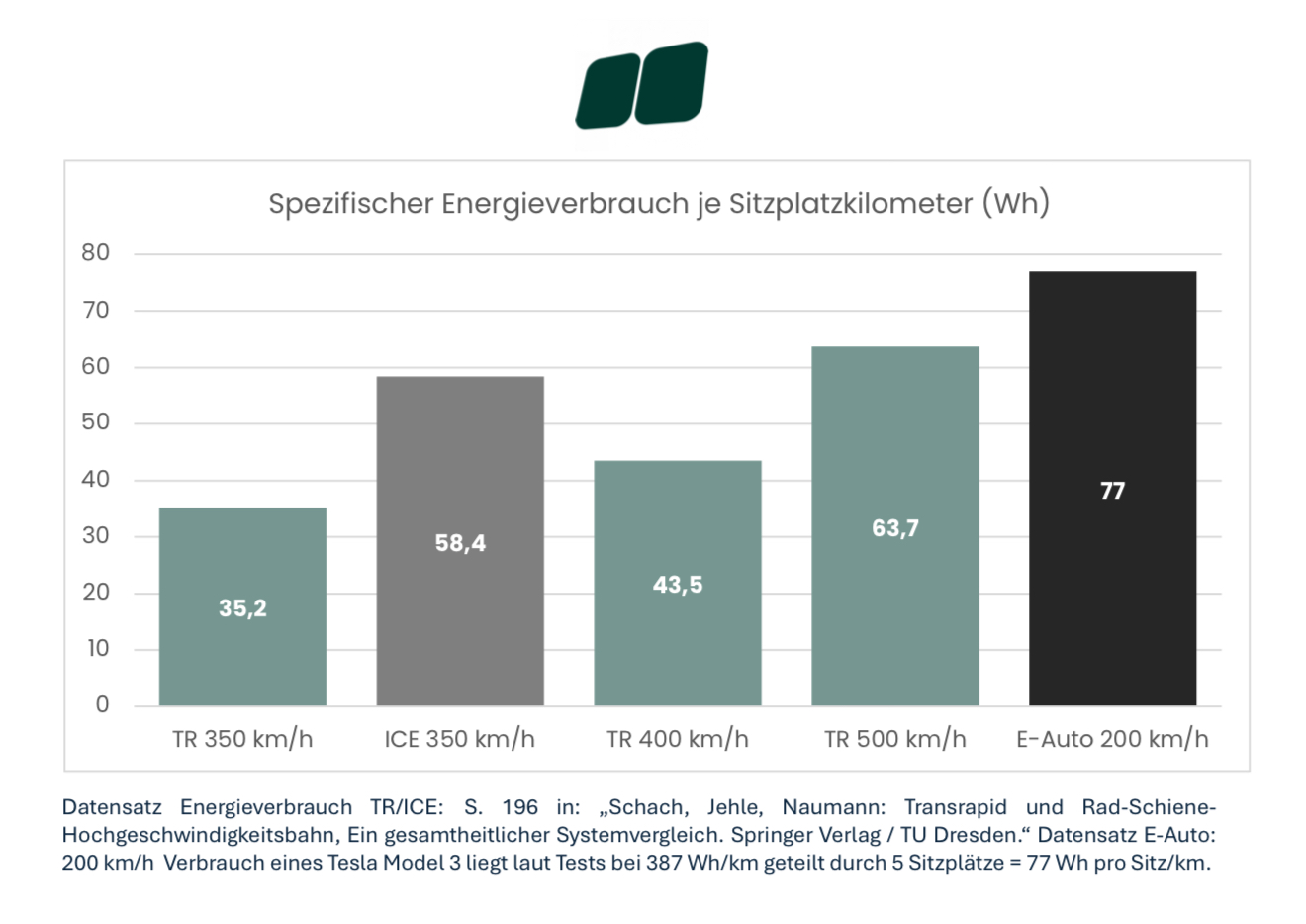
Already at 350 km/h, the Transrapid is far superior to the ICE (Germany’s high-speed train) in energy efficiency. According to the technical system comparison by TU Dresden (2006), the Transrapid uses only 35.2 Wh per seat-kilometer at 350 km/h, while the ICE reaches 58.4 Wh at the same speed. That is an advantage of over 40% in favor of the Transrapid.
This efficiency advantage becomes all the more remarkable when you look at the comparison with road traffic: a Tesla Model 3 uses about 387 Wh/km at 200 km/h, as tests prove. Dividing this figure by five seats gives a specific energy consumption of 77 Wh per seat-kilometer, more than twice as much as the Transrapid at 350 km/h. Driving an electric car “foot to the floor” thus becomes not only an energy burden, but also shows how little environmentally friendly high speeds in private transport actually are.
And even at still more extreme speeds, the Transrapid shows what is technically possible. At 500 km/h its energy consumption does rise, but at 63.7 Wh per seat-kilometer it still stays below that of the electric car at 200 km/h. That is a clear signal: high speed does not have to come with high energy consumption, if the system is right. Comparing an electric car occupied only by the driver with one seat in the Transrapid, the energy saving is an incredible 84%, despite 300 km/h more on the speedometer than the already fast 200 km/h.
The energy demand per person on the Transrapid remains astonishingly low despite extreme speed. The reasons are the absence of rolling resistance thanks to maglev technology, the aerodynamic shape and the high load capacity per vehicle. What is a sporty and unsafe solo experience in cars becomes, on the Transrapid, a collective high-speed journey with safety and environmental advantages.
Especially in the transport policy debate, this comparison is an important signal: battery-electric private transport is not the sole solution, particularly not over long distances or at high speeds. Anyone who floors it on the Autobahn should know: Even a Transrapid at 500 km/h is more economical.