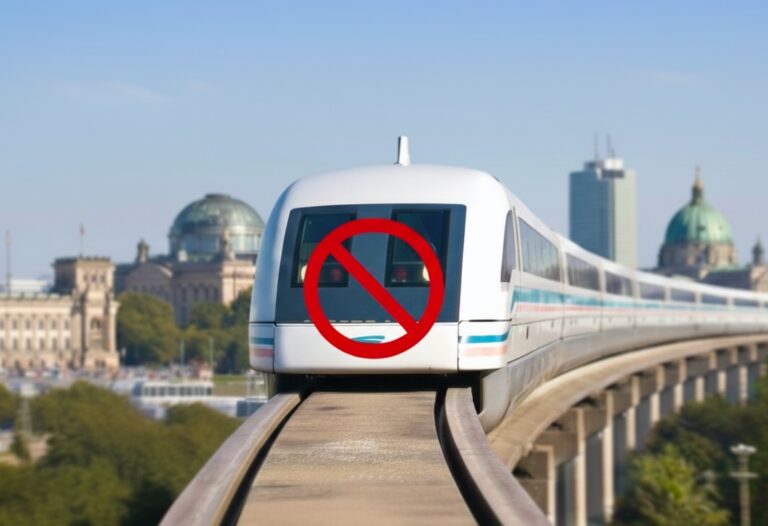
450 km/h 30 Years Ago: The TR07, the Vehicle of Records
Thirty years ago, on June 10, 1993, the Transrapid 07 set a world record: it reached 450 km/h on the Transrapid Test Facility Emsland (TVE). That made it the fastest rail vehicle in the world - and to this day the fastest train in Germany.
Thirty years ago, on June 10, 1993, the Transrapid 07 set a world record: it reached 450 km/h on the Transrapid Test Facility Emsland (TVE) in northwestern Germany. That made it the fastest rail vehicle in the world – and to this day the fastest train in Germany.
Thirty years ago, the TR07 was already setting records that we can only dream of today. High-speed trains in Germany run well below 300 km/h in regular service, on a completely overloaded infrastructure that causes countless delays.
The Transrapid 07 is a comprehensive further development of the Transrapid 06. It featured an improved levitation and running gear that offered greater safety and redundancy, as well as an optimized car body built by Krauss-Maffei in Munich. The Transrapid 07 was designed for a nominal speed of 500 km/h and had room for 192 passengers.
With the Transrapid 07, the maglev system was declared technically ready for commercial use in 1991. The system was based on the principle of the synchronous long-stator linear motor, in which the drive is integrated into the guideway and the vehicle was guided by a controlled electromagnetic levitation system above the guideway. This allowed the Transrapid to handle high speeds, gradients and slopes without wear or friction. In June 1993, it was not only the world record of 450 km/h that fell: the longest non-stop run was also carried out, covering 1,674.05 km without a break on the 31.5 km test track.
The Transrapid 07 was a milestone of maglev technology and demonstrated the potential of this innovative transport solution. Unfortunately, the system was never implemented commercially in Germany, even though several projects were planned. The only Transrapid line in regular service is in Shanghai, where an airport shuttle has been running since 2002 at a top speed of 431 km/h. In China, the technology is being developed further and is expected to enable even higher speeds in the future. In November 2003, a successor vehicle (SMT, based on the TR08) even reached 501.5 km/h – on a line barely 30 km long.
The Transrapid 07 can still be seen today: one section is parked in Lathen, where the TVE was operated until 2011. The other section is at Max Bögl. The Transrapid 07 remains a testament to German engineering and the fascination of maglev.
This month, the Transrapid Visitor Center is devoting itself to the TR07 in many ways.
In addition to a small special exhibition with information about the vehicle, tours of the vehicle are also possible. The visitor center’s opening hours can be found at transrapid-besucherzentrum.de.
MagnetBahn+ members support our work & advocacy for maglev trains and receive exclusive photos of the vehicle’s interior at this link.

How the TR07 Came to Be
The TR07 is the direct successor of the TR06 – the first vehicle tested at the Transrapid Test Facility Emsland. The TR07 thus builds on the experience & insights gained with the TR06 in high-speed operation. New on the TR07 were the fundamentally redesigned vehicle structure and the levitation and running gear, which is designed with much greater redundancy and features a new, non-mechanical emergency braking concept (eddy-current brake).
Construction of the vehicle began in 1988. Before it entered service at the TVE in 1989, it was presented at the International Transport Exhibition in Hamburg (IVA88) in 1988.
The microwave radio system introduced with the TR07 relies on 38 GHz radio links, which enable communication with the control center. This allows low-latency communication.
The interior of the vehicle was completely redesigned. The vehicle was fitted with 2×2 seating, with very wide seats. The 2-section vehicle consisted of a seated section in which passengers rode – and a measurement section in which the Transrapid engineers could use measuring equipment and sensors to analyze and improve the vehicle’s characteristics & behavior in real time.
Operation of the TR07
The TR07 was operated for 10 years, covering a cumulative total of more than 588,000 km on the 31.5 km track and carrying over half a million passengers. In 1999 it was replaced by the TR08. The TR07 is possibly the most important vehicle in Transrapid history, since it was the vehicle on which the Transrapid system was declared technically ready for use in 1991. This meant that the technology was now approved for commercial operation.
In 1993 the TR07 broke two records. On June 6, the longest non-stop run, with the vehicle covering 1,674.05 km without a break on the test track in Emsland.
Just four days later, on June 10, the TR07 broke the speed record with 450 km/h. The TR07’s previous record was 436 km/h; the TR06 managed 412.6 km/h. These speeds are no problem for the Transrapid system. Almost 10 years later, in November 2003, a successor vehicle reached 501.5 km/h in Shanghai – on a line just 29.9 km long. No other train can travel, accelerate and brake as fast as the Transrapid.
From 1989 to 1992, the TR07 was at times operated simultaneously with the TR06. The operations control systems of the two vehicles are incompatible, which is why the TVE control center was equipped with both systems at the time.
Only one TR07 vehicle with two sections was ever produced. Many people think there were different variants of the TR07, but that is not true. The different looks of the vehicle are due to modifications made to test various aerodynamic shapes, with the aim of making the vehicle even quieter and more energy-efficient. That succeeded: measurements prove that new shapes of the TR07 are significantly quieter. It was painted red in 2000 / 2002, when it was used as an info point in Munich & Essen.