Language
Language
Transrapid ·

New 600 km/h Vehicle from China & Call for Tests on the SMT Line

Maglev development in China never stands still. Based on Transrapid technology, new vehicle prototypes are regularly built and tested in China. Chief among them is the flagship "CRRC CF600", which will reach up to 600 km/h. A smaller variant of the Transrapid was also unveiled in China in 2021: the CF200, which will run at much lower speeds but has a different section layout. One thing they all share: the platform of these vehicles is the German Transrapid.

Maglev development in China never stands still. Based on Transrapid technology, new vehicle prototypes are regularly built and tested in China. Chief among them is the flagship “CRRC CF600“, which will reach up to 600 km/h. A smaller variant of the Transrapid was also unveiled in China in 2021: the CF200, which will run at much lower speeds but has a different section layout. One thing they all share: the platform of these vehicles is the German Transrapid.

CF600 requested for the Shanghai Transrapid line

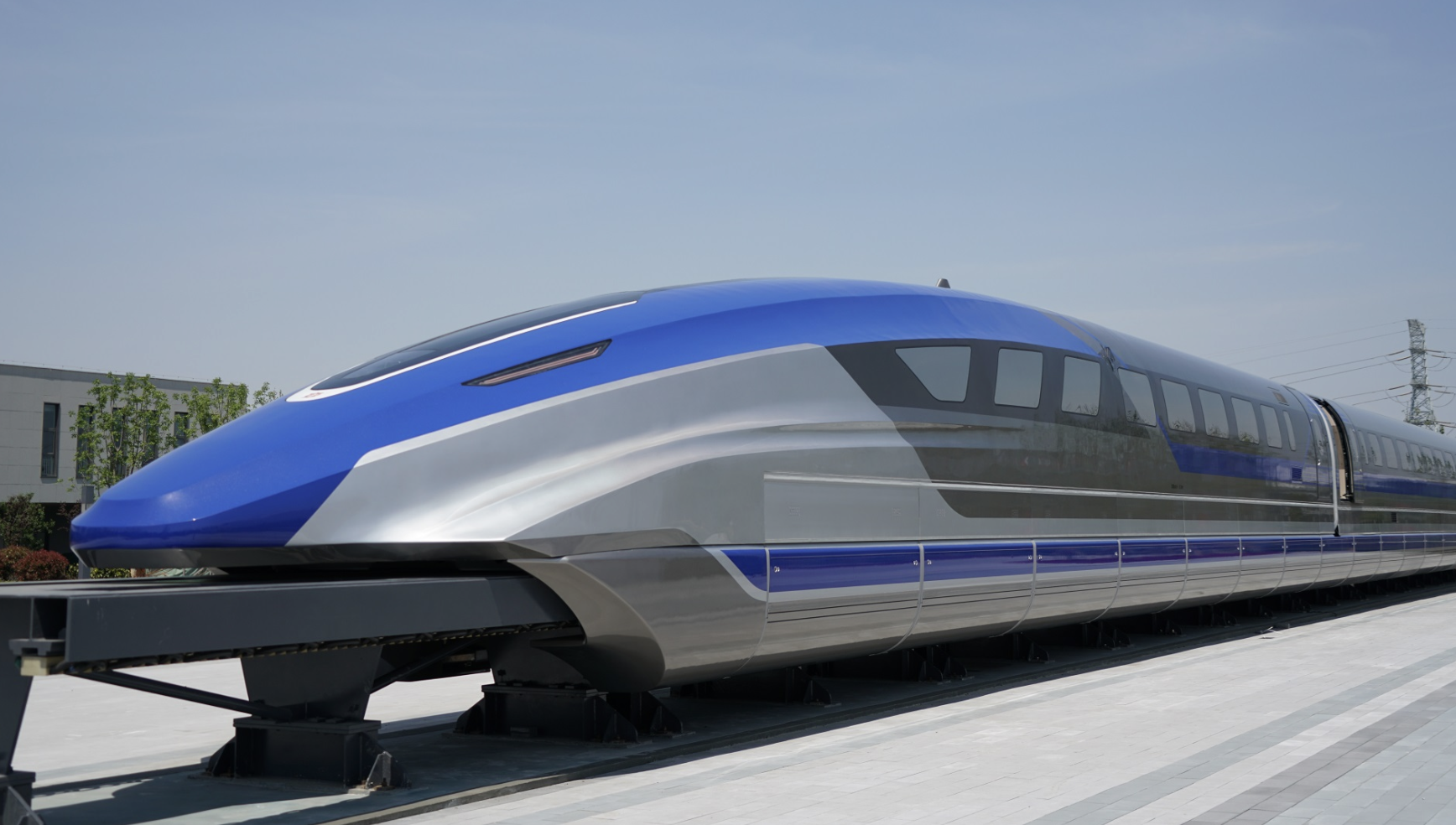
CRRC CF600. Image: CRRC Sifang

The CF600 was presented to the public in 2019. A complete 4-section vehicle was finished in early 2021 and still sits, even today, without a high-speed test track in its own factory hall in Qingdao. It is developed and built by the CRRC company “Sifang” (in Qingdao); since 2021 there has even been a complete research center that fulfills the same tasks as the German Transrapid Test Facility Emsland. The big difference is that the track is too short: only 660 m are available, so the vehicle can only move at speeds in the two-digit range. Plans to extend the test track by 200 km and build a second lane have not been realized so far. From January 2020 to January 2021, a middle section of the CF600 was tested on the Tongji line, a research track just 1.5 km long in Shanghai that belongs to Tongji University and was built from leftover guideway girders of the Shanghai Transrapid (SMT) line.

For this reason, high-ranking figures in China are now calling for the Chinese CF600 vehicle to be tested at high speeds on the “original” Transrapid line in Shanghai. Specifically, it is proposed to carry out the tests of the Chinese vehicle at night so as not to disrupt regular passenger service of the TR08 vehicles in Shanghai.

The proposal comes from Sun Yongcai, Party Committee Secretary and Chairman of CRRC, the manufacturer of the vehicles. At the same time, coordination of a 600 km/h application line is to be promoted.

The tests are to be carried out on the 29.9 km Transrapid line at speeds of up to 500 km/h. The SMT line is too short for higher speeds, and the drive infrastructure also allows a theoretical maximum speed of “only” 557 km/h. In November 2003, the SMT (TR08) reached a record speed of 501.5 km/h on the short line, and had to brake again correspondingly quickly.

New 600 km/h vehicle

The new vehicle. Image: CCTV13

Alongside the call to run the CF600 vehicle on the Shanghai Transrapid line, a new vehicle was presented to the public.

It is easy to see that this is once again German Transrapid technology. At present only an end section is known.

The vehicle differs mainly in its car body. It is clear that the sharp edges of the first CF600 vehicle have been eliminated, and the design now goes for a much rounder overall look. It is also notable that the vehicle has no windows at the front, unlike the CF600. The German TR09 likewise has no windows at the front, since they were no longer needed because of fully automatic operation and added unnecessary weight. Broken panes from bird strikes are also not uncommon. A camera has been installed at the front instead.

Another special feature is that this vehicle is not a successor to the CF600 but a parallel development by a different CRRC company, namely CRRC Changchun. This means that several companies in China are trying to bring a 600 km/h vehicle to market.

The vehicle is to be tested on the Tongji line, though no precise schedule is known yet.

Front view. Image: CCTV13
Join the team

Help build maglevhub.com

maglevhub.com started in 2026 as the international offshoot of magnetbahn.de and is now growing on its own. We are looking for writers, translators, researchers, video makers and developers from all over the world.