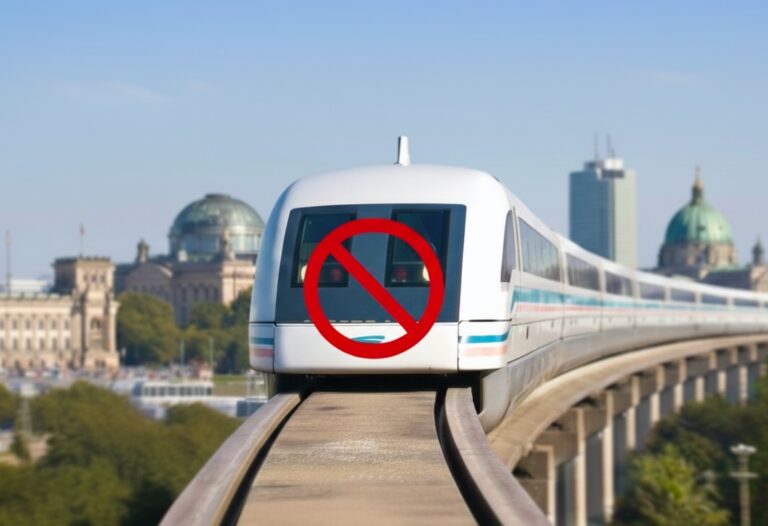
Transport Ministry Refuses to Accept Transrapid Petition
Despite almost 62,000 signatures calling for the Transrapid to be deployed in Germany, Federal Transport Minister Patrick Schnieder has declined to accept the petition in person. In the ministry’s written reply, it says that, for reasons of “impartial equal treatment,” it generally refrains from accepting petitions in person “outside the usual channels of delivery.”
This reasoning is contradictory, however: in the past, the German Federal Ministry of Transport has indeed accepted petitions in person, even with far fewer supporters. In 2023, representatives of a petition against the expansion of motorways handed around 11,000 signatures to the ministry in person. In 2022, the ministry even officially accepted a petition for child-friendly road traffic law, partly by the minister himself, partly by senior staff. Such examples show that an individual handover is by no means unusual but apparently a question of political will.

That the Transport Ministry does not want to accept the petition is absolutely incomprehensible, especially since other petitions have been accepted in the past. It is still apparent today how controversial the Transrapid is and how nearly all politicians, whether members of parliament or ministers, keep their distance from it, even though it delivers precisely the benefits that long-distance travel in Germany needs right now.
It is important to note that this refusal is nevertheless not a setback for the petition itself: it will still be handed to the ministry, albeit by other means, which I am currently examining. The focus is the handover to the Petitions Committee of the Bundestag (German parliament) anyway, and that will take place soon. In view of Article 17 of the Basic Law (the right of petition), I am convinced that the petition will be taken seriously there.David Harder, initiator of the petition
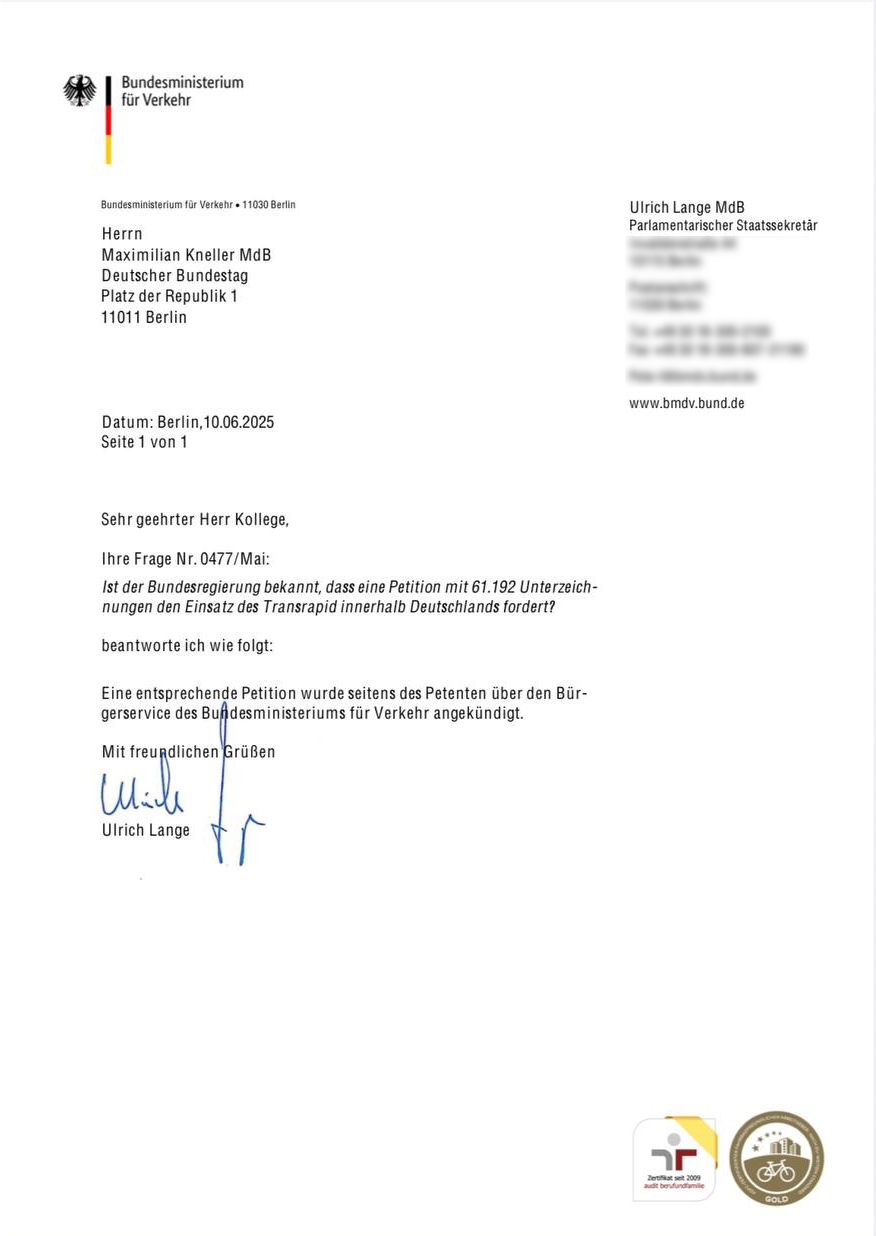
A recent reply by Parliamentary State Secretary Ulrich Lange to an inquiry from member of parliament Maximilian Kneller, a strong supporter of maglev trains, makes it clear: “The petition is known to the ministry and was properly announced via the Federal Ministry of Transport’s citizen service.” That means it is effectively already there through official channels.
For me, the decision against a personal handover is therefore not particularly problematic. Even without a symbolic act, the petition will find its way into the ministry, by post if necessary. In addition, it will soon also be handed to the Petitions Committee of the German Bundestag, which will initiate formal parliamentary consideration.
That the ministry refuses a personal handover is regrettable, but it changes nothing about the matter: the Transrapid offers an answer to central transport problems in Germany. It runs faster, more quietly, more energy-efficiently and more reliably than conventional trains. It relieves the overloaded rail network, runs at 500 km/h, saves CO₂, and does so at investment costs comparable to the ICE.
While the long-distance network groans and punctuality becomes a gamble, the Transrapid shows what is already possible today: 500 km/h, 99.96% availability (Shanghai), 70% lower maintenance costs, and lines that affect landscape, agriculture and nature far less.
This petition does not demand a vision, but the sensible use of a proven technology. That is why I will continue to hand the petition to the responsible ministries and committees and to make the case for this technology, which has been ready for service since 1991.