Language
Language
General ·

The M-Bahn Was Not a Maglev

Berlin's M-Bahn (1984-1991) was in fact not a maglev. The term "M-Bahn" stands for Magnetbahn (magnetic railway), because the system is driven by a linear motor built into the guideway. Permanent magnets serve as the exciters of the electromagnetic traveling field, while the vehicle ran on rollers and never levitated.
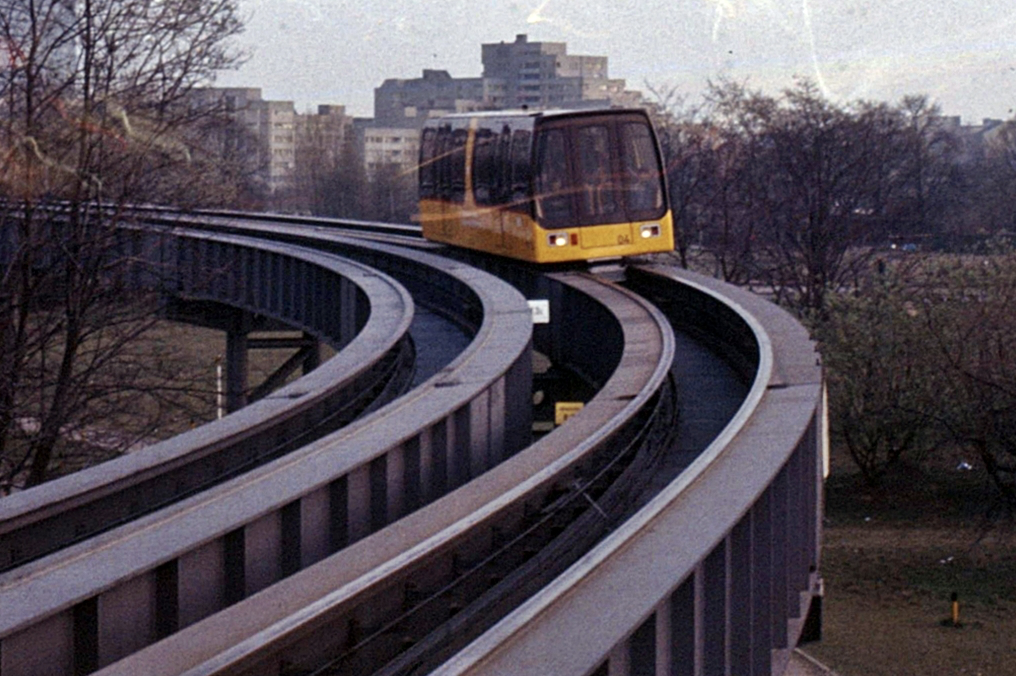
M-Bahn in Berlin. Image: Bassaar via Wikipedia

Berlin’s M-Bahn (1984-1991) was in fact not a maglev. The term “M-Bahn” stands for Magnetbahn (magnetic railway), because the system is driven by a linear motor built into the guideway. Permanent magnets serve as the exciters of the electromagnetic traveling field, while the vehicle ran on rollers and never levitated.
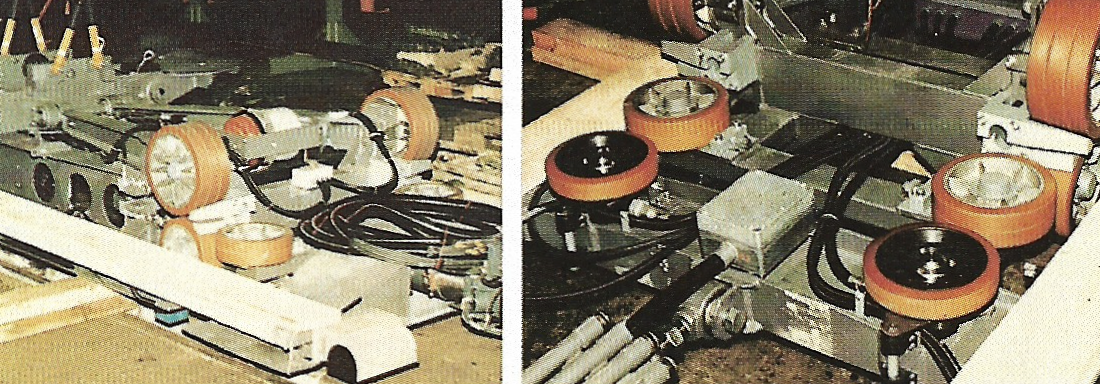
The M-Bahn was carried and guided by rubber rollers like these. Image: Magnetschnellbahn AG, Kassel (1991)

Historical context

In 1974, Thyssen-Henschel (today ThyssenKrupp) began developing a synchronous long-stator linear motor for use in high-speed maglev trains. We have Thyssen-Henschel to thank for putting the drive in the guideway: earlier asynchronous short-stator maglevs (TR02, TR04) had the problem of being very heavy, since they had to carry their entire drive power permanently on board.

Thyssen-Henschel’s synchronous long-stator linear motor meant the vehicle benefited from enormous weight reductions, which also improved energy efficiency. While the drive power was installed on the guideway side, the vehicle consisted only of the car body and the levitation chassis.

This technology was developed from 1974 together with the Technical University of Braunschweig. There they saw the potential to implement the system in an urban transit train, from which the M-Bahn later emerged. The Berlin M-Bahn

The technology in detail

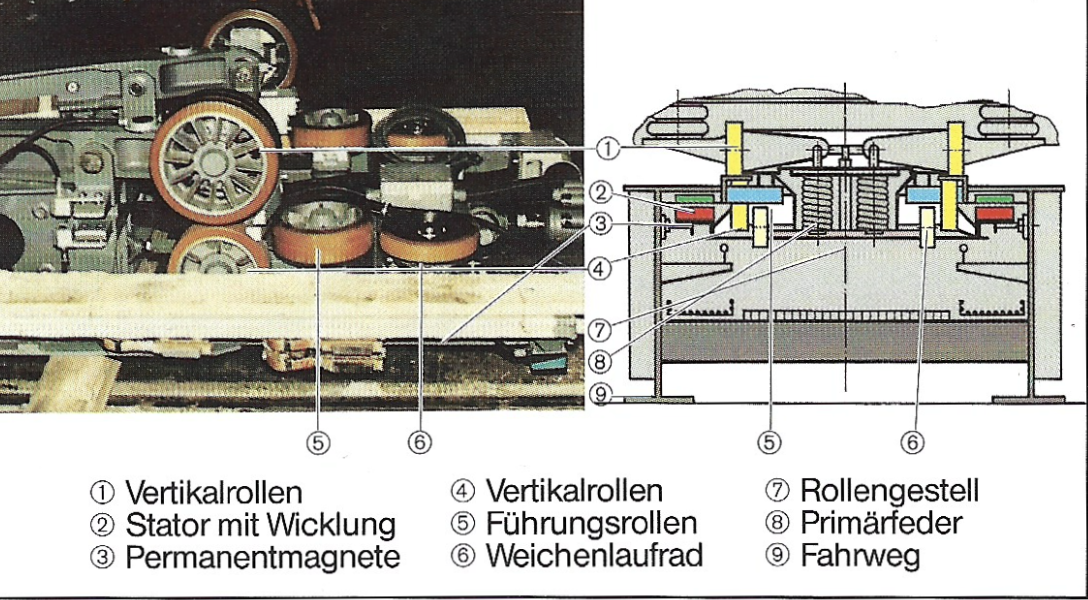
Cross-section of the M-Bahn system. Image: Magnetschnellbahn AG, Kassel (1991)

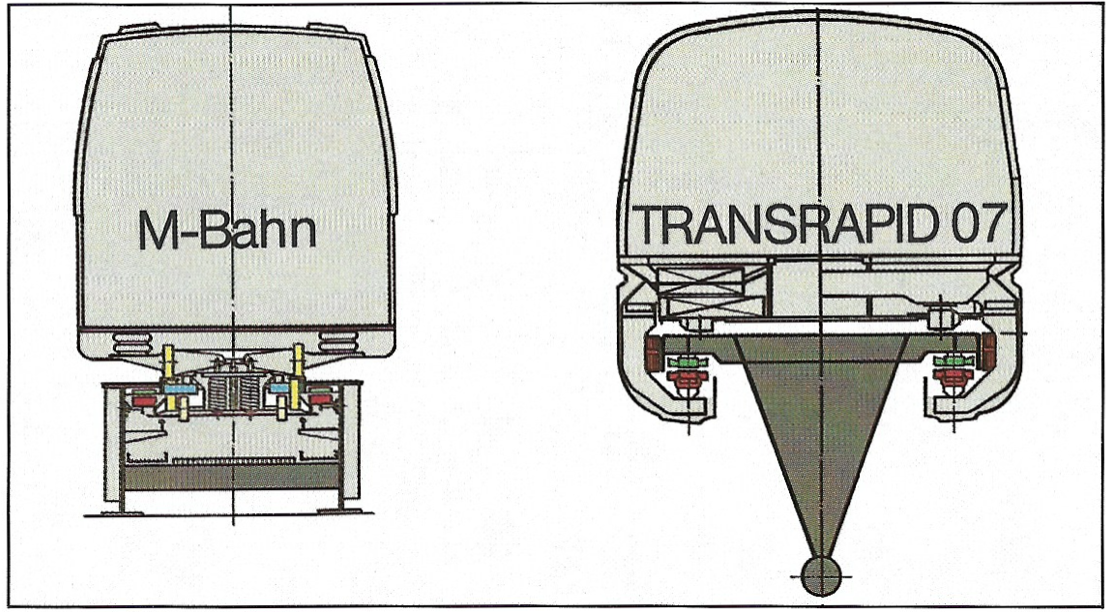
Like the Transrapid, the M-Bahn is driven by a synchronous long-stator linear motor on the guideway side. The resulting traveling field pulls the vehicle’s magnetic field along in sync with the alternating-current frequency, which propels the vehicle (drive).

To excite this traveling field on the vehicle side, the M-Bahn has permanent magnets built in, which generate a magnetic field that is pulled along by the traveling field. There is no levitation function. The vehicle is carried and guided by rubber rollers.

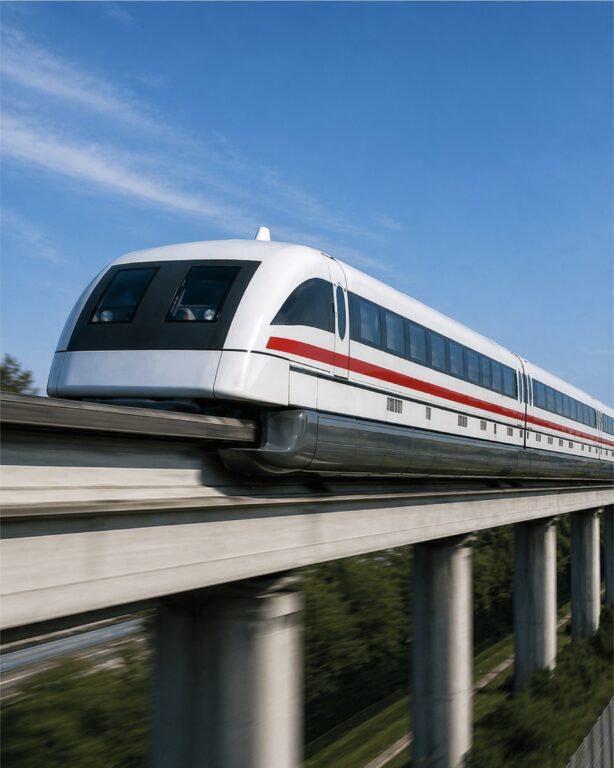
In this respect the system differs fundamentally from the Transrapid. The Transrapid has a levitation chassis that lifts the entire vehicle electromagnetically. When lifting, the vehicle generates a magnetic field that is pulled along by the traveling field of the linear motor installed in the guideway. The Transrapid has no rubber rollers.

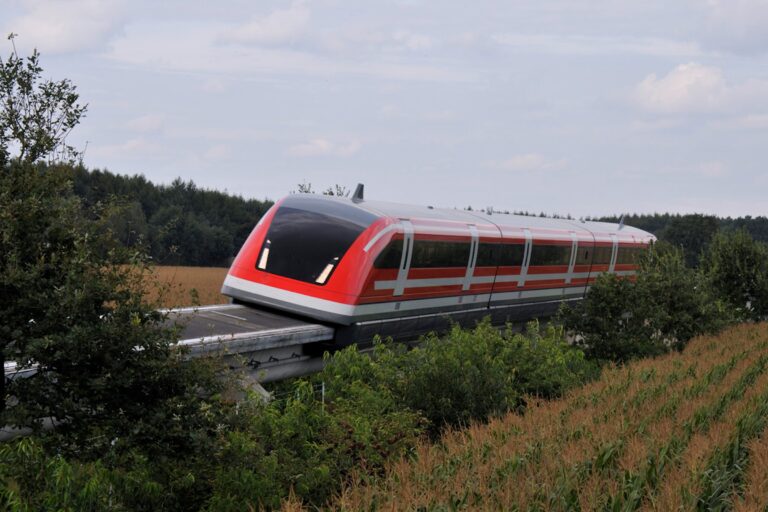
The M-Bahn also has nothing in common with the Transport System Bögl (TSB). Although the guideway looks similar, the systems differ fundamentally in technical terms. The TSB is an electromagnetic levitation train that levitates with a 7 mm air gap and is driven by an asynchronous short stator installed in the vehicle. This drastically reduces the investment costs for the guideway, since no active system components (such as the entire long-stator linear motor on the TR or M-Bahn) are installed in it.

Cross-section of the M-Bahn compared with the Transrapid. Image: Magnetschnellbahn AG, Kassel (1991)
Join the team

Help build maglevhub.com

maglevhub.com started in 2026 as the international offshoot of magnetbahn.de and is now growing on its own. We are looking for writers, translators, researchers, video makers and developers from all over the world.