How the Transrapid Technology Came to Be
Hermann Kemper is considered the inventor of the maglev train. In 1922, while studying electrical engineering, he came up with the idea of replacing the levitation and guidance functions of the wheels on conventional locomotives with electromagnets.
Hermann Kemper's patent
Hermann Kemper is considered the inventor of the maglev train. In 1922, while studying electrical engineering, he came up with the idea of replacing the levitation and guidance functions of the wheels on conventional locomotives with electromagnets.
But because of his studies, he lacked the time to realize this technology.
In 1932, after taking over his father’s meat processing business, he turned to his idea of electromagnetic levitation again.
Patent No. 643316 was later published, the basis of all electromagnetic maglev trains.
In 1938 he supplemented this patent with a vehicle guidance function, which is essential in particular for switches and curves.
He also worked out a concept that evaluated electromagnetic levitation trains in airtight tunnels. At the time he noted that this technology would be most advantageous in an airtight tunnel without air resistance. Today this principle is known as the Hyperloop.
In 1939 he was offered a job by the Aerodynamic Research Institute Göttingen (AVA). The aim was to realize a maglev train.
A 20 km test track was to be built in Landsberg. But in 1943 the tide turned, when the German Reich stopped all spending that was irrelevant to the war.
Hermann Kemper saw this as the death blow to his technology. He gave up the development and did not renew the patents, since he himself no longer believed in the technology’s success and saw no benefit in an expensive patent renewal.
All that remained of this development was a test stand. It should also be noted that, given the state of the art at the time, the levitation technology was impractically large.
A new chance
Hermann Kemper gave up. He kept promoting the technology but was only ridiculed for it. But when Hermann Kemper met Ludwig Bölkow during a spa stay and told him about his patent, the situation changed.
Bölkow believed in the technology right away and had the feasibility of this technology examined at his company (Bölkow GmbH, later MBB). The result was positive, and in 1969, after being convinced by Federal Transport Minister Georg Leber, Bölkow initiated a high-speed rail (HSB) feasibility study.
The result of this study was known by the end of 1971. It became clear that efficient travel at high speeds with conventional wheel-on-rail technology would be uneconomical. As a result, many German companies began developing maglev trains.
Of all the different maglev developments, the system by Thyssen-Henschel ultimately prevailed: the Transrapid.
In 1974, Thyssen-Henschel, together with the Technical University of Braunschweig, began developing an efficient long-stator motor system for the EMS system. The advantages of this technology were immense weight reductions of the vehicles, propulsion located in the guideway, and very high acceleration values and power peaks.
(Building on this propulsion basis, TU Braunschweig later developed a transport system that was driven by a linear motor but ran on wheels. This is the M-Bahn.)
HMB1
In 1974, the first track for this system was built in Kassel. It was 102 m long, and a 2.5 t test frame was initially trialed on it, which not only proved the advantages but also confirmed the technical feasibility. There were fears that the electromagnetic field of the vehicle (levitation/guidance) could interfere with the electromagnetic traveling field of the guideway (propulsion). Fortunately, this turned out to be wrong.
HMB2
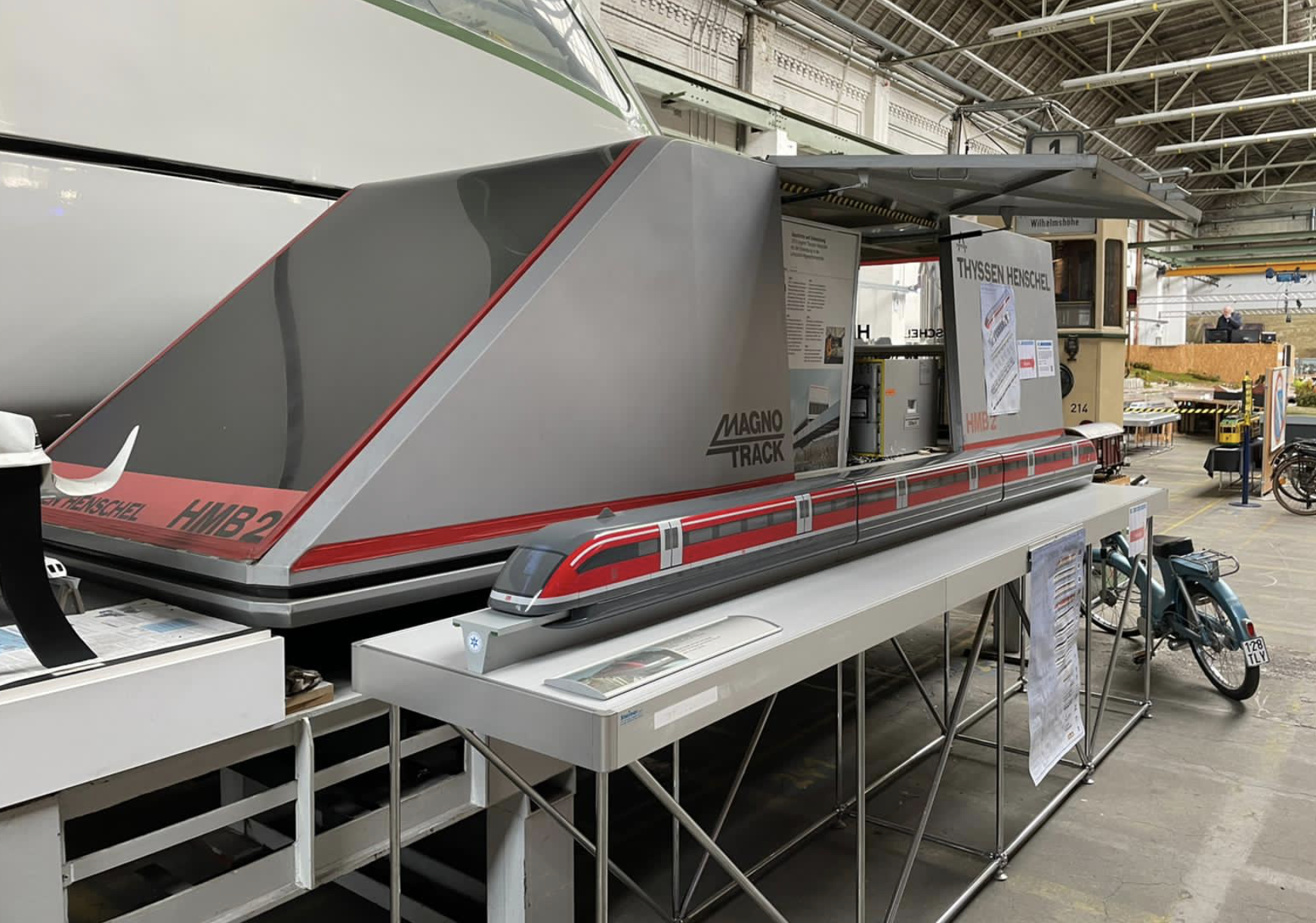
The levitation frame was later developed into a vehicle, the HMB2. It reached a top speed of 36 km/h and had room for up to four passengers. This technology was groundbreaking for the future of the maglev train.
The Transrapid (05-09) builds on this technology, as do the CRRC CF200/CF600.