Hamburg-Hannover New Line: Transrapid Overdue Since 1988
The German Federal Ministry of Transport is pushing for a prompt Bundestag (German parliament) decision on building a second rail corridor between Hannover and Hamburg. What sounds at first glance like an overdue capacity expansion turns out on closer inspection to be an infrastructural dead end: instead of daring to give German rail transport a boost of innovation, the plan is to duplicate the existing line with a largely identical system. And this despite the fact that the Transrapid was already planned there in 1988, and studies as well as the Lower Saxony state government attested to its full feasibility and sense.
Duplicating the line without progress
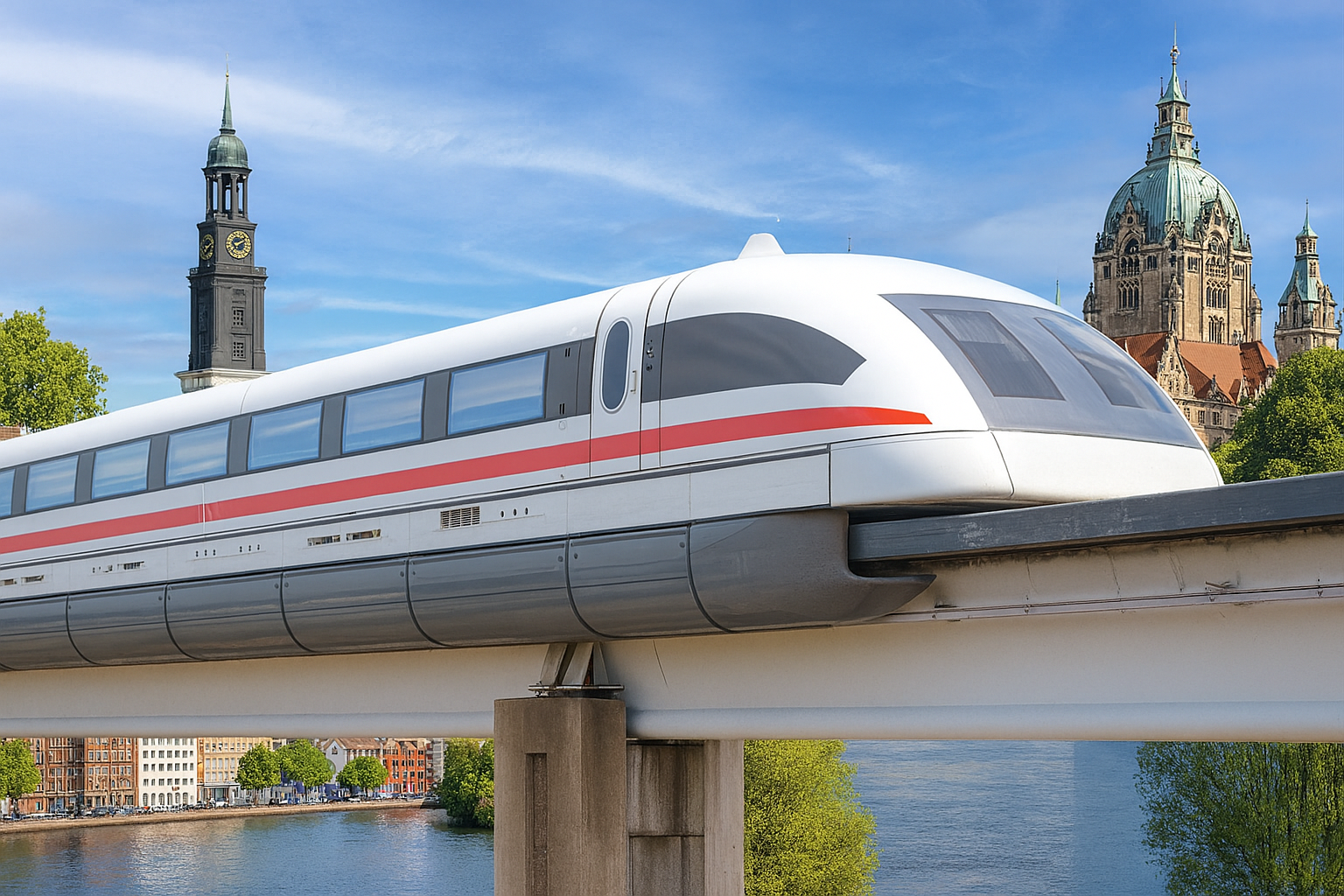
The plan provides for building a new corridor more or less parallel to the existing high-speed line, for the same trains, on the same tracks. This would not only mean a multi-billion-euro investment in redundant infrastructure but also squander a historic opportunity: the realization of a future-proof mode of transport that could achieve far more than the classic wheel-on-rail system, with the same infrastructure investment costs but a top speed of 500 km/h, 40% lower energy demand than an ICE (Deutsche Bahn’s high-speed train) at 350 km/h, and 70% lower maintenance costs overall than an ICE, despite double the top speed. German transport policy thus stays in the “comfort zone of the status quo” instead of breaking new ground.
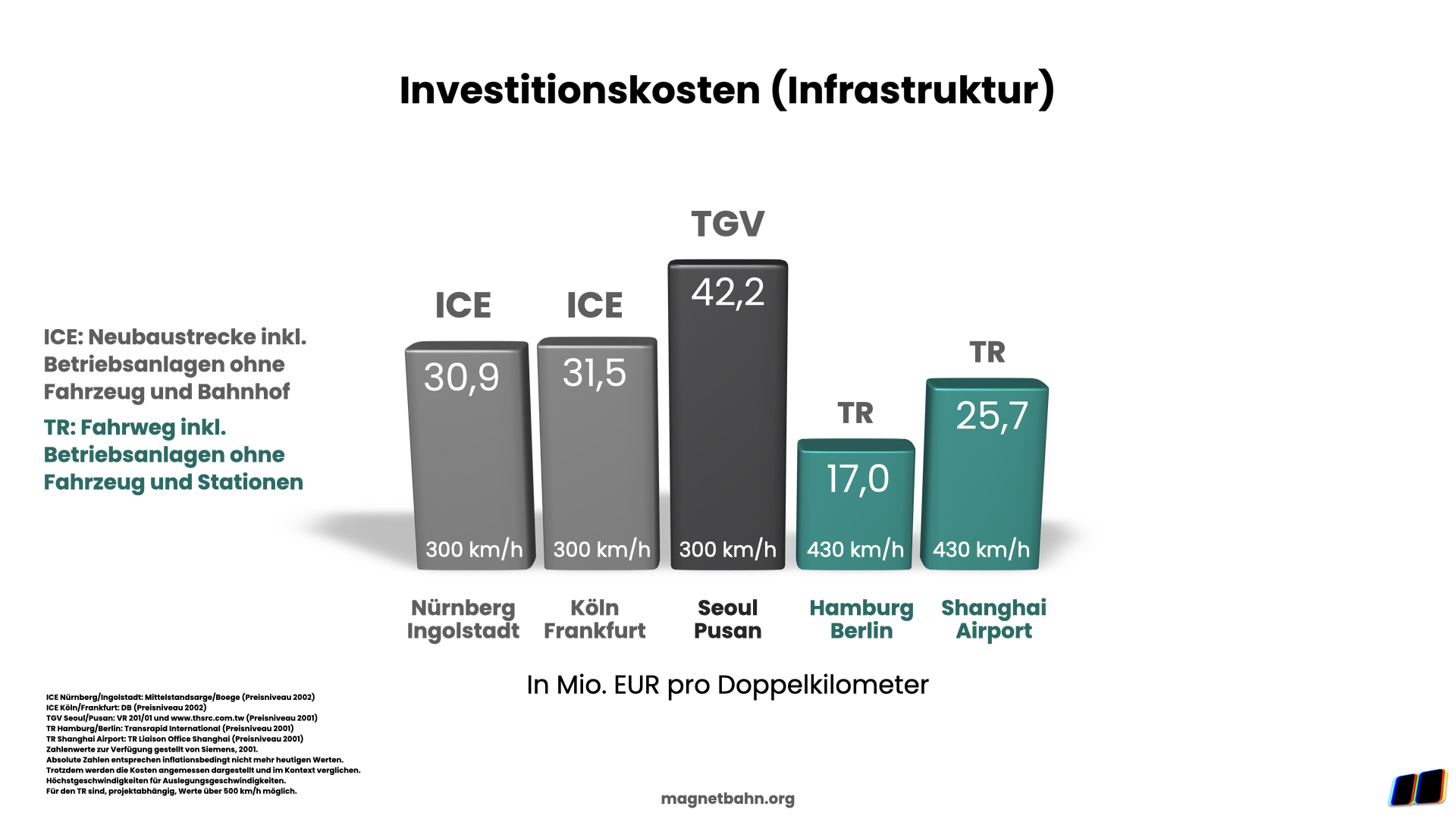
Transrapid: yesterday’s vision, tomorrow’s opportunity
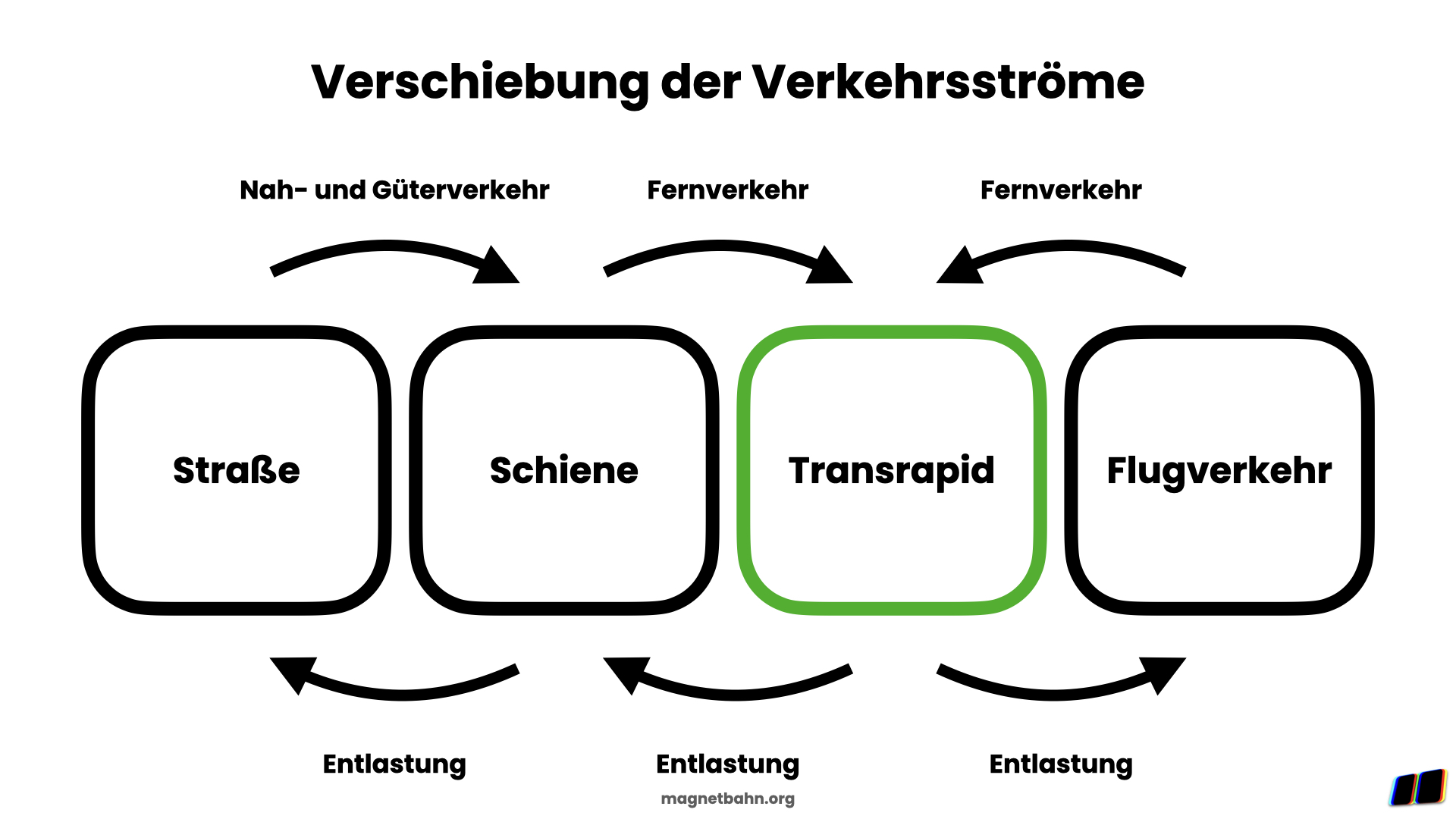
A look at the past shows that things could be different. As early as 1988, the Transrapid was envisaged for the Hannover-Hamburg route. Even then, maglev technology was credited with enormous potential for shifting traffic from road and rail to the levitating high-speed train. Studies showed that the Transrapid would not only have drastically cut travel times but also helped relieve the existing rail network.
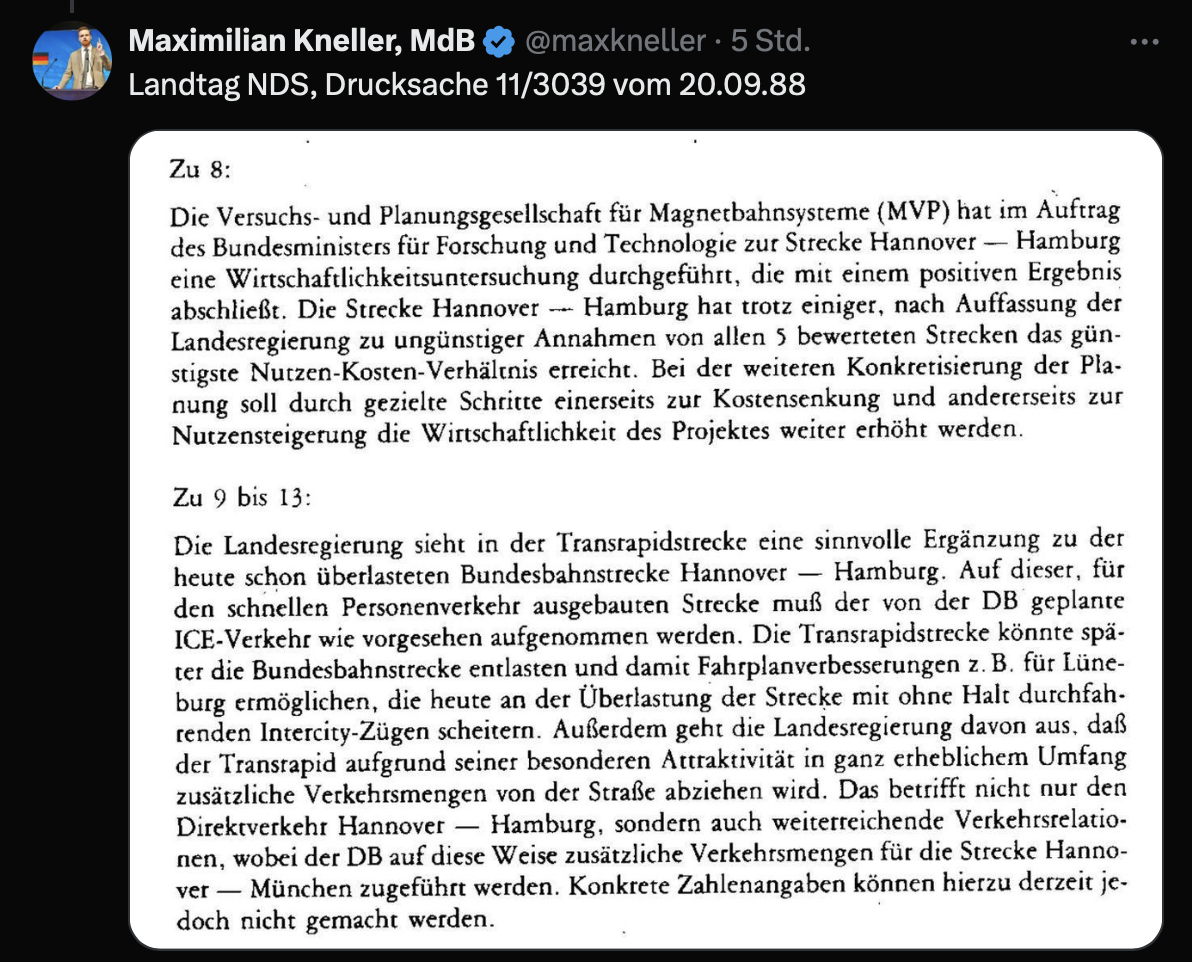
The position of the Lower Saxony state government at the time is particularly noteworthy. A statement read: “The state government sees in the Transrapid line a sensible complement to the Hannover – Hamburg Bundesbahn line, which is already overloaded today. (…) The Transrapid line could later relieve the Bundesbahn line and thus enable timetable improvements, for example for Lüneburg, which today fail because of the line’s overload with Intercity trains passing through without stopping.”
This 1988 report was recently published on the platform X (formerly Twitter) by Bundestag member Maximilian Kneller and brought back into the public debate. Kneller, a member of the Bundestag’s transport committee, criticizes the current plans as too expensive and protracted. In an interview with the “Neue Westfälische” in Bielefeld he was clear: his alternative is a new Transrapid line. The maglev could be built faster and at considerably lower cost.
Political courage instead of routine planning
Reviving the project would be not only a commitment to technical avant-garde but also a contribution to sustainable mobility. The Transrapid is locally emission-free, causes no mechanical wear on the guideways and, thanks to its high degree of automation, enables powerful operations management. In China, a system based on the Transrapid already runs between Shanghai and Pudong Airport: fast, quiet, reliable. At this link you can see all the advantages.
That Germany categorically refuses this option is not a practical constraint but a political decision. A decision against technological diversity, against a willingness to innovate and ultimately against a structural change that is urgently needed.
Planning muddle between federal and state governments
Meanwhile, parliamentary inquiries show how poorly coordinated the planning between the federal government and the states is. In an inquiry to the federal government, Maximilian Kneller wanted to know which planning variants of the route corridors examined by DB AG (Deutsche Bahn) would affect the construction of the state road L712n near Bielefeld. The answer of July 1 was sobering: “None.” For Kneller, proof that “one side doesn’t know what the other is doing”. The topic is also causing a stir in the state parliament. There, the AfD asked whether the state government was aware of structural overlaps between the planned gap closure of the L712n and the rail routes. The answer: “The state government is aware of possible structural overlaps.” (As reported by NW Bielefeld)
A plea for a technology-open debate
The Bundestag should not treat its vote on the project as a mere infrastructure question but as a switch-setting moment for the future of mobility. This necessarily includes examining alternative technologies, taking historical studies into account and an honest comparison of the economic, ecological and operational effects.
The call for technology openness must not remain lip service. Anyone who wants to shape tomorrow’s transport system must be prepared to question the familiar and seriously examine the new. The Hannover-Hamburg route offers an ideal testbed for this. It would be a mistake to squander this opportunity again.