Language
Language
China ·

All Chinese Versions of Transrapid Technology

China continues to believe in Transrapid technology: besides the continuous operation of the Transrapid line in Shanghai, the Chinese government has for almost 15 years been betting on the domestic further development of this German high technology.
China continues to believe in Transrapid technology: besides the continuous operation of the Transrapid line in Shanghai, the Chinese government has for almost 15 years been betting on the domestic further development of this German high technology.
This is made possible by technology transfer, which allows CRRC to use individual Transrapid system components in its own vehicles. Many other components for which no transfer took place have been reverse-engineered by the Chinese, including, for example, the eddy-current brake.

The German Transrapid manufacturer has not given up yet: the company still exists, and in 2018 an official cooperation between thyssenkrupp and CRRC was even announced.

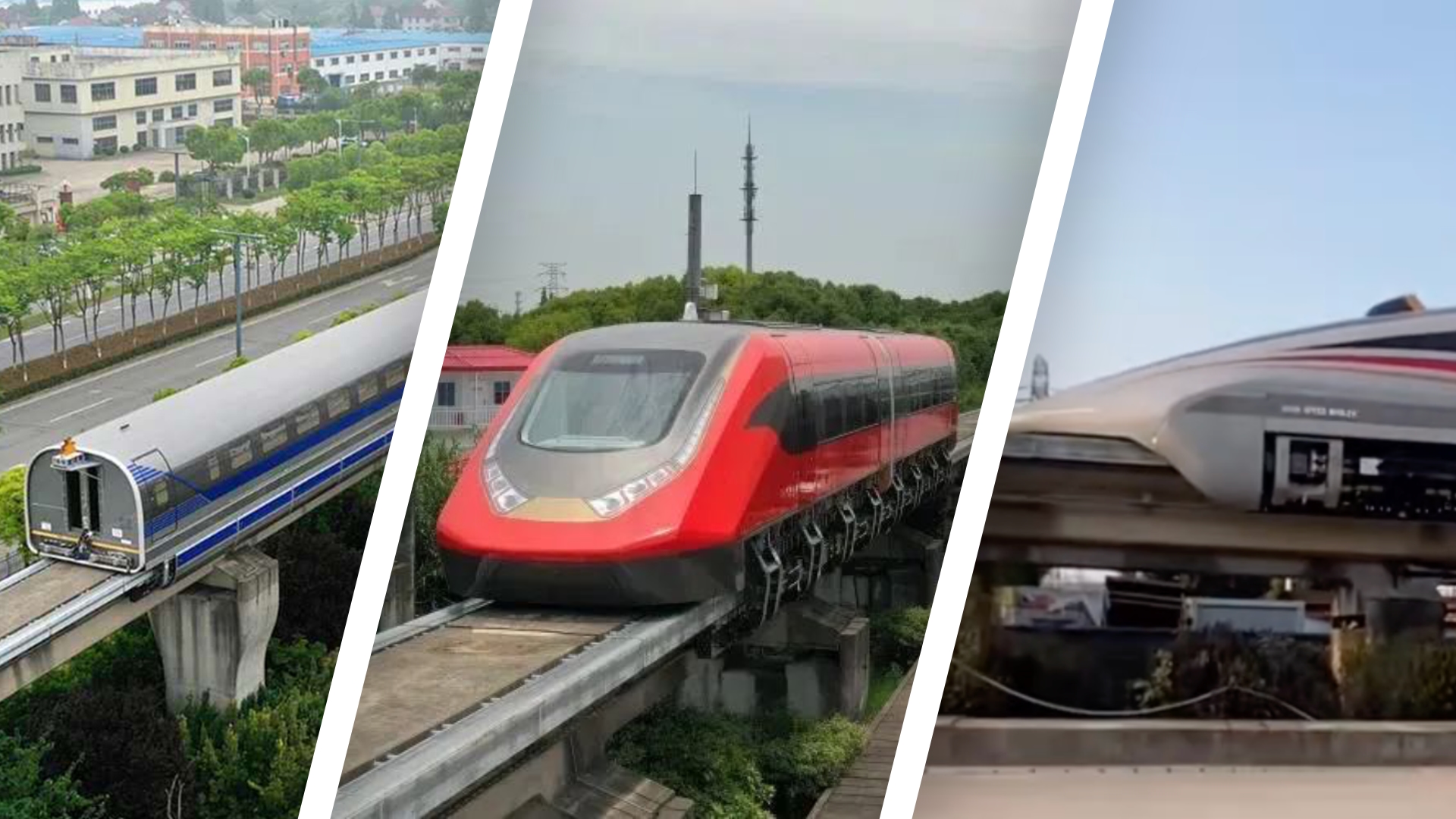
Based on Transrapid technology, CRRC is currently developing three different versions of its own vehicles:

  • – A 600 km/h vehicle with a Transrapid running gear, 3.70 m wide
  • – A 500-600 km/h vehicle with a considerably narrower car body, 2.90 m wide
  • – A 200 km/h urban transport vehicle, 3.70 m wide, with a section length halved to just 12.5 m

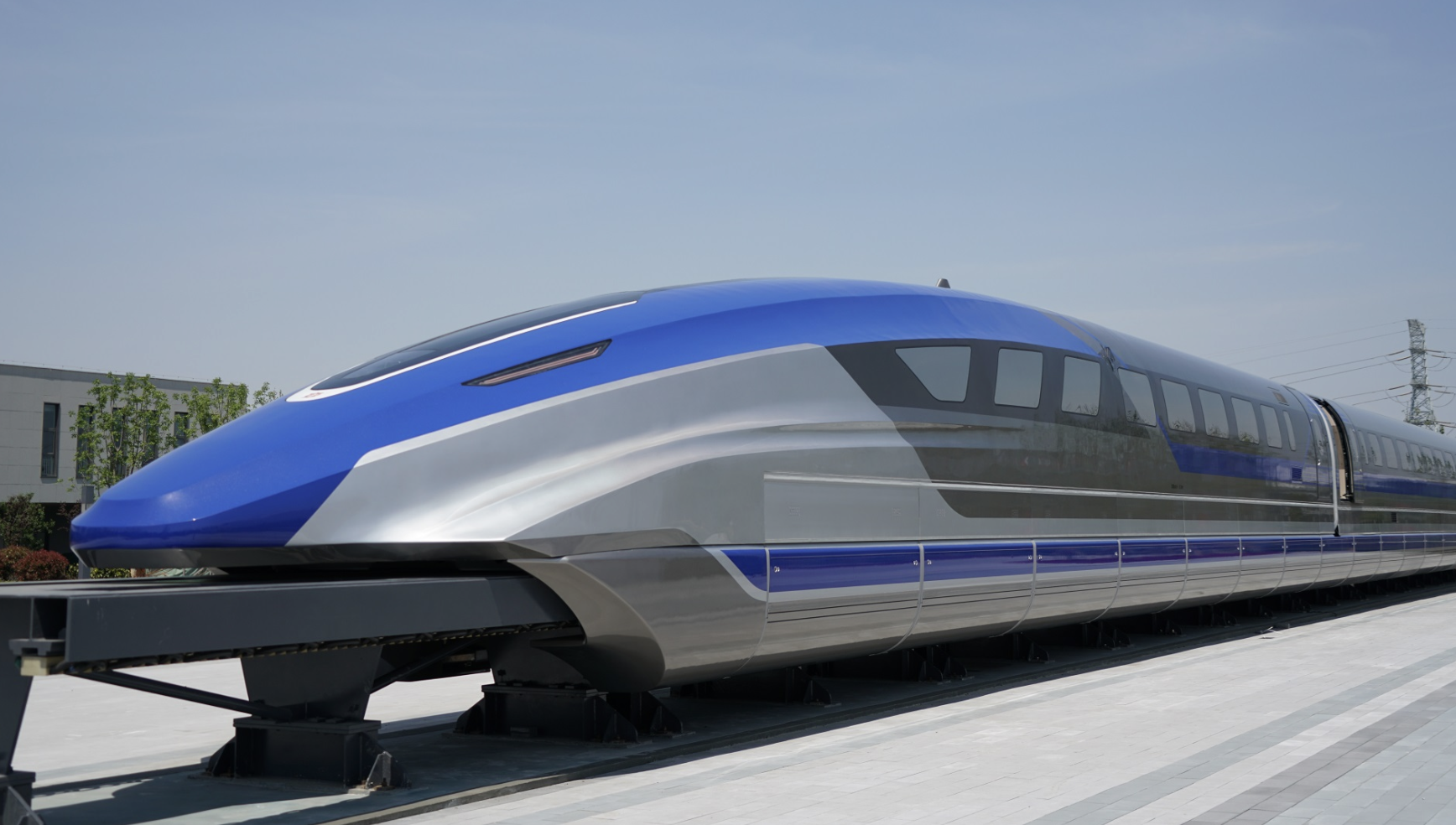
CRRC CF600

Main development line, 3.70 m wide

The CF600 at its presentation in mid-2019. Image: CRRC

The 600 km/h vehicle called the CRRC CF600 is effectively the flagship of all the development lines mentioned. Essentially, it is a copy of German Transrapid technology. Technical analyses show that the CF600’s magnetic running gear is identical to that of the TR09 and TR08. In some cases, German Transrapid parts are even compatible with the Chinese vehicle.

The biggest innovations on the CF600 are not notable advances in the running gear but rather the new car body. The car body is designed for high rigidity and stability, particularly for high-speed tunnel running.

Reaching the higher speed of 600 km/h is no great feat, because the drive is in the guideway. All that is needed is to optimize the substations. Specifically, the output transformers have to raise their frequency. While the German transformers installed on the Shanghai line allow a vehicle speed of 550 km/h at a maximum of 300 Hz, Chinese transformers reach a maximum of 356 Hz, making 660 km/h possible. The design speeds are exceeded by 10% in order to comply with regulatory approval requirements. There is nothing to stop a German Transrapid from running at 600 km/h too, if that makes any sense at all.

CRRC CF600 (narrow)

Optimized vehicle, 2.90 m wide

Illustration of the still unfinished narrow CF600 vehicle. Image: CRRC

A narrower version of the vehicle just described is also planned: just 2.90 m wide instead of 3.70 m. The engineers expect this to reduce construction costs through material savings, particularly for use on lines that run largely underground. The 3.70 m wide “normal” Transrapid is just as suitable for tunnels as narrower vehicles, but because of its larger frontal area and the resulting less favorable aerodynamics, it is not suited to permanent tunnel use. The narrower vehicle is being developed explicitly for mainly tunneled lines, including the planned Guangzhou-Shenzhen-Hong Kong line. For normal lines, which are mostly at ground level or elevated, the vehicle of conventional width is to be used.

Within China, the development of this vehicle has not yet been announced publicly. Information about it is only released during technical presentations.

The vehicle is currently in development, and completion is expected within a few months. Nevertheless, a platform with the narrower guideway is already being assembled at the CRRC maglev research center in Qingdao.

CRRC CF200

Urban transport variant of Transrapid technology

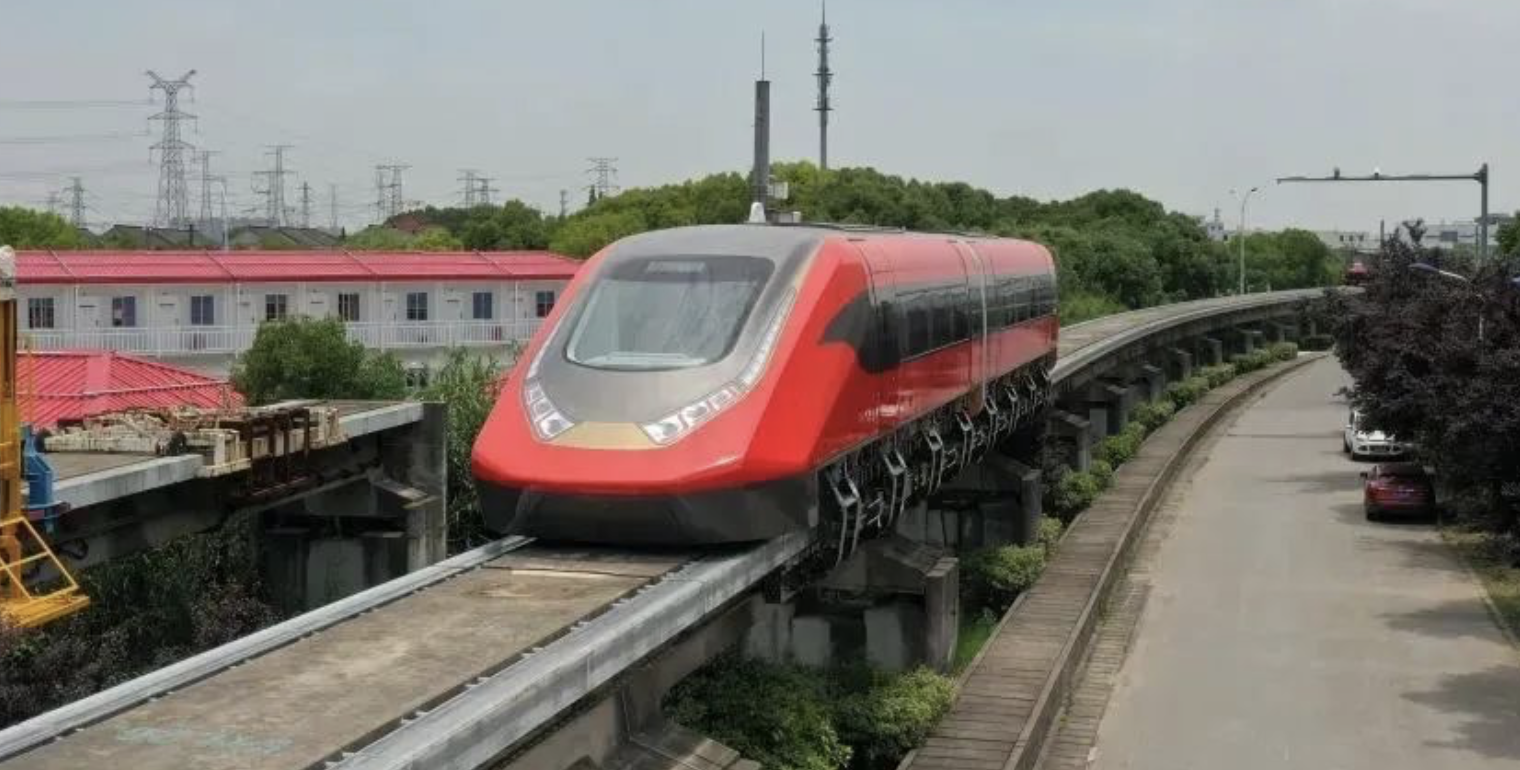
CF200 on the Tongji line. Image: WeChat

An even more interesting development is currently being tested in Shanghai on a test track of almost 2 km, made up of guideway girders left over from the construction of the SMT line (Shanghai Transrapid). It is an urban transport variant of the Transrapid that will run at a top speed of 200 km/h.

The vehicle is made possible by halving the vehicle sections. That means a section is not 25 m long but only 12.5 m, while the properties of the magnetic running gear remain unchanged. Halving the section length allows tighter curve radii, which are unavoidable in urban city traffic.

Like the conventional Transrapid, this vehicle is 3.70 m wide.

Many different maglev technologies for urban transport are currently being developed in China, for example the Beijing S1 Metro or the Changsha Maglev. These vehicles, however, are based on entirely different technologies and platforms.

Adapting Transrapid technology achieves a unification of systems, if China wants to settle on a single maglev standard. This also saves costs: existing experience, components, spare parts and switch and guideway girders can be drawn on.

All the vehicles just mentioned have one thing in common: the Transrapid platform. The Chinese have, however, made smaller adaptations, in particular to the operations control system. While the Transrapid communicates via 38 GHz radio antennas connected to the control center by fiber optic, Chinese vehicles rely on 5G technology. It should be noted that the 38 GHz millimeter waves (mmWave) that have been standard on the Transrapid since 1989 even surpass current 5G systems. It is highly likely that the Chinese have also adopted this already known technology and simply given the mmWave system a more modern name.

Join the team

Help build maglevhub.com

maglevhub.com started in 2026 as the international offshoot of magnetbahn.de and is now growing on its own. We are looking for writers, translators, researchers, video makers and developers from all over the world.