Internal Chancellery List: German Government Wants to Promote Maglevs
A list of planned projects from the German Federal Chancellery, classified “for official use only,” offers a rare glimpse into the federal government’s actual working agenda. The confidential document, seen by Business Insider among others, lists numerous projects to be advanced over the next 90 days, from security laws and social reforms to a surprising item in the transport sector: the promotion of innovative transport systems, explicitly including the maglev.

"Innovative approaches in local transport": maglev named concretely for the first time
According to the list, the Federal Ministry of Transport is planning a so-called “Infrastructure Future Act” to speed up planning and approval procedures in Germany. In parallel, the Municipal Transport Financing Act is to be expanded to also support “innovative approaches” in public local transport, for example the “maglev,” as the internal paper literally puts it.
This means the maglev appears in an official government document for the first time in years, not just in the general coalition agreement but in a concrete implementation plan from the Chancellery.
Between announcement and reality
The idea is not new, however. The 2025 coalition agreement between the CDU/CSU and SPD already agreed to examine and promote innovative transport technologies. But so far it has stayed at empty announcements: no studies, no budget funds, no pilot project.
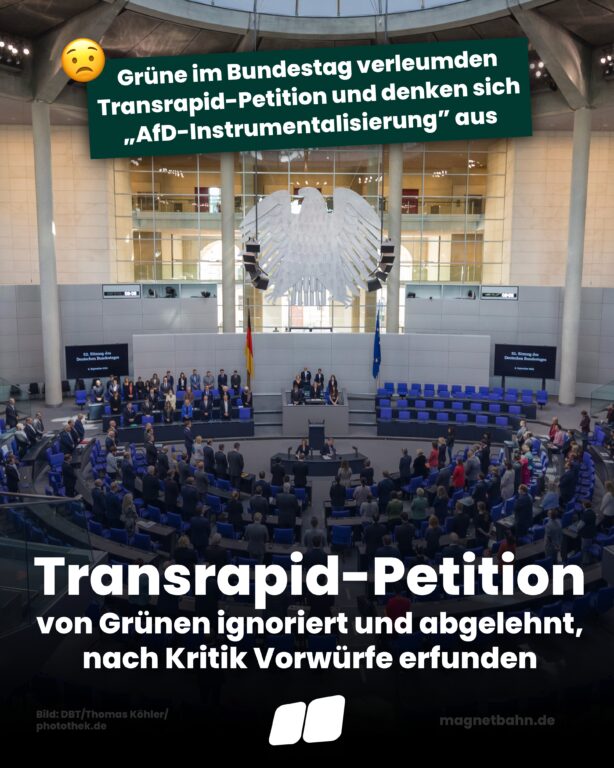
So far the federal government has only made announcements, and no one from the governing parties CDU/CSU or SPD has spoken positively about maglevs in this legislative term. Even the Transrapid petition from magnetbahn.de with 62,000 signatures was either ignored or rejected by all members of parliament from the governing parties. Only Maximilian Kneller, a member of the Bundestag for the AfD, has actively pushed the topic so far. He is regarded as the only member of the Bundestag who consistently represents maglev technology there and advances it substantively through several parliamentary inquiries.
Kneller recently revealed that the federal government is sticking with the dismantling of the Transrapid Test Facility in Lathen despite rising costs of €68 million, and that the work is to be completed by 2034, even though the facility causes no structural problems. Information like this had previously been kept secret.
A real change of course?
That the Chancellery mentions the maglev again is remarkable, but not yet a breakthrough. As long as no concrete projects, pilot lines or budget allocations follow, it remains a formal rediscovery of a long-known idea, or the same empty announcements as before. The future of German maglev technology will be decided on the political agenda of the coming months and years. Its inclusion on the list is a positive sign in any case, even if no real action from the government has followed so far.