200 km/h Transrapid Unveiled in China
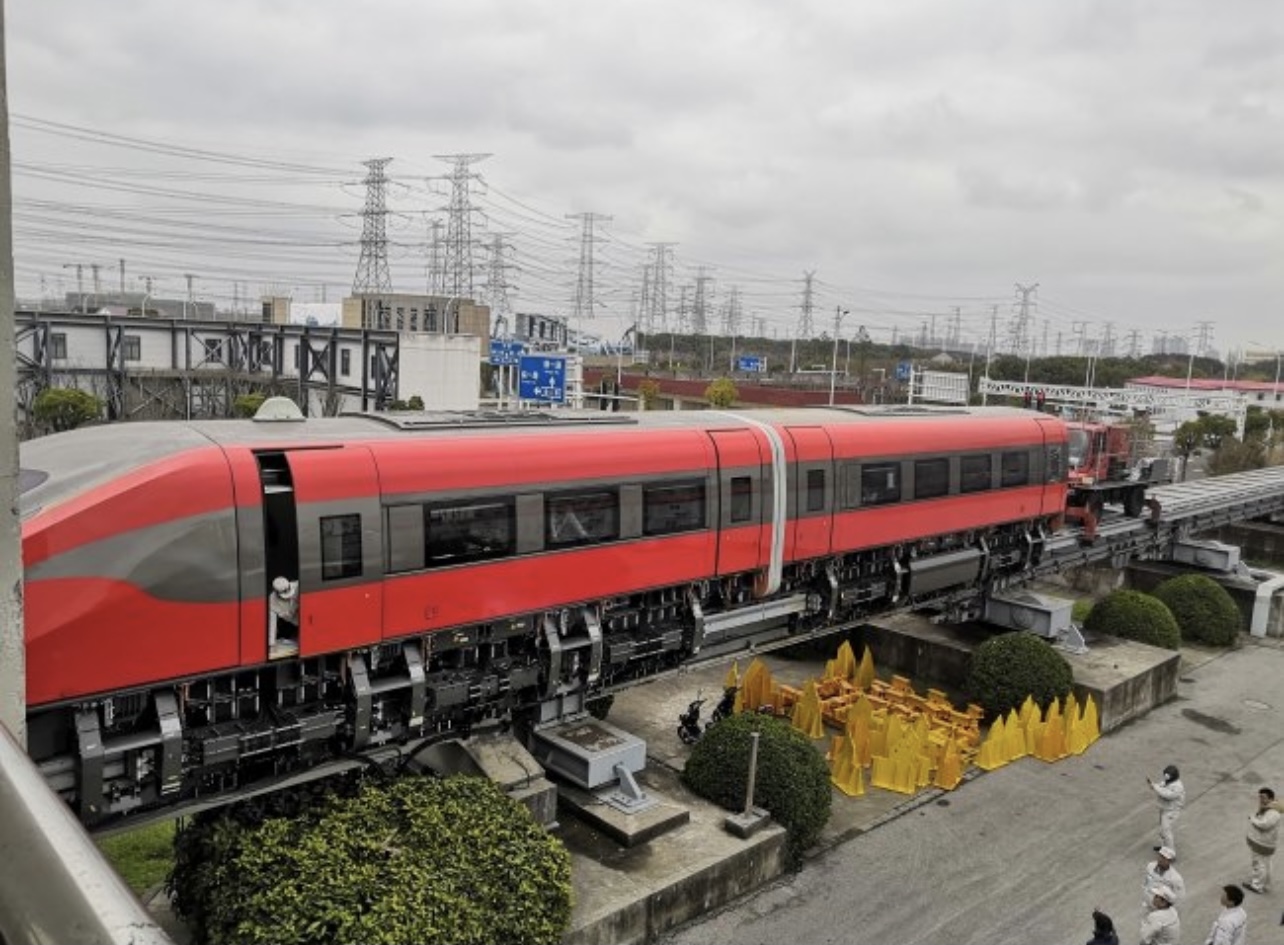
It became known today that a new vehicle has been running on the Tongji test track since March 8, 2021.
It became known today that a new vehicle has been running on the Tongji track since March 8, 2021. It is a vehicle from the manufacturer CRRC Zhuzhou, which was already presented at a Chinese industry conference in 2019.
Transrapid technology scaled down
The picture immediately shows that this is the German Transrapid technology, especially since the vehicle runs on the Tongji track and has an almost visually identical levitation chassis. The Tongji track in Shanghai mentioned above was built around 2005 and is, essentially, a Transrapid line.
200 km/h and tighter curve radii
In fact, more than 30 years ago Thyssen-Henschel took a similar approach. The aim was to create a vehicle that could negotiate tighter curve radii. The compromise at the time was to halve the length of the vehicle sections and switch to a short stator, which technically would have had little to do with the real Transrapid. The vehicle was never produced and never got beyond the study phase.
On the new vehicle on the Tongji track, too, it is clear that the individual vehicle sections are halved in length and that a TFMM (levitation-guidance magnet module) is missing at the transition between the end section and the middle section. As with the Transrapid-N, the goal is to be able to negotiate tighter curve radii.
The intention behind the new research line
Why research a 200 km/h train with tighter curve radii now, when CRRC has already successfully tested a 600 km/h maglev?
To understand this, you have to think in very general terms. In the long term, China plans to lay roughly 1,500 km of guideway for the CRRC 600. The vehicle will reach up to 600 km/h. The downside is that energy consumption rises accordingly and the vehicle will be louder than a 431 km/h Transrapid. (It is perfectly understandable that a 600 km/h vehicle uses more energy than, for example, a 250 km/h ICE.)
It is conceivable that an “eco Transrapid” is also being considered for shorter connections.
In China, the CRRC 600 is mainly meant to relieve air traffic; a vehicle that is only half as fast could then relieve local and regional transport.
This applies particularly because of the tighter curve radii and the comparatively low speed of only 300 km/h, since at 300 km/h the Transrapid is especially quiet and comfortable. However, at the 200 km/h threshold there are still no major energy-efficiency advantages; the reasons for that are a separate topic.
An additional eco variant makes no sense
Because the drive is in the guideway, and the guideway is identical to the Transrapid’s, there is no obvious reason to build a slower Transrapid, as the maximum speed depends on the guideway.
Whether you run the CRRC 600 or even the TR08 at 200 km/h on a line, or develop a separate vehicle for it: in terms of energy consumption, efficiency and noise, there is no difference.
What is conceivable, however, is an intention to build lines whose configurations allow a maximum of 200 km/h. That would probably save money on substations, transformers and switching stations. But this too is extremely unrealistic; in China the tendency is rather to aim for 600 km/h.