The End of the Hyperloop Bubble: Almost a Billion Euros Wiped Out
Anyone who has followed the news in recent months could hardly have missed it: Hardt Hyperloop (Netherlands) and Zeleros (Spain), two of the loudest representatives of an entire technology movement, went insolvent within a few weeks of each other. Together with Virgin Hyperloop One (shut down at the end of 2023) and HyperloopTT (effectively insolvent since 2024), the world’s four most prominent hyperloop companies are now history. The balance sheet is clear: over a billion US dollars of public and private funds burned, and not a single kilometer of commercial passenger service.
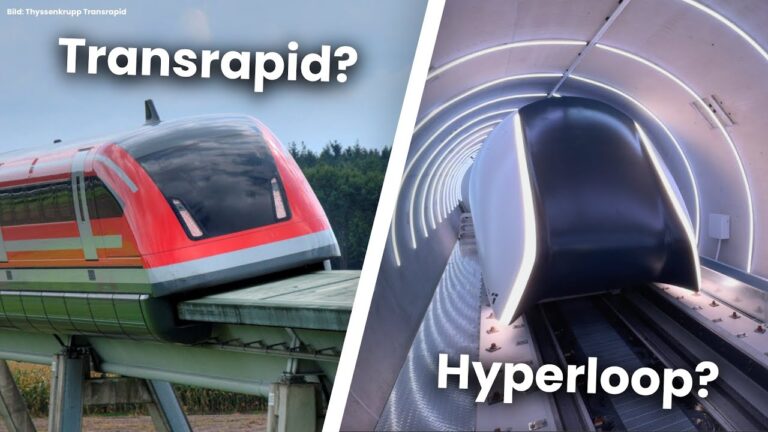
I saw this coming in an article back in 2021, and I am not saying that to brag. I am saying it because it is politically important. Because while the industry collapses, what has always been the real problem carries on merrily in Germany: taxpayers’ money flows into a technology for which there is still no safe emergency exit, while the Transrapid, ready for service since 1991, merely rots away due to political incompetence.
The reason politicians stick with the project despite the global failure and meager test results is a well-functioning symbiosis of interests from which almost everyone outside the railway benefits: while professors generate prestigious research projects and third-party funding, students work on a media-hyped future project and can tinker freely. Participating companies secure state-subsidized contracts without immediate economic pressure to succeed, and politicians use the project for publicity-friendly pictures to present themselves as “technology-open innovators.” A win-win situation for everyone involved, in which in the end only the taxpayer and transport reality are left by the wayside.
Hardt Hyperloop: €50 Million for 85 km/h
The Dutch company, which emerged in 2017 from a TU Delft student team, was long seen as a showcase of EU technology policy. With public funding from the national government, the province and the EU, Hardt built the so-called European Hyperloop Center in Veendam (Groningen): a 420-meter vacuum tube, opened in September 2023 in the presence of politicians and a cheering press.
What those 420 meters cost is documented: €15 million alone from the European Innovation Council (EIC, October 2021), a further round of €12 million (2023, partly EU co-financed), plus €7.5 million from the Dutch state and province, €3 million from the EU structural fund REP-SNN, and private capital from POSCO International and other investors. Total according to Rolling Stock World: over €50 million.
The result: the fastest manned test reached 85 km/h in September 2025, against a promised 700+ km/h.
On March 4, 2026, the court in The Hague declared Hardt insolvent. The immediate trigger was the rejection of a second EIC funding tranche of around €13 million. Trustee Sjoerd Warringa put it in a nutshell: “The direct cause of the bankruptcy lies broadly in the failure to be awarded the second part of a so-called ‘open commitment’ totalling approximately 13 million euros from the European Innovation Council.” Without subsidies, no business model: that is the soberest summary of the entire sector.
Zeleros: Spain’s Hyperloop Dreams Sold for €958,000 to Military Drones
The Valencia-based start-up Zeleros (founded 2016, also from a university team) had the same structural problem despite a technically more thought-out approach (onboard propulsion, higher tunnel pressures): no revenue, only grants. Over €15 million flowed into the company, including a €7 million round led by Altran (2020), funds from EIT InnoEnergy and from the Spanish entrepreneur Juan Roig. Partners were Renfe, Airbus, Acciona, ArcelorMittal and other industrial groups.
At the end of March 2026, Zeleros voluntarily filed for insolvency; of the former 80 employees (2023), 26 were left. The core technology was taken over by the Spanish Amper group for around €958,000, not for passenger transport but for launch systems of military drones and energy storage. The failure of a civilian mobility revolution could hardly be illustrated more symbolically.
The Global Graveyard
Virgin Hyperloop One had raised over US$450 million. Its only manned test on November 8, 2020, reached 172 km/h, or 14 percent of the promised 1,220 km/h. At the end of 2023 the company was shut down; its intellectual property went to DP World for use in port logistics.
HyperloopTT had, by its own account, raised around US$50 million in capital and a further US$77 million in unpaid working hours. In January 2024, CEO Andrés de León admitted in a shareholder letter that employees had gone months without salaries. The test track in Toulouse was dismantled in 2022. Today the company survives on a single ongoing contract: a €1.6 million feasibility study.
Overall balance: Almost a billion US dollars of public and private funds. Zero commercial passenger kilometers. The fastest manned test worldwide so far: 172 km/h, WITHOUT A VACUUM!
What I Wrote in 2021, and Why It Matters
On July 14, 2021, I published the article “Why the Hyperloop Is Unrealistic” on this site. Three arguments from it that I will briefly repeat, because today they are demonstrably the causes of the failure:
Vacuum safety and emergency exits. In the event of an accident in a vacuum tunnel, there is no safe exit without compromising the system. The EU has meanwhile recognized this unresolved question as a problem itself: it separately funds a call worth several million euros for “safety and certification” alone. Five years after my article.
Cascade risk. Capsules carrying 10 to 50 passengers have to follow one another at intervals of seconds to reach the capacity of a Transrapid or ICE. An emergency braking maneuver at 1,200 km/h with capsules at minimal spacing cannot be mastered in terms of physics or control technology.
System complexity. A 600 km line means at least 7 billion liters of air that have to be pumped out permanently. Any crack in the tube leads to an implosion. This infrastructure effort makes the hyperloop structurally more expensive than any proven alternative.
My conclusion back then: “The Transrapid would be the better choice, considering the hyperloop’s safety concerns.” That applies more than ever today, and is empirically confirmed by the failure of the entire industry.
TUM Hyperloop / NeoWays: Söder’s Selfie Project for €3.5 Million
While insolvencies follow internationally, the Bavarian hyperloop program continues in Munich. The Technical University of Munich (TUM) has run a hyperloop research program since 2020, which emerged from the student group that won the SpaceX Hyperloop Pod Competition four times. That is the only honest part of the whole story: students with real engineering spirit achieved something impressive. What came afterward is another chapter.
What the taxpayer paid for it: The Free State of Bavaria has funded the program since 2020 through the Hightech Agenda Bayern. Premier Markus Söder himself at the groundbreaking in September 2022: “We are now building a 24-meter test tube for €3.5 million.” The total pot of the Hightech Agenda for aerospace, including TUM Hyperloop, is €90 million according to the Bavarian Ministry of Science; how much of it went directly into the hyperloop program remains opaque.
What came out of it: A 24-meter concrete tube in Ottobrunn/Taufkirchen, opened in July 2023 with Söder and Science Minister Blume in front of the cameras, certified by TÜV Süd for passenger operation. The first “passenger ride under vacuum conditions,” on a stretch shorter than the length of one ICE car. Next planned step: a one-kilometer test track, in order to then build a “reference line” on which passengers are to travel at over 800 km/h.
NeoWays Technologies GmbH was founded in 2024 as a spin-off from the TUM program, led by Gabriele Semino, who has worked in the TUM team since 2017. Positioning: “European deep-tech start-up at the forefront of hyperloop development.” In March 2025, NeoWays signed an MoU with India’s IIT Madras and TuTr Hyperloop. Concrete funding rounds: none publicly known. Revenue: zero. Product: a roadmap and an iF Design Award for the capsule styling.
Emden/Leer University of Applied Sciences: Diligent, Well Connected, and Still Took a Wrong Turn
Emden/Leer University of Applied Sciences has done hyperloop research since 2016. In 2025 the “goTube” was installed on the Emden campus: a 27-meter test tube, according to Prof. Dr. Walter Neu the longest hyperloop test track in Germany. Research focuses: vacuum technology, operations control technology, structural monitoring, communications technology. That is technically more sober than the glossy promises from Munich and The Hague.
Nevertheless, Emden/Leer is deep in a network that is just collapsing.
HyperBRIDGE project (start October 2025, running until 2029): Interreg VI A Germany-Netherlands, total volume €4.8 million, of which around €2.2 million EU funds and just under €450,000 Lower Saxony state funds. Coordinated by the European Hyperloop Center in Veendam, which is exactly the operator whose main partner Hardt Hyperloop has just gone insolvent.
Hyper4Rail project (start December 2024): Horizon Europe, EU funding of around €2.3 million, 27 organizations from 13 countries. Emden/Leer is one of the participating institutes.
Seed funding from Lower Saxony’s science ministry (MWK) (2019): €290,000 for a coordination office and building a research network.
The central contradiction: the HyperBRIDGE project is coordinated by the European Hyperloop Center, which now stands without its most important anchor tenant. Interreg funding runs until 2029; after that there is no follow-up funding if the EHC does not remain functional as test infrastructure.
The Pattern: Student Enthusiasm → Photo Op → Grant Application → Next Grant Application
TUM and Emden/Leer are not fraud. They are a symptom. The pattern is always the same: student enthusiasm, political photo op, institutional funding, growing project bureaucracy, no commercial revenue, next grant application.
Nobody in this chain personally bears the financial risk. The premier gets his pictures. The professor gets his third-party-funded position. The student gets his thesis. The taxpayer gets a 24-meter concrete tube in Ottobrunn and €4.8 million for an Interreg cooperation with an insolvent coordinator.
In German research funding, there is no mechanism that forces academic projects to apply the yardstick of commercial reality. A university does not have to explain why it researches vacuum tube technology while the world’s four largest commercial hyperloop companies have just gone insolvent.
Germany Is Planning a National Hyperloop Reference Line Anyway
What really annoys me: in the 2025 coalition agreement between CDU/CSU and SPD, the federal government commits to building a national hyperloop reference line, at exactly the moment when the technology’s European showcase companies are filing for insolvency one after another.
At the same time, the same coalition agreement contains no mention of the Transrapid, a technology that has been approved in Germany since 1991, has run in daily scheduled service in Shanghai since 2004 and has reliably covered over 28 million kilometers. The Test Facility Emsland, which Emden/Leer had expressly examined as a possible reactivation site, is to be dismantled by 2034.
That is not transport policy. That is technology policy by press office.
Conclusion
The hyperloop is not failing for lack of pioneering spirit among its founders. It is failing on physical and business fundamentals that have been known for years: an infrastructure that has to be one hundred percent fail-safe in order not to be deadly; a capacity problem that prevents mass operation; and a business model that does not survive without subsidies. I wrote that in 2021. The industry proved it between 2023 and 2026.
Anyone who puts public money into a technology for which there is not even a safe emergency exit bears responsibility for the result. That responsibility should now, after the collapse of Virgin, Hardt, Zeleros and HyperloopTT, be addressed politically. Instead of planning a national hyperloop reference line, the federal government should explain what was achieved with the money already burned.
The Transrapid is ready. It runs. It carries passengers. We have been talking for decades.
Further reading on magnetbahn.de: Why the Hyperloop Is Unrealistic (2021) · Transrapid vs. Hyperloop: the differences · Hyperloop remains a pipe dream
Sources: Bavarian State Ministry of Science and Arts, TUM press releases, NWZonline.de (10/22/2025, 1/21/2026, 1/23/2026), European Hyperloop Center (hyperloopcenter.eu), Emden/Leer University of Applied Sciences, NL Times (3/4/2026), Railway Gazette (4/10/2026), Bloomberg, Fortune, Rolling Stock World