Federal Government Refuses to Re-Examine the Transrapid
The Transrapid is considered a failure in Germany not because it would not have withstood a renewed review, but because such a review is explicitly being refused. That is shown by the most recent handling of my petition, with nearly 62,000 supporters, by the Petitions Committee of the German Bundestag (federal parliament). What is decisive is a statement by the German Federal Ministry of Transport before the committee, on the basis of which any new investigation is waived.
Neither a study nor a comparative assessment of using the maglev system in German long-distance travel is planned, so the debate is formally ended before it could even be reopened. maglevhub.com, however, objects and demands that the Transrapid at least be given a chance.

Yet the petition demands nothing unusual. Anyone who calls for the deployment of a transport system rightly expects politicians and administrators to examine whether and where that deployment makes sense. This is exactly where the conflict lies. The Transrapid is not rejected because it was examined and failed. It is rejected because a renewed examination is explicitly refused.
In substance, the ministry’s reasoning is contradictory. It concedes that there are no reliable empirical values for the service life of the Transrapid guideway and that blanket cost comparisons are not possible. At the same time, precisely this lack of data serves as the justification for allowing no new investigations. Uncertainty thus becomes not a reason for research but a pretext for inaction: after all, a study of the kind I am demanding as petitioner is meant to find out exactly that.
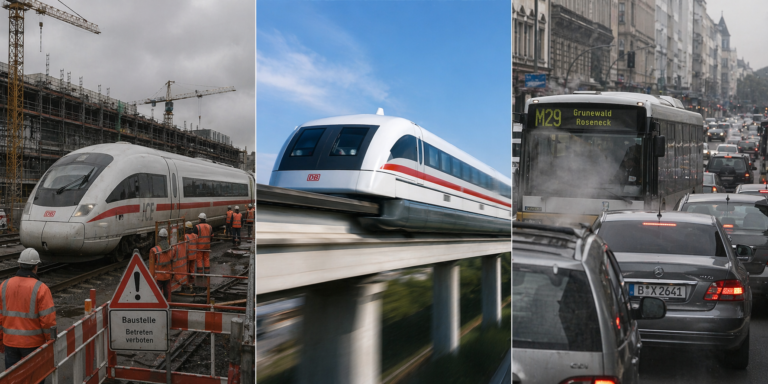
The need for factual clarification would be obvious. The German rail network is overloaded, new construction projects drag on for decades, and on routes like Hamburg-Munich, domestic air traffic remains high. A comparative study of conventional new ICE lines and a new Transrapid line on heavily used corridors could have provided answers. It was not even considered.
Long-familiar arguments are also repeated without being checked. The Transrapid is portrayed as a single-manufacturer technology, even though thousands of supplier companies were involved in its development and production. Economic disadvantages are asserted without backing them with current project figures. What appears to be a factual argument turns out, on closer inspection, to be a politically convenient simplification.
Finally, the handling of public interest is remarkable. Nearly 62,000 signatories are not to be neglected. They document a clear need for alternatives in long-distance travel and for technological openness. That this signal remains practically without consequence in the parliamentary process raises questions about the true value placed on citizen participation.
In the end, the Transrapid is not a failed system. It is a system that may no longer be examined in Germany. Not because the results argue against it, but because people shy away from establishing them in the first place.
The Transrapid has thus not failed because it was examined, but because it is not allowed to be.