Deutsche Bahn Burns Billions – But the Transrapid Is Supposedly Uneconomical?
It is right and important that the state provides and finances infrastructure for citizens and business. Without public investment in roads, rails or power grids, a modern society could not function. Yet while high costs are taken for granted in conventional rail and road construction, many still consider the Transrapid supposedly “uneconomical.” That is not just a prejudice but simply factually wrong.
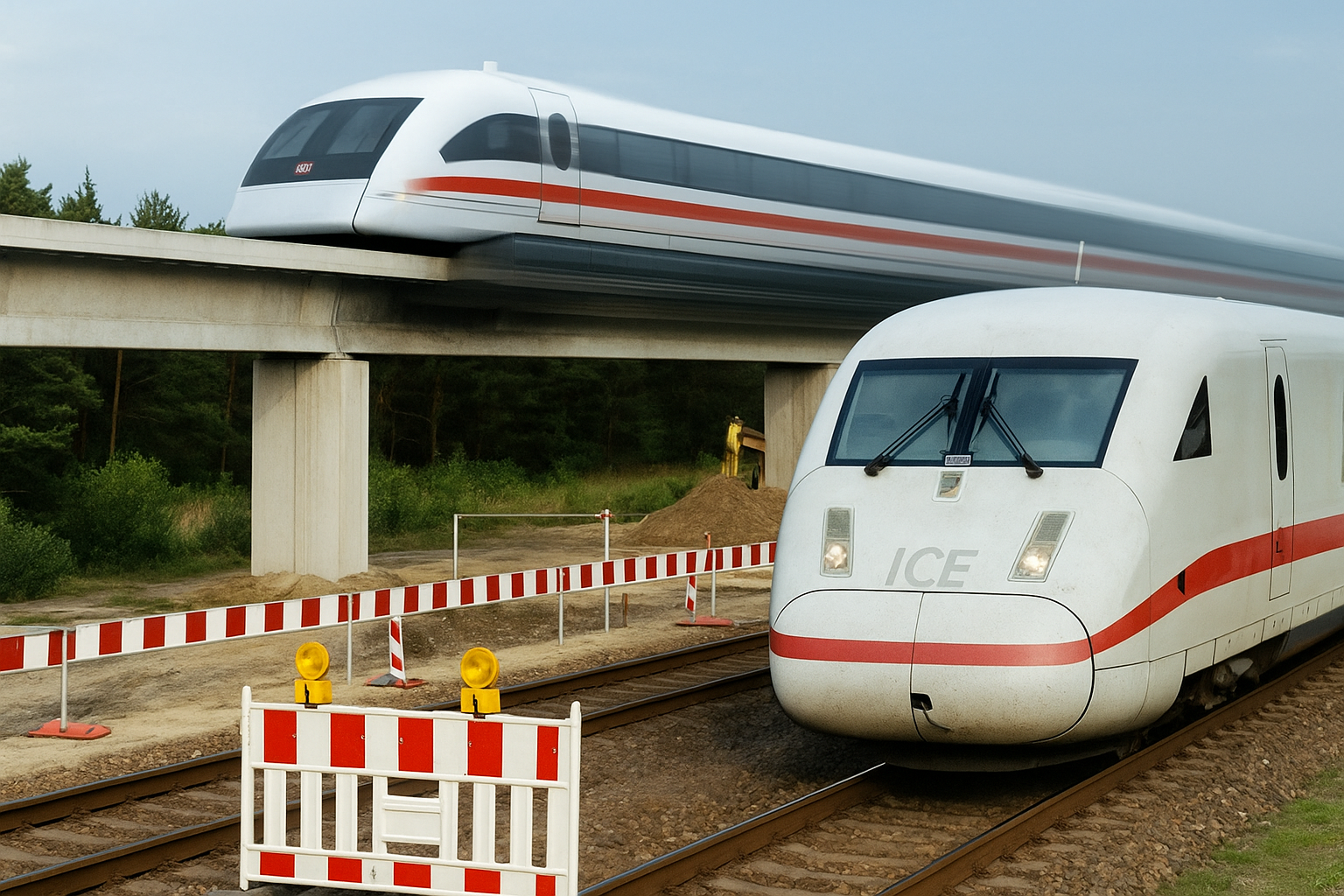
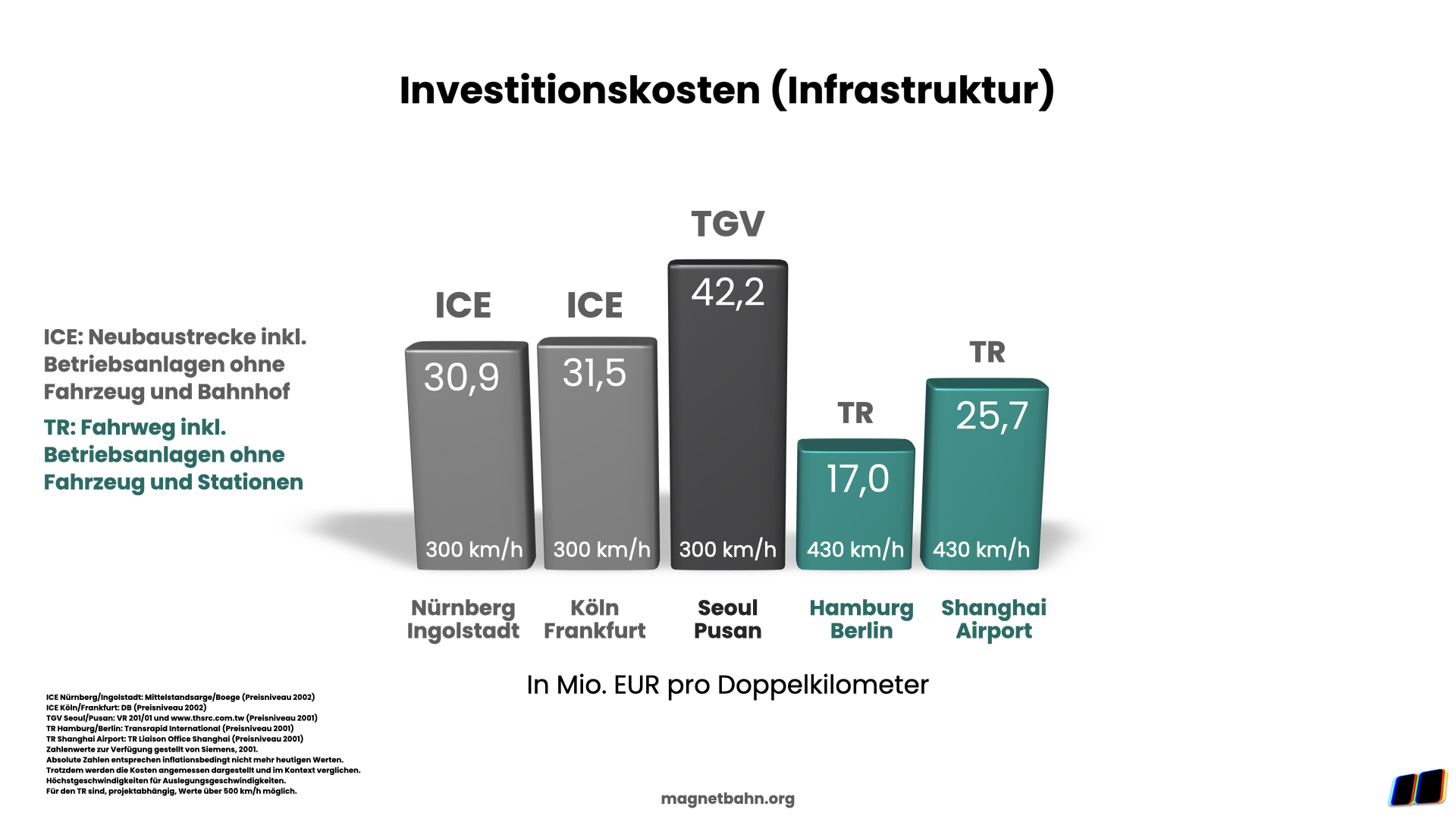
In the long run, the Transrapid is significantly cheaper than classic wheel-on-rail technology – with comparable investment costs. It requires around 70 percent less maintenance, the guideway’s service life is about four times that of conventional ICE tracks, energy demand is lower even at higher speeds, and staffing costs also fall considerably, since the Transrapid can be operated fully automatically. And all this despite a top speed of 500 km/h. Nevertheless, its cost-effectiveness continues to be questioned out of political inertia or ideological rejection – while billions flow into an overloaded rail system that has been structurally overstretched for years.
In 2024, Deutsche Bahn received around €22 billion in direct and indirect state subsidies. Even so, the group posted an annual loss of €1.8 billion. DB cited, among other things, the poor condition of its own infrastructure. That is the expression of a system that has been pushing against its limits for decades. Short track lifespans, heavy material wear, high energy demand at high speeds and massive punctuality problems make conventional rail a lasting economic and operational problem. The share of punctual long-distance trains most recently stood at only 65 percent. The network is crowded, overloaded and in many places simply no longer future-proof.
Yet an economical and high-performing alternative has long been available. With the €22 billion that went to Deutsche Bahn in 2024 alone, around 550 kilometers of Transrapid line could be built at today’s cost estimates. A national Transrapid network would be not only faster and more reliable but also considerably more cost-efficient to operate. The comparison becomes even more drastic in the medium term: Deutsche Bahn itself puts its investment needs over the coming ten years at around €290 billion. For less than half of that amount, a Transrapid network of around 2,800 kilometers could be built connecting all of Germany’s major cities – independent of today’s rail network, with true high speeds of up to 500 km/h, extremely short travel times, maximum punctuality and minimal wear.
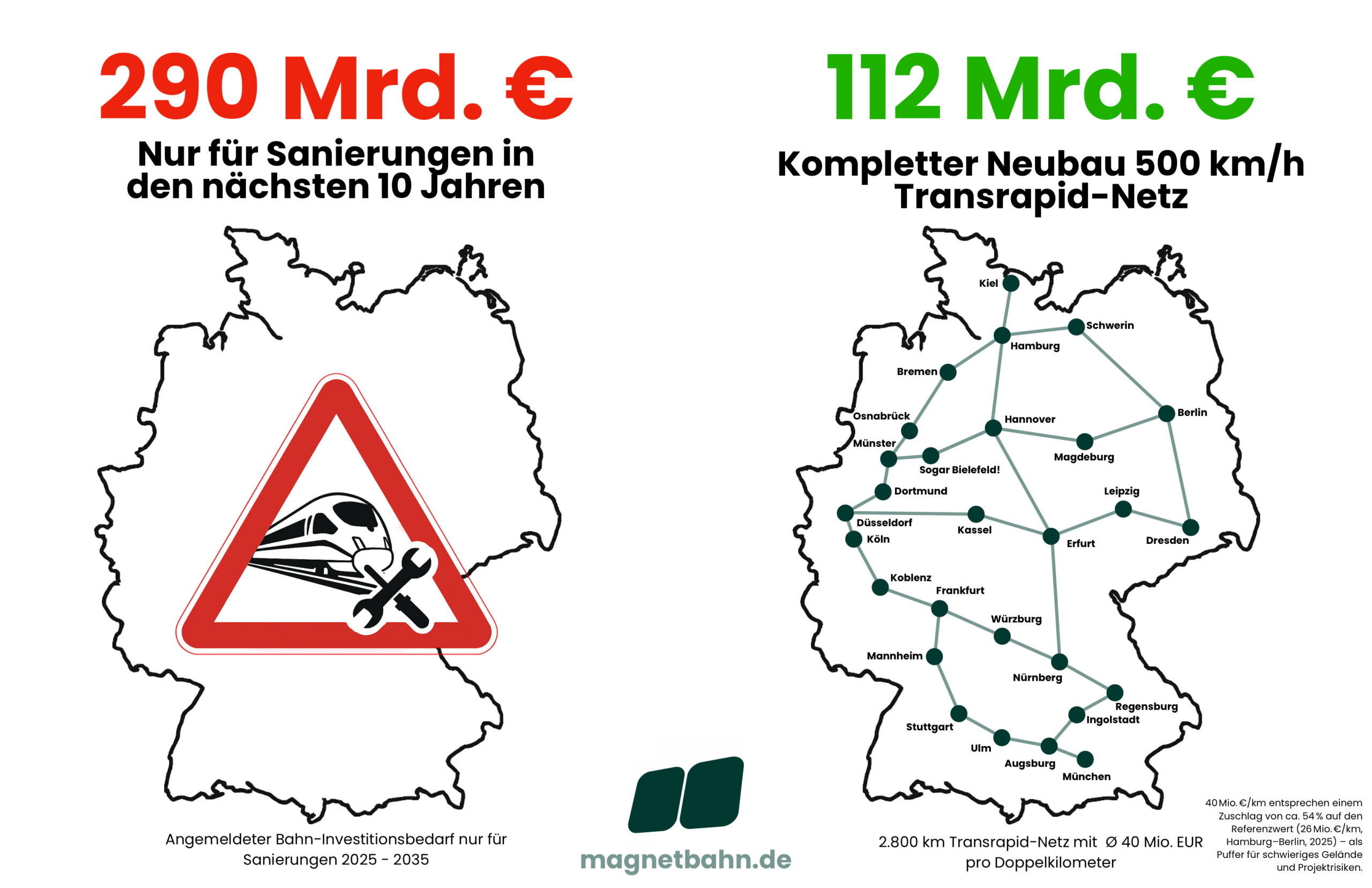
Of course the existing rail system must be rehabilitated. Crumbling bridges, outdated signal boxes and constant disruptions make a fundamental renewal unavoidable. But a purely rehabilitating strategy brings no new capacity, no redundancy and no technological leap. Anyone who really wants to relieve the railways – and with them millions of daily passengers – must put a true high-speed alternative alongside them. The Transrapid can take on exactly this role.
The system can also be built without large land consumption along existing transport corridors. Earlier projects such as the planned Metrorapid (2002) envisioned running 95 percent of the routes along existing motorways or rail lines. This minimizes the environmental burden as well as intrusion into existing settlement structures.
Anyone who, under these conditions, continues to claim that the Transrapid is “too expensive” ignores reality. Germany already spends double-digit billions every year on a system that can hardly be operated economically in its current state – and which even further billions will not fundamentally modernize. Instead of continuing to invest into a dead end, we need the courage to supplement and to develop technologically.
It is high time for an independent, high-performance Transrapid infrastructure. Not as a replacement for the railways, but as their long-overdue relief. The arguments are clear – all that is missing is political will.
In 2024, Deutsche Bahn received the following subsidies:
1. Investment grants to the DB Group: approximately €12.6 billion
According to Deutsche Bahn’s 2024 integrated report, the investment grants go predominantly to infrastructure. These grants come from the federal budget (LuFV, BSWAG, etc.) as well as from the states and EU programs. The increase in income-effective maintenance grants was also expanded for 2024 .
The journal Wirtschaftsdienst also states that DB InfraGO alone received around €12 billion in grants in 2024 .
2. LuFV III (performance and financing agreement) for replacement & maintenance: approx. €7.48 billion
According to Wikipedia (entry on LuFV III), a supplement for 2024 raised the federal infrastructure contribution to €4,736 million and the maintenance contribution to €2,060 million, plus a minimum own contribution of €125 million, giving a total volume of about €7,477.5 million .
3. EU state aid for DB Cargo: €1.9 billion
On November 29, 2024, the European Commission officially approved €1.9 billion in state aid for DB Cargo as part of a restructuring plan to secure long-term competitiveness – as one-time support for the years 2022–2024.