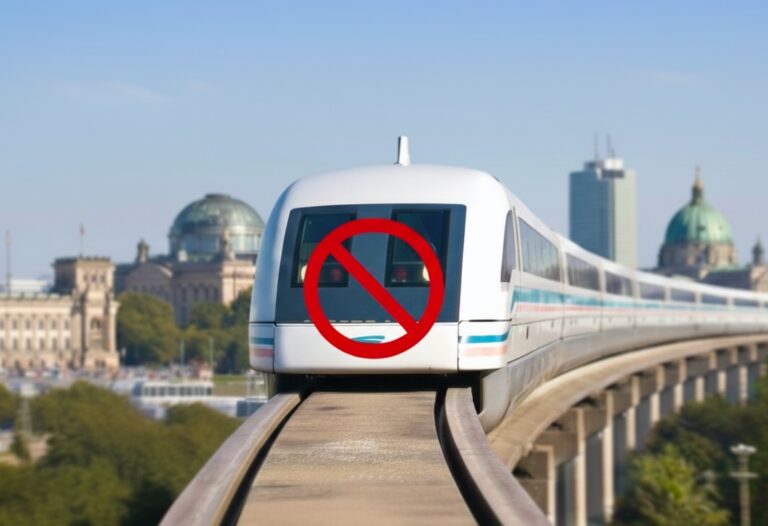
The Truth About the Transrapid in Shanghai
The Transrapid in Shanghai is a technical marvel of German engineering. Over just 30 km of track it accelerates to a record of up to 501 km/h, uses 40% less energy per seat than an ICE (Deutsche Bahn’s high-speed train) at 350 km/h, and was built at 85% lower construction costs per kilometer than, for example, metro Line 19 in Shanghai. The numbers speak for themselves – and yet public perception in Germany is the opposite.
Several German media outlets have managed to ruin the Transrapid’s reputation. Instead of technical facts, the coverage is about alleged unprofitability, low ridership and a Chinese turn away from the technology. On closer inspection, these claims turn out to be misinformation or portrayals taken out of context.
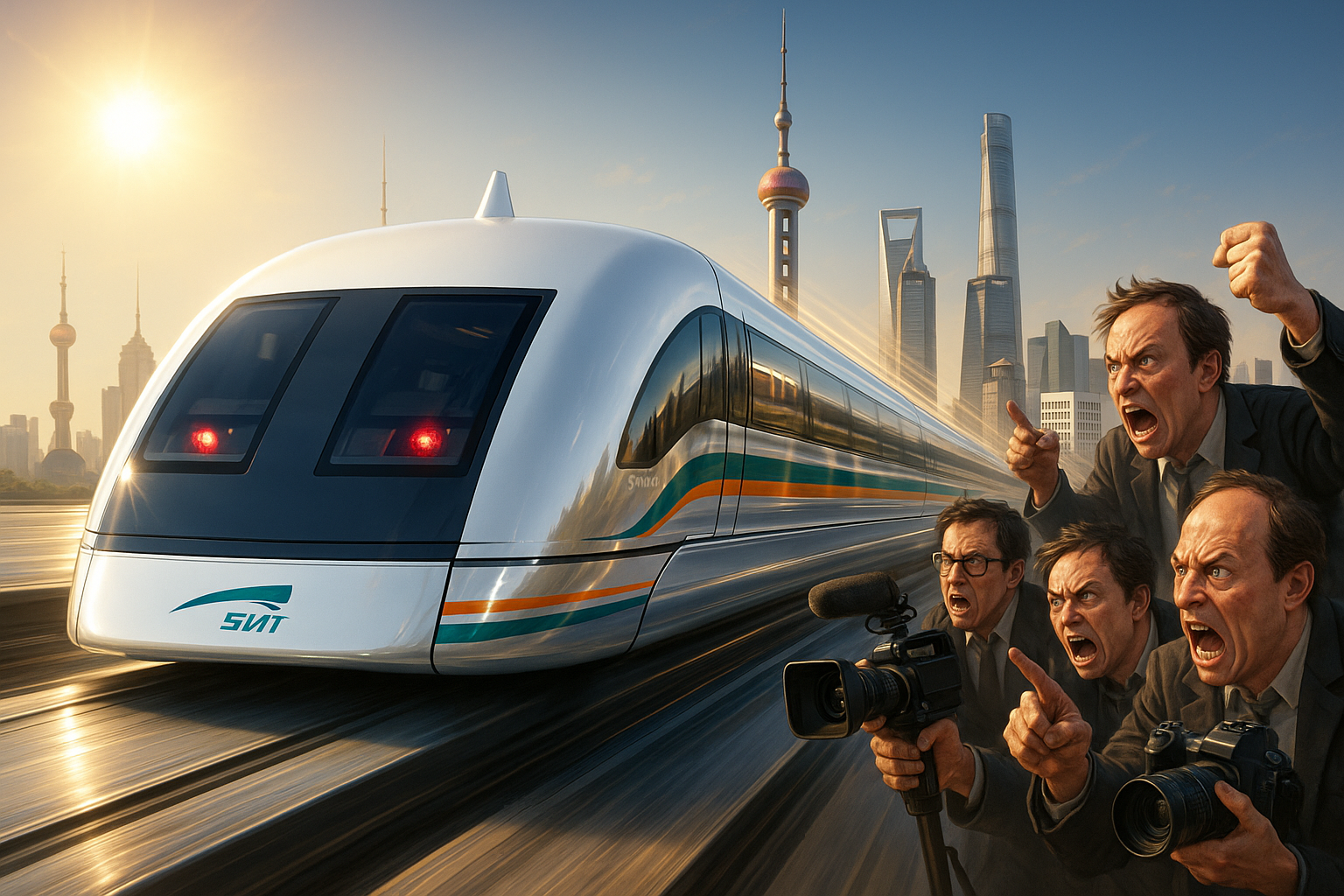
For example, Handelsblatt reported in November 2024 that the “prestige project faces the end” and the line is “drifting toward its end”. Similarly, WELT, which in October 2024 called the Transrapid a “smiled-at museum piece” and complained that the Transrapid delivers no added value in Shanghai and is too expensive. Or Tagesschau (Germany’s main public-television news program), which in October 2023 claimed that maglev trains have not caught on in China and that the Transrapid has made serious losses. Here, an end is put to this misinformation.
Costs: cheaper to build than a metro
A common accusation is that the Transrapid in Shanghai is uneconomical. But this criticism is not only too narrow – it is also wildly selective. Because what is conveniently left out: the Shanghai metro is not economically viable either. Like almost all urban transit systems worldwide, it posts massive losses every year and is heavily subsidized by the state.
The Transrapid is different: it is run by a separate company with a different financing structure – with lower subsidies. That the Transrapid in particular is singled out for its profitability, while the metro faces zero criticism despite large deficits, makes no factual sense.
On top of that, the Transrapid line cost about US$43.6 million per kilometer – including guideway, stations, 3 vehicles and operating technology. Metro Line 19 came to US$323.5 million per km, more than seven times as much – at a fraction of the speed. Other lines show similar figures: Line 14 cost US$231 million per km.
In the long run, too, the Transrapid is considerably cheaper to operate: no mechanical contact between guideway and vehicle means extremely low wear: 70% lower maintenance costs than an ICE – despite twice the top speed. The guideways are designed for a service life of 80 to 100 years – far more than with classic rail systems. Doing without wheels, axles, brakes or overhead lines dramatically reduces maintenance effort, energy demand (40% lower per seat at 350 km/h than the ICE) and costs.
That the higher quality is also noticeable in comfort is evident every day: a trip takes only 7 minutes instead of 45 minutes by metro.
Good ridership
Many media outlets claim the Transrapid is barely used. On site, however, a different picture emerges. The SMT line was a demonstration line from the start and never aimed to operate economically in the classic sense. It connects Pudong Airport with the suburb of Longyang – the city center can only be reached by metro. So anyone who has to take the metro anyway often rides it all the way instead of first taking the Transrapid only to change trains regardless. That is a question of routing, not of technology.
Even so, ridership is solid. Our own observations and conversations with staff on site show that the trains are well filled during the day. In September 2023 the timetable was even adjusted – with shorter intervals due to increased demand. The fact that the line has worked reliably in daily operation for 20 years, with over 28 million kilometers traveled, is left out of many German reports. The following video from October 2024 is a reality check on how big the passenger volume really is.

Critics often claim that the Transrapid’s reduced top speed of 301 km/h is a sign of technical shortcomings or an attempt to cut operating costs. In truth, this decision has a very different background: Since the line went into operation in 2004, Shanghai’s population has more than doubled, putting massive strain on the infrastructure – especially the power grid. In recent years there have been repeated power shortages, such as in summer 2022, when even the skyline lighting was switched off, or in August 2024, when the city hit a consumption record of over 40 gigawatts (as much as the Philippines). The speed limit is thus a deliberate contribution to grid stabilization – not an expression of technical weakness. The effect on travel time is minimal: at 301 km/h the trip takes only about 20 seconds longer – just 4% more than otherwise. And: full speed of 430 km/h was still run later on a test or temporary basis. That these connections go unmentioned in German media reports shows how distorted the coverage of the Transrapid is.
Given up? No!
Another widespread misunderstanding is that China has turned away from the Transrapid. The opposite is true. Maglev technology has been developed further for years. The state-owned rail technology group CRRC presented a prototype of a new maglev generation as early as 2019. In 2021 a working 5-car vehicle for 600 km/h followed, called the CRRC CF600.
The further development is accompanied scientifically by Tongji University in Shanghai, which has been researching Transrapid technology since 2005. The university operates a 1.5 km test track made of original guideway components. Since 2013 there has been a joint research lab there with ThyssenKrupp, in which Chinese and German specialists research the next generation together. TU Stuttgart is also a partner and regularly publishes studies in cooperation with CRRC Sifang.
These projects are not concepts on paper – they are long since in practical testing. Anyone who claims today that the Chinese maglev plans are unrealistic, untested or nonexistent is knowingly standing against reality.
Major expansion planned
Critics like to complain that the Transrapid line in Shanghai was never extended. What is left out is that the Chinese strategy deliberately focused on localization and further development of the technology. The aim was not just to import, but to understand, adapt and build it themselves.
That goal has now been achieved. With the CRRC CF600, a modern, near-series vehicle is ready that has been optimized (on the Transrapid platform) for up to 600 km/h. Plans for line extensions have existed in many variations for years – and they are now close to implementation, as soon as the vehicle has finished development and politics releases corresponding projects. New Transrapid lines could soon emerge within China – based on German technology, made in China.
Not a failed project - an underrated pioneer
The story of the Transrapid in Shanghai is not a story of failure – but a story of ignorance of the facts. While China keeps investing, researching and running, Germany – despite its technical leadership – has largely said goodbye.
It is high time to correct the narrative. The Transrapid in Shanghai shows: the technology works. It is economically competitive, more efficient than wheel-on-rail systems and is being developed further internationally – with German participation as well. The technology finally deserves recognition rather than defamation – as three decades ago, so sadly today.