Hyperloop: Hamburg and Federal Government Plan Reference Line for Vacuum-Tunnel Maglev
The new German federal government and the newly elected state government of Hamburg have committed in their coalition agreements to supporting a Hyperloop reference line. The coalition agreement of Hamburg’s new government states specifically: “Hamburg is interested in Hyperloop technology and, together with its partners, will propose to the federal government to build a first technical reference line that is to enable system integration of all components.”
The coalition agreement of the federal government (CDU, CSU, SPD) also explicitly mentions the Hyperloop: “We are launching an offensive for aviation and space and successfully bringing together top-level research and commercialization. We will build a national Hyperloop reference line.”
The Hyperloop, a high-speed maglev system meant to run in a vacuum tunnel, is regarded as a visionary mobility solution: emission-free, quiet and potentially traveling at over 500 km/h. The idea fascinates politicians and the public alike. In practice, however, the concept is still in its infancy: worldwide there are only a few short test tracks, and regular operation has not been realized anywhere so far. Technical, economic and legal hurdles remain high. In Germany it is unclear who could take on building and operating such a facility. The Technical University of Munich (TUM), however, has already developed a prototype with its Hyperloop project that enables the first passenger transport under vacuum conditions, progress that makes it a potential candidate for a reference line. Other university projects exist as well, but are at an earlier stage of development.
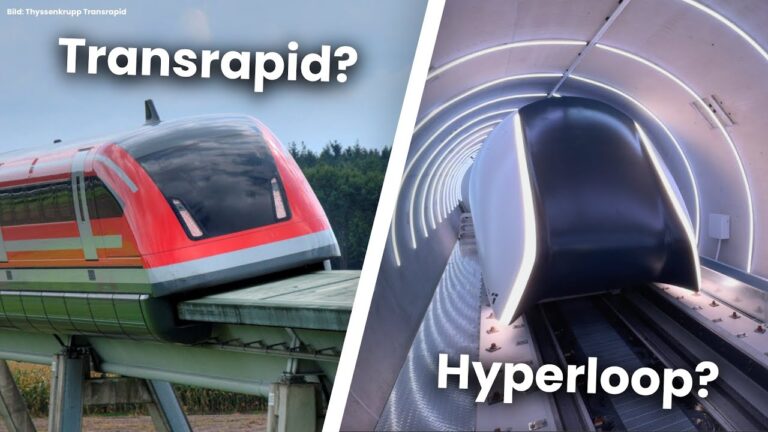
Meanwhile, a functioning alternative remains largely overlooked: the Transrapid. The German maglev was already developed to operational readiness in the 1990s, has been in successful commercial operation in Shanghai for two decades and has covered roughly 30 million kilometers worldwide. At 350 km/h, the Transrapid uses about 40% less energy per seat than an ICE (Germany’s high-speed train), is 70% cheaper to maintain, and reaches its 500 km/h top speed faster than an ICE needs to reach 300 km/h. Nevertheless, the system is not mentioned at all in the current political debate. The political focus on the Hyperloop ignores the fact that, with the Transrapid, there is already a German high-speed system that is ready for use and could be developed further.
Developments in the Hyperloop field remain exciting, but at present there is still too little publicly available information on exactly where the line is to run and who will be responsible for building and operating it. While political support for the project continues to grow, it is unclear whether the Hyperloop can ever live up to the high expectations. At the same time, the proven Transrapid system, which can already demonstrate technical maturity and operating experience, is largely ignored in the current debate, even though it could be developed further as a possible alternative.