The Transrapid Would Vastly Improve Long-Distance Travel
Today more than ever, the Transrapid has the potential to substantially improve long-distance travel. Imagine Germany had a Transrapid network: what would it deliver? How would passengers benefit? Let's find out.
Today more than ever, the Transrapid has the potential to substantially improve long-distance travel. Imagine Germany had a Transrapid network: what would it deliver? How would passengers benefit? Let’s find out.
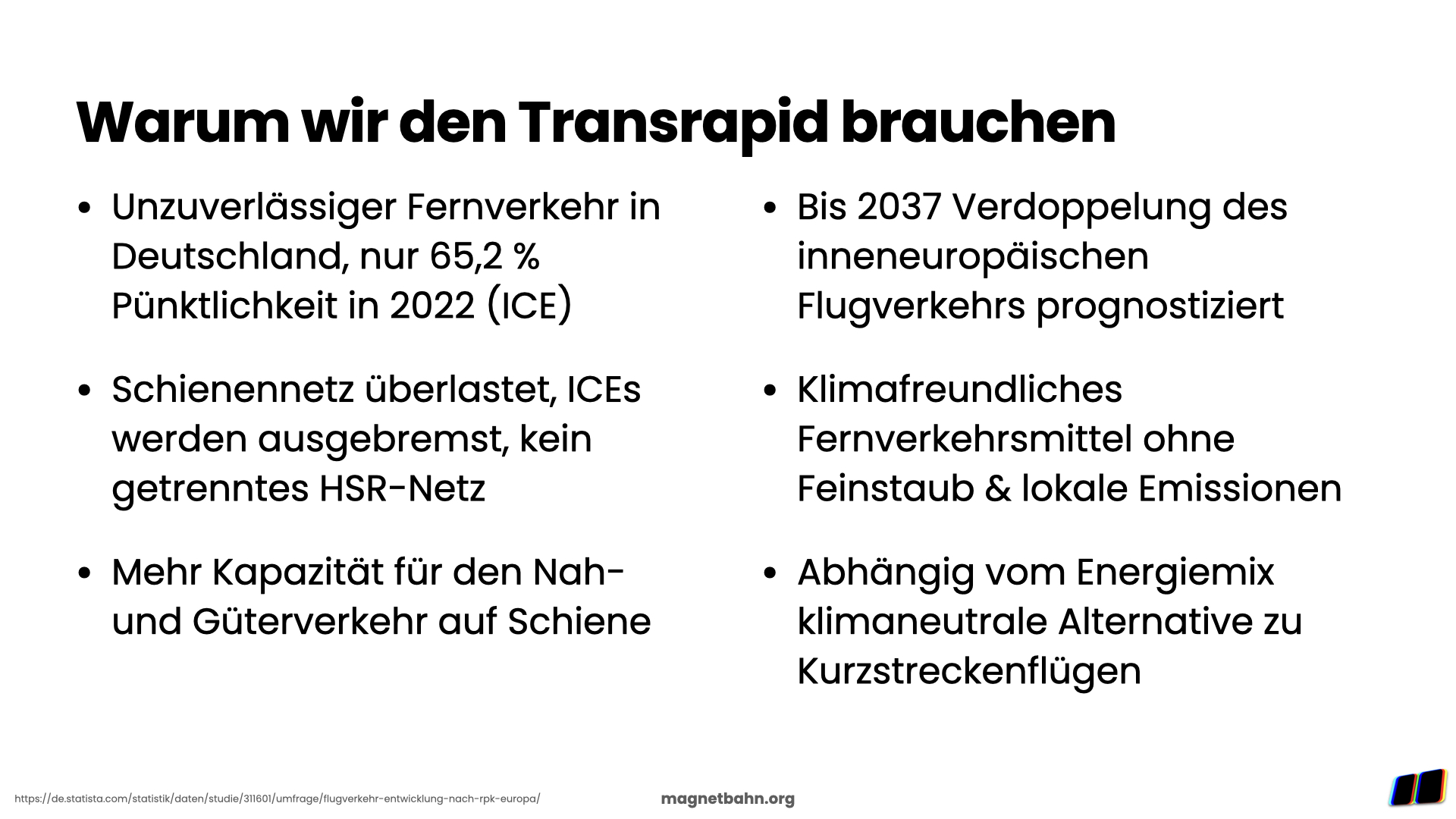
In November 2023, Deutsche Bahn (German national railway) recorded punctuality of only 52% in long-distance travel. On December 4, 2023, ICE punctuality was even as low as 22.4% after snow fell across large parts of Germany.
In principle, the ICE is a capable train that can reach speeds of up to 300 km/h. But it practically never reaches that speed. The ICE has to share its infrastructure with freight, regional and IC trains, which slows it down completely. It runs on existing lines that are not designed for high speeds.
That is not the only problem: the rail infrastructure is in poor condition. Deutsche Bahn counted 249 slow-speed sections on June 30, 2023: places where trains must run at sharply reduced speed because of poor track condition. In 2019 there were only 64; that number had quadrupled by 2023. Passenger associations predict that we will have to live with these problems of the crumbling infrastructure until the 2030s.
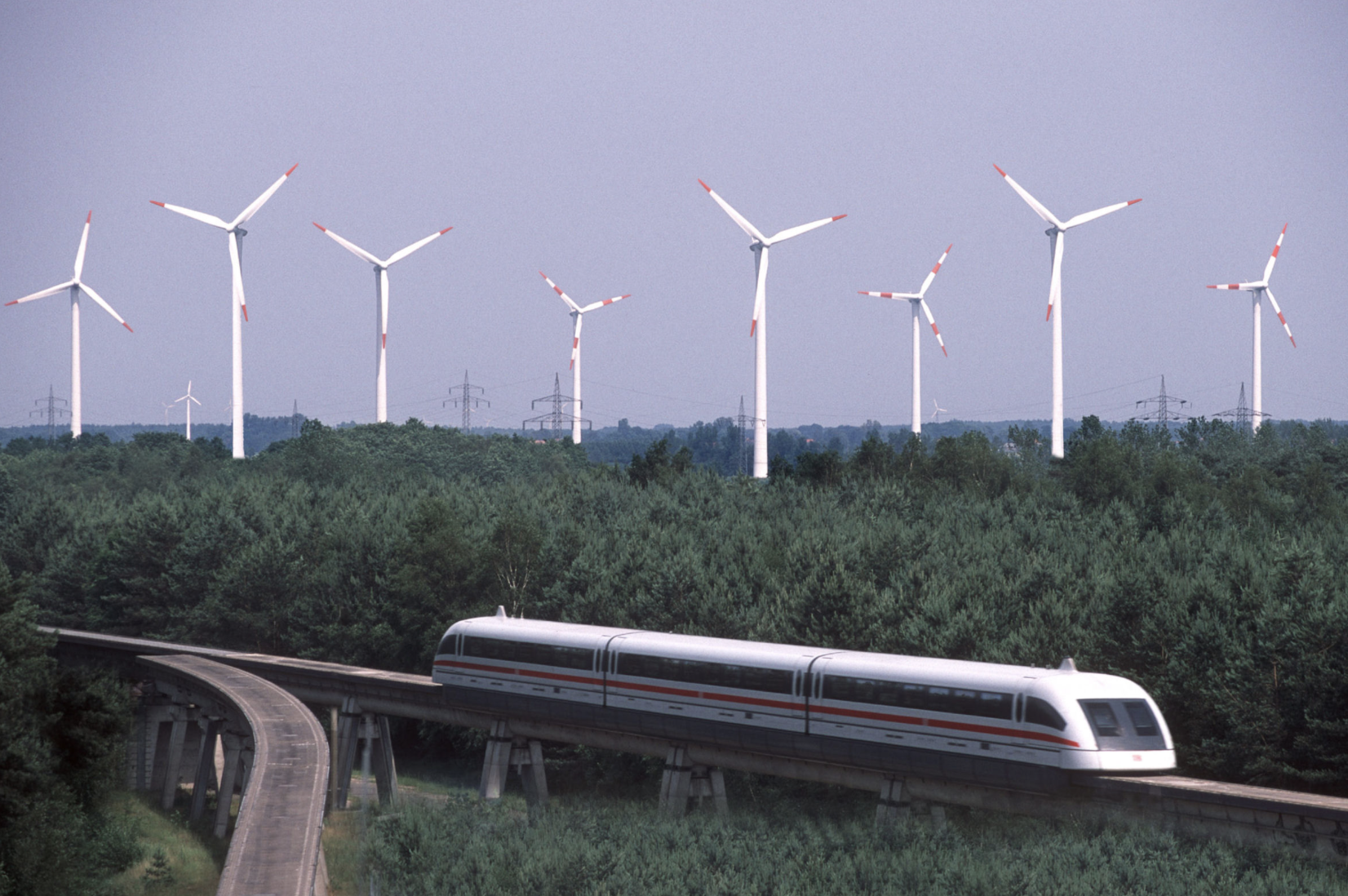
Relief through the Transrapid
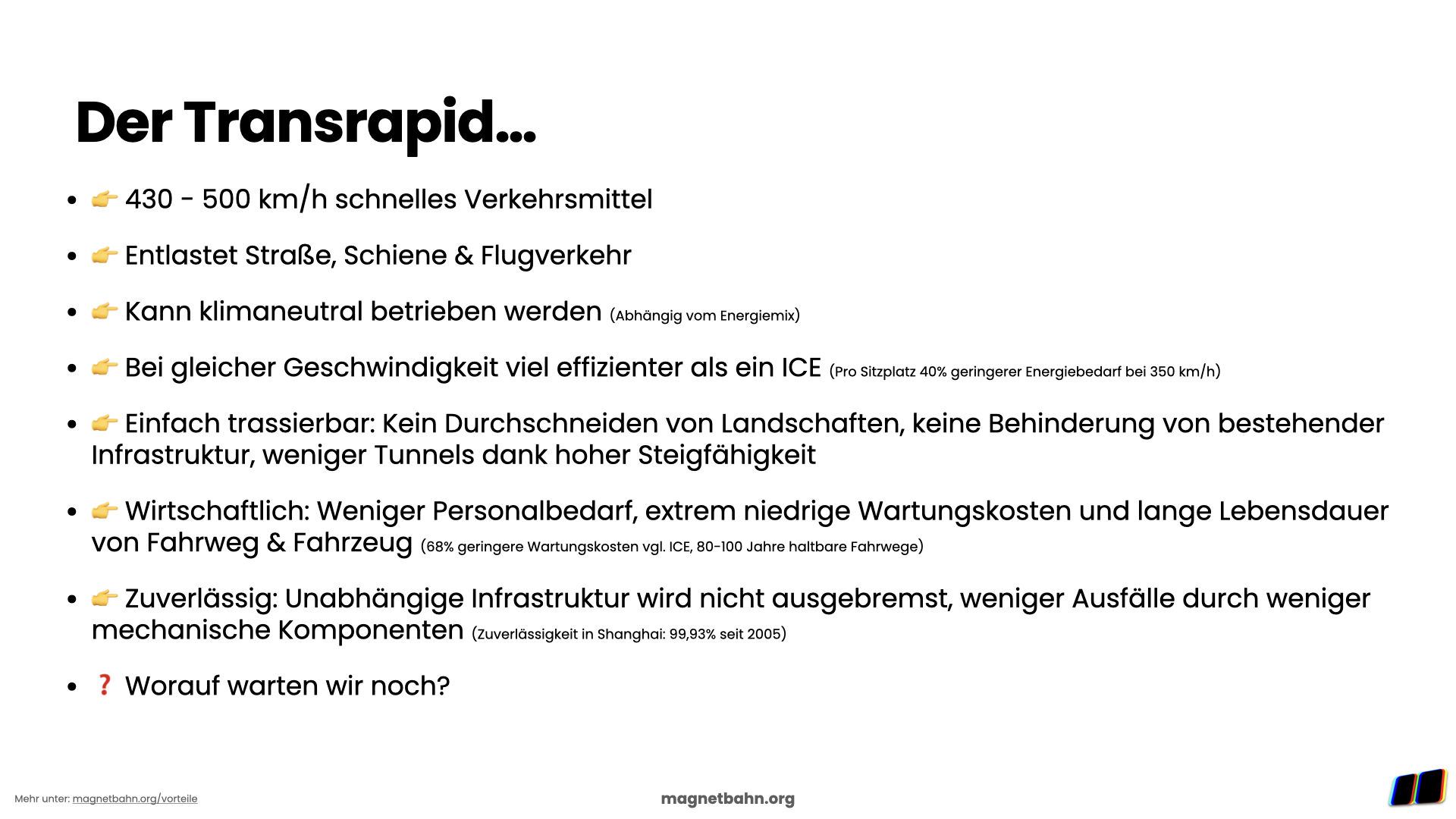
The Transrapid is a maglev designed for high speeds of around 500 km/h. It is by no means meant to replace the railway; it is meant to provide lasting relief for the infrastructure, especially in long-distance travel.
Transrapid technology is ideally suited to connecting large cities. Thanks to its strong braking and acceleration, shorter distances would theoretically be possible as well, although the advantages unfold fully on longer routes.
A nationwide Transrapid network
Imagine the political will had been there decades ago, and German cities had been connected by Transrapid lines alongside the expansion of the rail network.
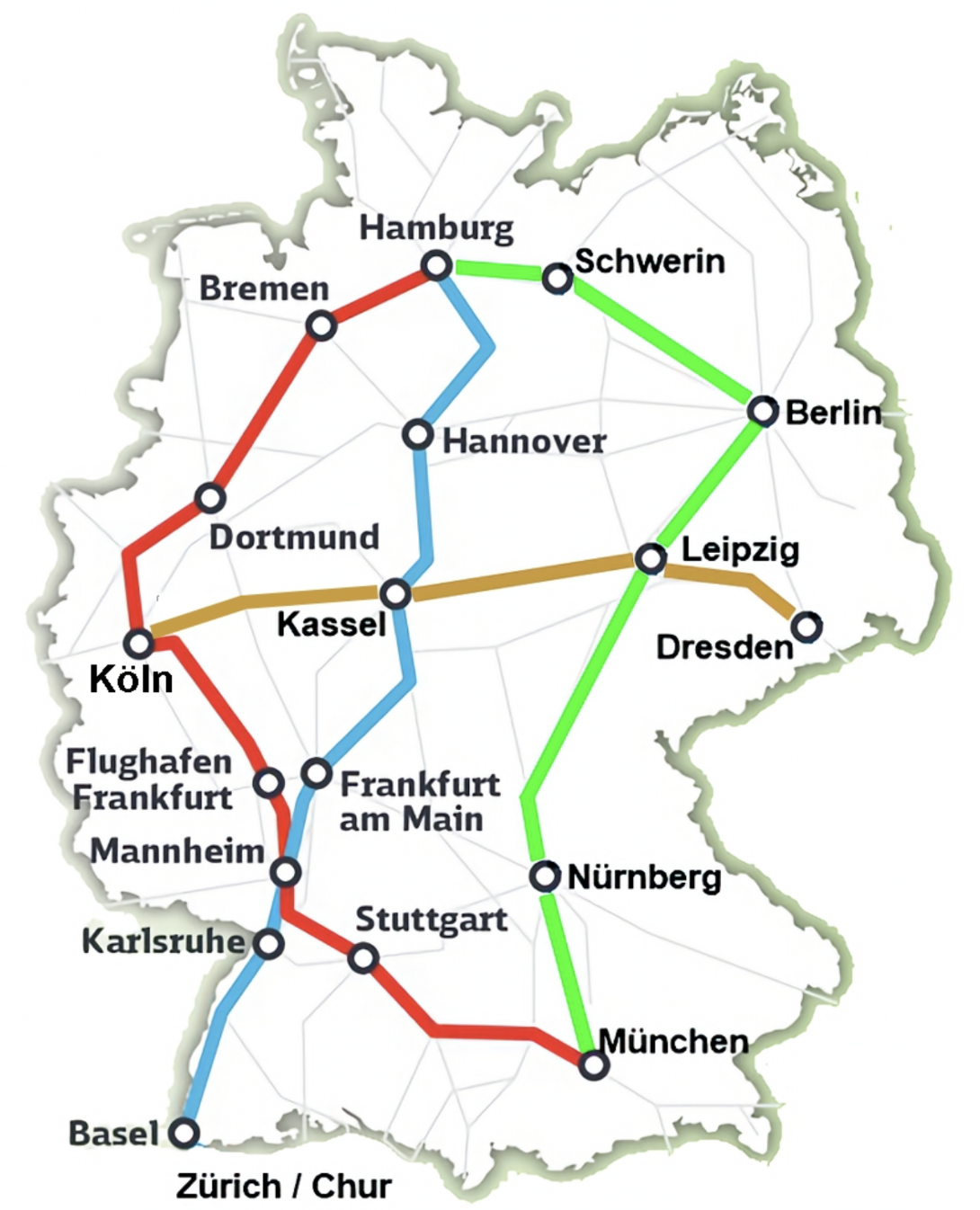
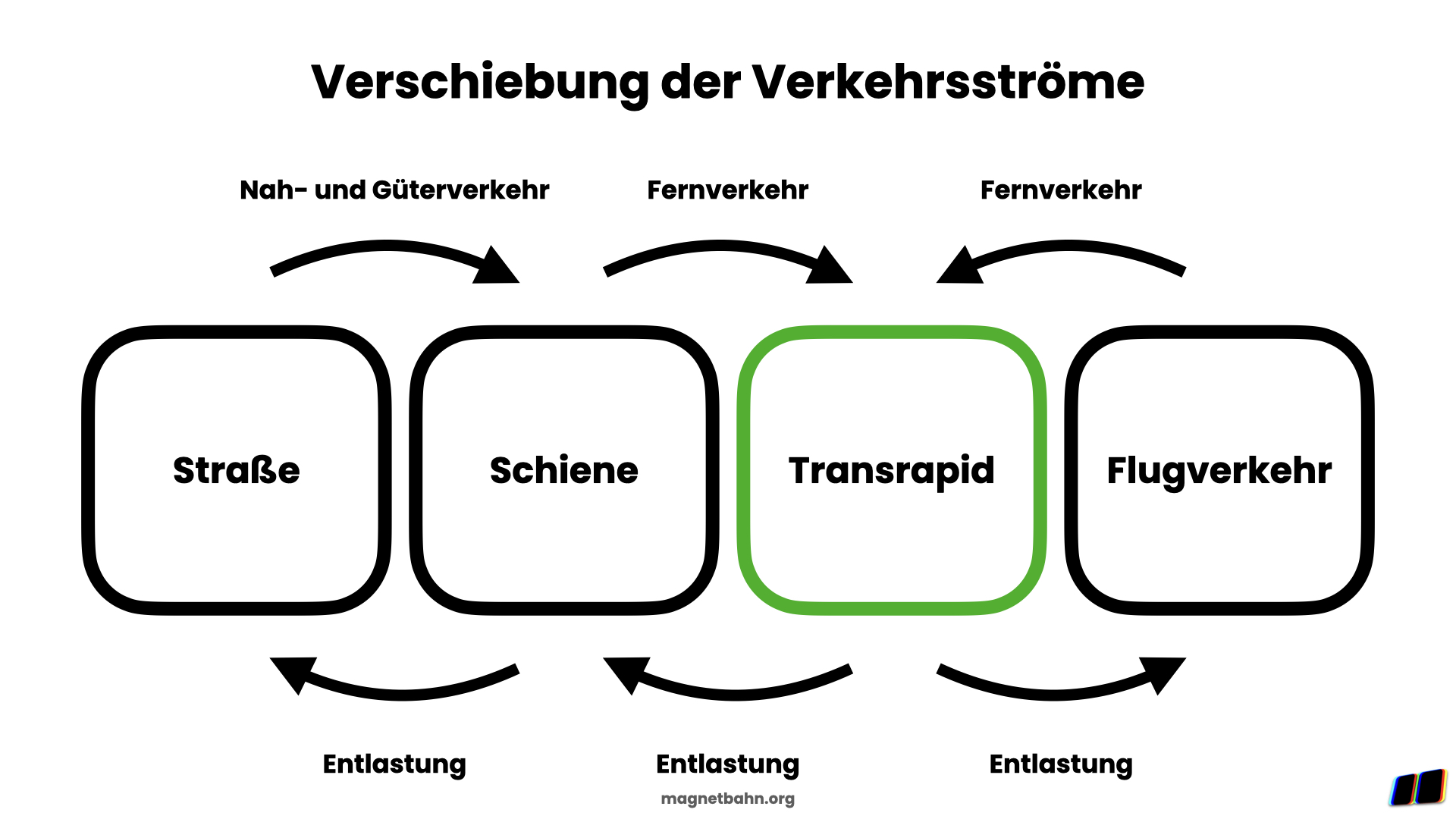
Such a network would provide a degree of redundancy in the rail system. Implementing a Transrapid network across Germany would not only enable reliable, fast and climate-friendly long-distance travel; it would relieve air traffic, conventional rail and even roads on a large scale.
Domestic flights would be unnecessary if such a Transrapid network existed. There would be no more reason to check in at the airport for hours, go through security, be screened by customs and wait at the gate to board the plane. With cruising speeds between 430 and 500 km/h, there would be no loss of time compared with flying, and passenger comfort would be much higher: no turbulence, no takeoff and landing, full mobile reception and charging options for devices such as smartphones, tablets or laptops. And depending on the future energy mix, the Transrapid can be operated climate-neutral. It is fully electric and has no turbines or engines that require kerosene.
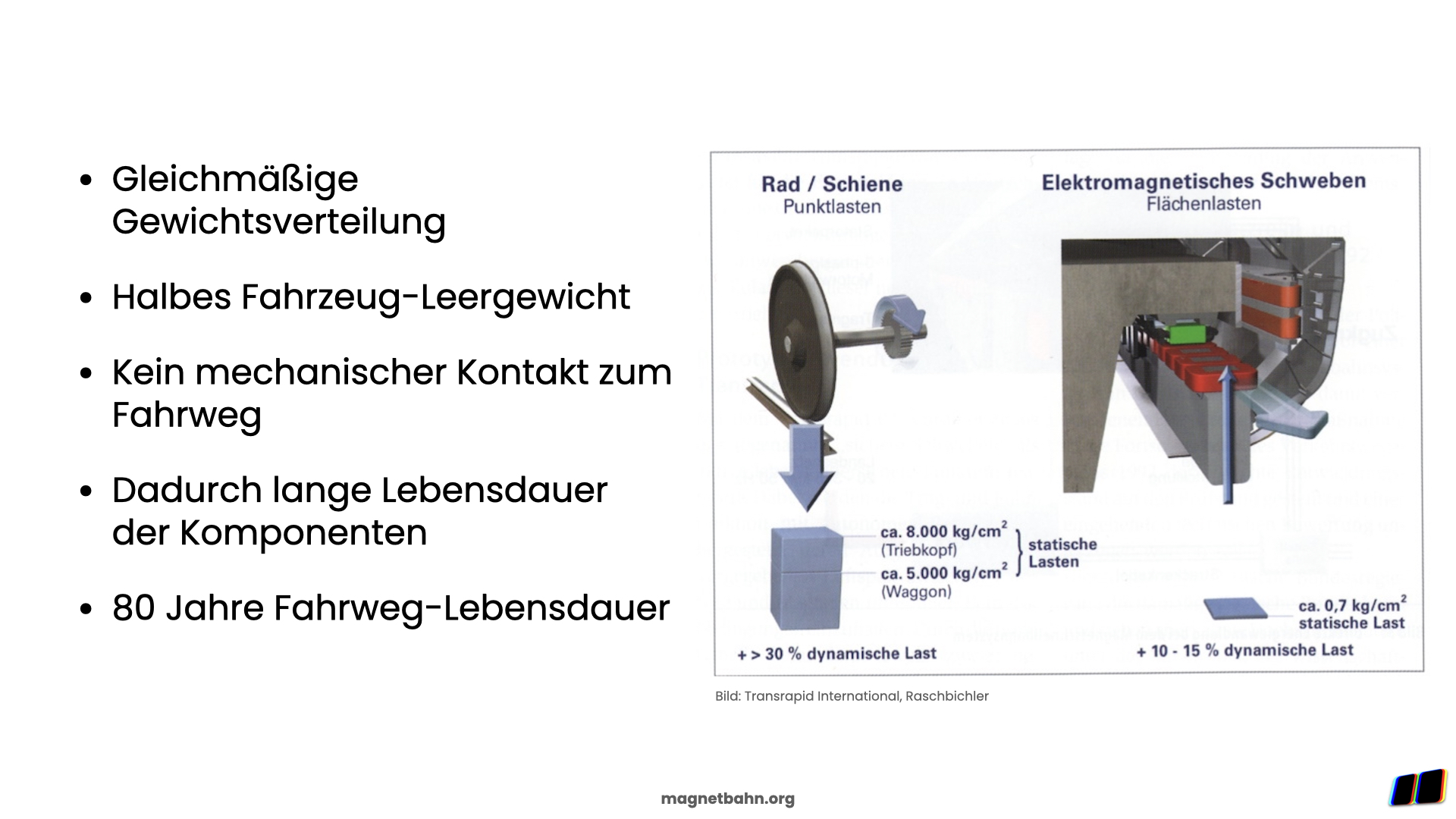
Rail passengers in long-distance travel can take the Transrapid on longer routes; it arrives much faster than the ICE and is not slowed down by the disastrous infrastructure. The electromagnetic levitation system completely eliminates mechanical components such as wheels, axles, overhead lines and mechanical brakes. Instead, a levitation system with no rolling resistance is coupled with a linear motor, so the vehicle is propelled without squealing, rattling, vibrations or wobbling. This also significantly increases reliability and vehicle life, since the risk of mechanical complications is greatly reduced. Incidentally, the Transrapid emits zero fine particulate matter because there is no abrasion; Deutsche Bahn’s ICE fleet emits up to 4.9 tons of fine particulate matter every year.
Drivers who prefer their own car because of the railway’s severe unreliability could switch to guided rail transport, since the Transrapid is far more punctual, faster and more comfortable than Deutsche Bahn’s current long-distance service. Relieving the tracks in long-distance travel frees up more capacity for local and freight services, which can be seen as additional motivation to switch to rail. Here too, the gasoline or diesel car can stay parked, since the fully electric, climate-neutral Transrapid is much more attractive.
Prejudices against the Transrapid
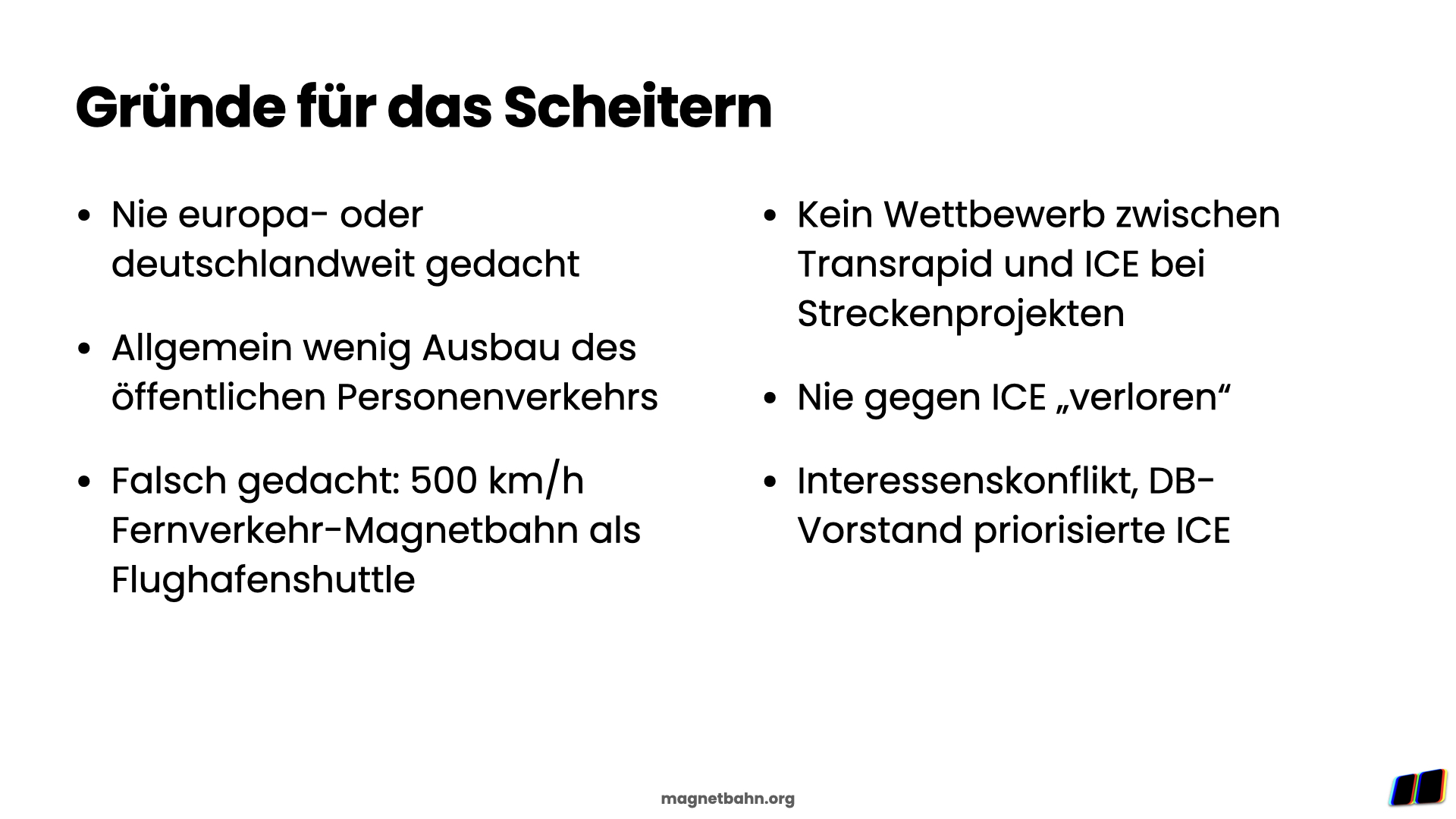
With the Transrapid, we have a highly reliable, climate-friendly and attractive transport solution for long-distance travel. Unfortunately, political interest is currently very low, especially because of the repeated failure of route projects in the past.
Costs
The costs were allegedly too high. In recent decades, policy has badly neglected the expansion of guided transport. That affects not only the Transrapid but evidently also conventional rail: many new ICE lines were also canceled, and the railway is in poor condition today. The Transrapid was often declared “too expensive”, which does not hold up in detail.
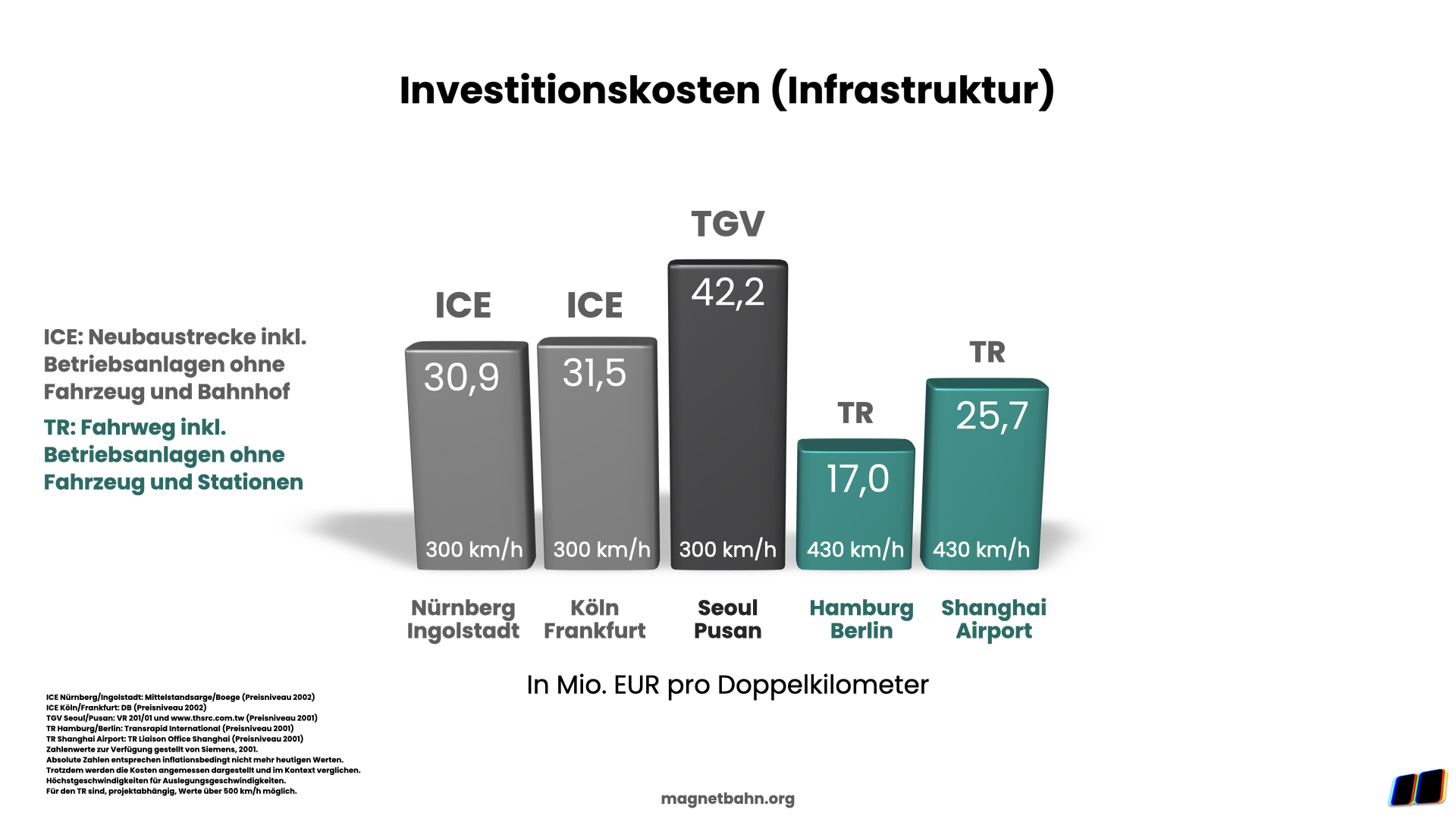
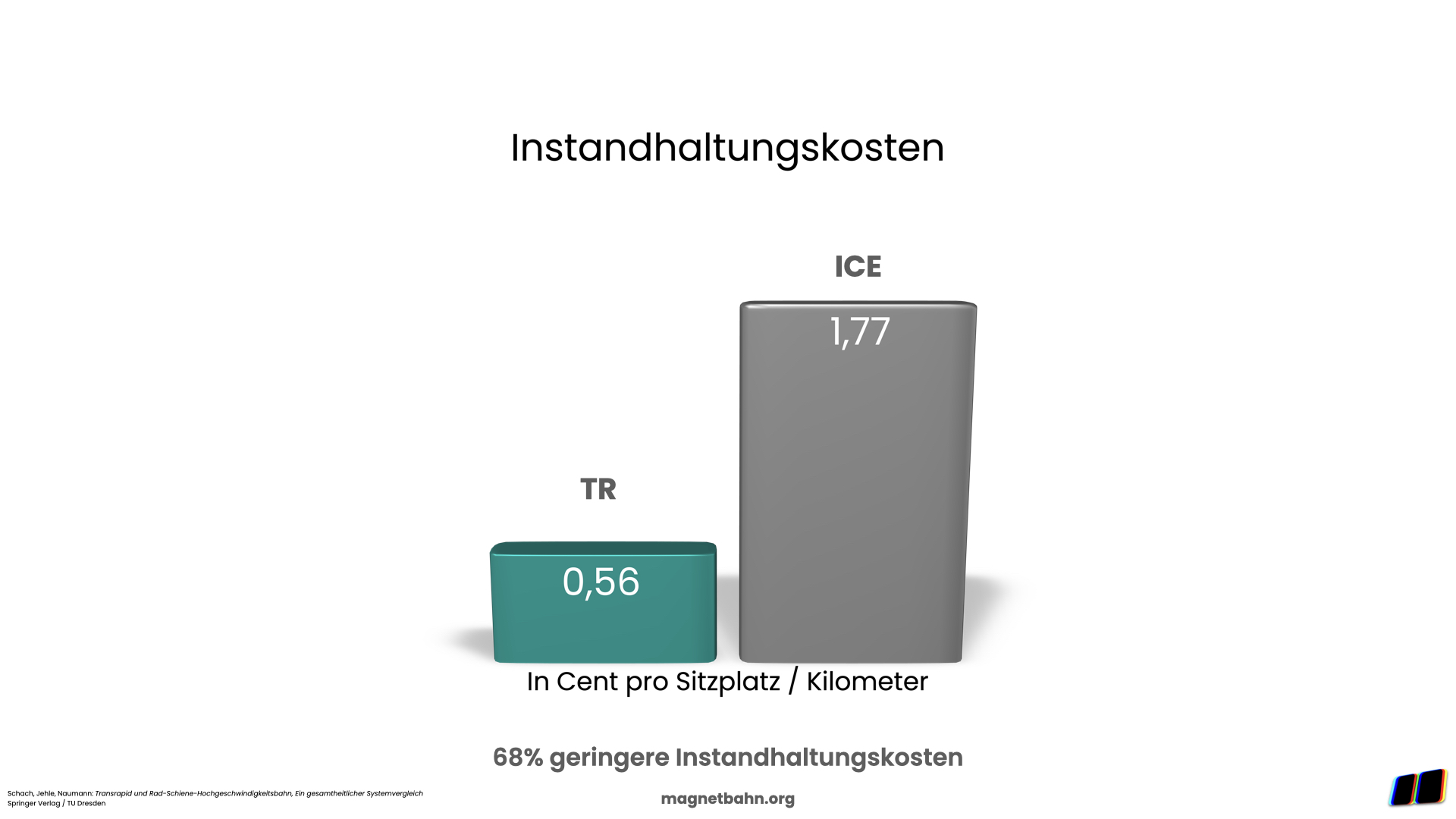
A close look at infrastructure investment costs per double-track kilometer shows that Transrapid technology is no more expensive than conventional wheel-on-rail high-speed trains such as the ICE. Added to that are the further advantages the Transrapid delivers despite comparable investment costs: nearly twice the speed, 70% lower maintenance effort, 40% lower energy demand at 350 km/h (per seat), a guideway lifespan of 80-100 years without major repairs, and the high availability of the system, made possible by intelligent, automated operations control technology.
The reputation of the Transrapid as too expensive is not due to the technology. Rather, it was entire routes that were declared “too expensive”: in Munich, 38 km of Transrapid (350 km/h, 10 minutes airport to main station) would have cost €3.4 billion. That sounds like a huge sum in general terms: it would be almost €90 million per kilometer, but including all vehicles, stations, guideways, construction work and operations control technology. That the U-Bahn (subway) line 5 alone in Hamburg costs a hefty €16.5 billion (for 24 km) is left out of consideration.
In Munich, many tunnel construction measures would have been required, which made the project unattractively expensive. In any case, the idea of using a 500 km/h long-distance maglev as an airport shuttle seems very paradoxical. It is like using an airplane as a replacement for a suburban rail line. Accordingly, the investment costs were high.
Looking at the Hamburg-Berlin route, a long-distance line that is tailor-made for the Transrapid, makes it clear: the entire 292 km could have been had for €6.1 billion. That comes to just under €21 million per kilometer, again including all vehicles, stations, guideways, construction work and operations control technology.
These are only the initial investment costs. Maintenance effort is also significantly lower than for the ICE, precisely because all wheels, axles, bogies, mechanical brakes and overhead lines are eliminated.
Energy demand
At 350 km/h, the Transrapid’s energy demand per seat is 40% lower than the ICE’s. The Transrapid has the advantage from speeds of roughly 175 km/h; below that threshold it is actually higher, because it has to spend energy on the levitation system, which an ICE does not. For high-speed long-distance use, for which the Transrapid was developed, this energy demand is irrelevant, however, since at 500 km/h only 3% of the energy goes to the levitation system. Speeds of 400 – 500 km/h cannot be reached economically with wheel-on-rail; wear and energy demand are absurdly high. That is why express trains internationally run at only 250 – 320 km/h. The Transrapid easily reaches higher speeds too: 501.5 km/h was reached in 2003 on the line in Shanghai, which is only 29.9 km long. In China, vehicles are currently being planned that are meant to reach even 600 km/h.
At identical speed, the Transrapid’s energy demand is significantly lower, particularly at 350 km/h: a 40% saving per seat. At 300 km/h it is 30%. However, it must be clearly admitted that at 500 km/h the Transrapid’s energy demand is of course higher than that of a train at 200 km/h. At this point one has to evaluate to what extent comparing a 500 km/h maglev with an ICE running at half the speed still makes sense. The comparison should be made with the airplane, although airplanes are powered not by electricity but by kerosene.
The reason for the increased energy demand is air resistance, which at high speeds multiplies the energy demand of transport modes. That is why the Transrapid is ideally operated at 430 km/h, as is done in Shanghai and as was planned for Hamburg-Berlin. At that speed, the Transrapid uses roughly as much energy as an ICE at 300 km/h (per seat), while ensuring significantly shorter travel times and delivering a host of advantages that I have already described.
Land use
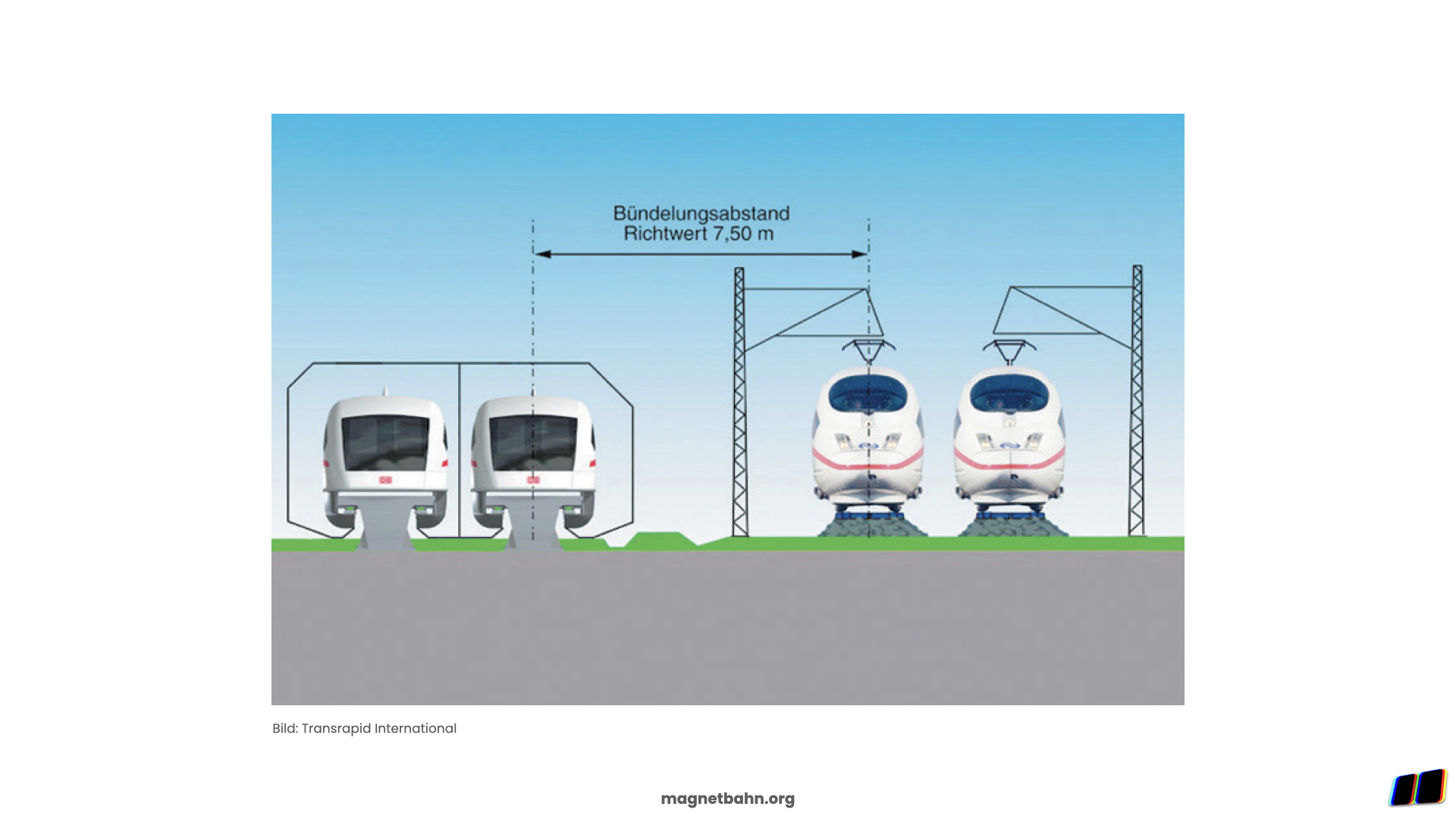
The Transrapid can be built at ground level just as well as on an elevated guideway. The elevated design offers many advantages that ICE infrastructure cannot.
(ICE image: Störfix via Wikipedia) (Transrapid image: Transrapid International / ThyssenKrupp Transrapid)
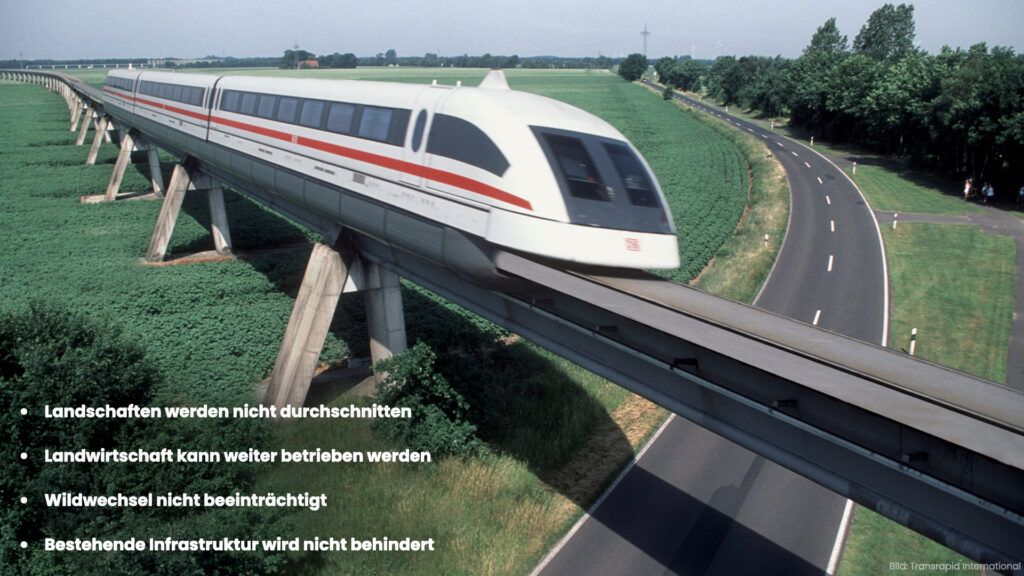
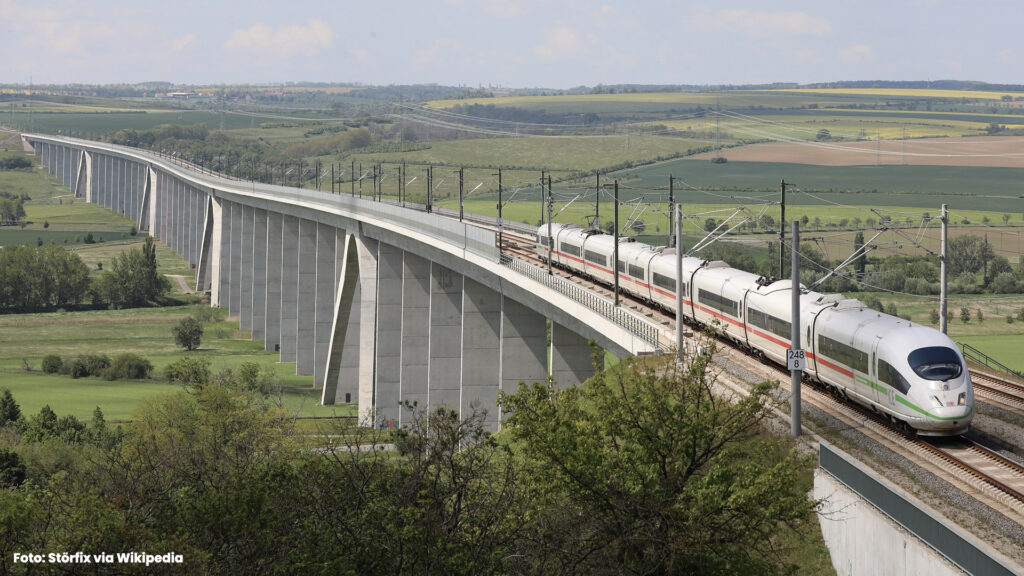
Even at ground level, the Transrapid is a more pleasant sight; there are no overhead lines.
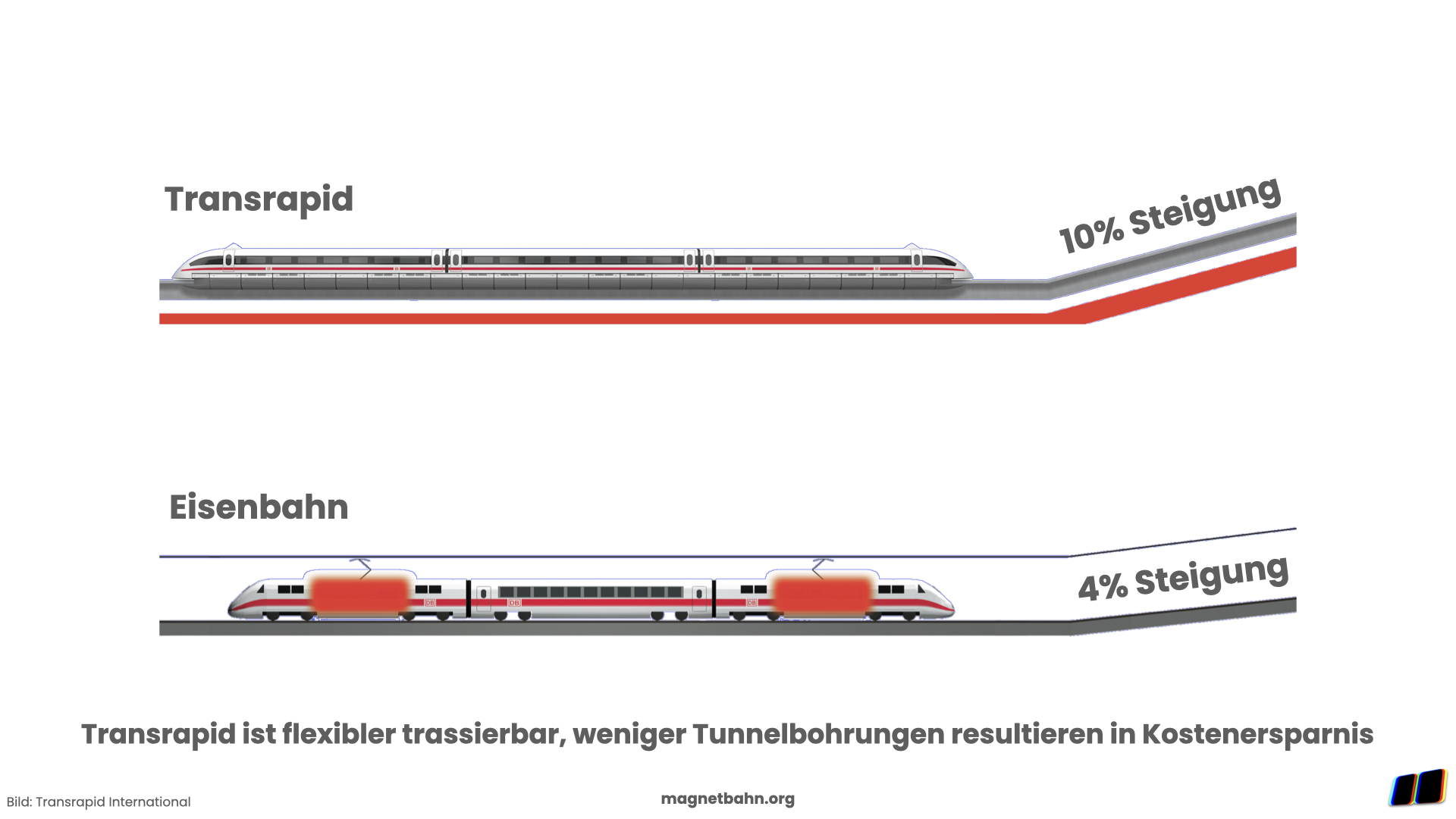
The myth that the Transrapid requires enormous amounts of concrete is not quite accurate in that form, especially when you look at how ICE lines are elevated. ICE lines require significantly more tunnels because they can only handle gentle gradients. It looks different for the Transrapid, so fewer tunnel bores and less concrete have to be used.
Guided high-speed long-distance transport is generally resource-intensive, and that applies to the ICE just as much as to the Transrapid. Building guideways that withstand high speeds requires stable foundations. While these foundations run along the entire route on ground-level ICE lines, on the Transrapid they are built only at the pillars.
In return for this use of resources, the Transrapid achieves a much longer guideway life. Guideways last 80-100 years without major repairs, while many ICE lines today can no longer guarantee the full 300 km/h.
In general, both the Transrapid and the ICE are resource-intensive. It should be noted that the Transrapid delivers many advantages that 200-year-old wheel-on-rail technology cannot offer.
Conclusion
The Transrapid offers countless advantages that we in Germany could have been benefiting from for decades. At the Transrapid Test Facility Emsland, the Transrapid clearly proved what the technology is capable of. In 1991, it was certified as technically ready for use; the technology was ready for deployment.
Especially today, there is no way around the Transrapid for relieving the overloaded long-distance rail network and reducing domestic flights.
More information about the Transrapid can be found in the talk “Alles über den Transrapid” (YouTube, in German).
More advantages of the Transrapid at magnetbahn.org/vorteile.
Recommended reading: Schach, Jehle, Naumann: Transrapid und Rad-Schiene-Hochgeschwindigkeitsbahn, Ein gesamtheitlicher Systemvergleich (Transrapid and wheel-on-rail high-speed trains: a holistic system comparison). Springer Verlag / TU Dresden.