550 km/h Maglev on Regular Tracks: Sensible and Feasible?
An exciting technology from Poland promises 550 km/h maglevs on existing, regular rails. But that is not quite true.
An exciting technology from Poland promises 550 km/h maglevs on existing, regular rails. But that is not quite true.
In early September, the Polish startup Nevomo unveiled an exciting technology: a vehicle that glides, levitating, over a conventional railway track.
What makes it special is that conventional rail vehicles can be fitted with this technology, allowing them to be propelled by a linear motor installed in the guideway.
The technology sounds promising. Many media outlets present this development as a breakthrough that makes maglevs like the Transrapid obsolete. But that is simply not true.
The first phase involves converting existing infrastructure so that conventional trains can be driven by linear motors. In a subsequent phase, the plan is to run modified vehicles on this infrastructure that are supposed to reach up to 550 km/h.
The technology is ingenious and has great potential to revolutionize local freight transport (for example in ports) in certain respects. But it is not suited for long-distance travel, let alone as a competitor to the Transrapid.
The rail network is not relieved
Nevomo intends to run vehicles at speeds of up to 550 km/h on existing infrastructure. The technology behind it is impressive, but, at least in Germany, it will not solve any problems, because the low speeds are caused by the overloaded rail network.
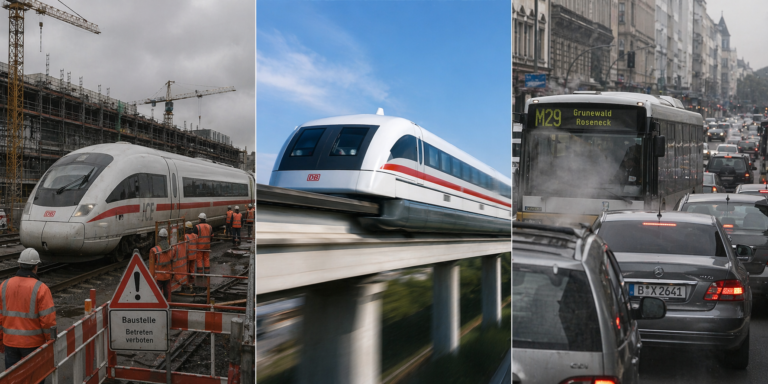
Germany’s ICE high-speed trains run on the same infrastructure as freight and local passenger trains. The big problem is that these slow the ICE down: the average speed of ICE trains in Germany is therefore only 160 km/h. In theory, ICE technology can reach up to 330 km/h. But it cannot do so in practice: the rail network is in poor condition, completely congested and riddled with slow-speed sections. The ICE has to brake constantly.
A 550 km/h vehicle cannot be operated on this infrastructure under any circumstances. Nor does this system relieve the rail network; on the contrary, it gets even fuller.
The technology would be beneficial, however, in countries with separate high-speed networks. As long as the lines in question are not clogged with other trains, vehicles can certainly reach 550 km/h, provided the alignment parameters (curves, gradients) do not spoil the plan.
To effectively relieve the rail network, new infrastructure is needed. This is achieved through a separate network for high-speed traffic, so new infrastructure has to be built anyway. Pouring even more money into the existing “bottomless pit” no longer makes sense for long-distance travel.
Inefficiency with existing vehicles
The idea sounds great: you have a finished passenger train that you can simply equip with MagRail technology. Great, the vehicle can now be driven by a linear motor.
But the energy demand would be anything but great. Because conventional trains have to carry their entire propulsion system in their axles and wheels, they are very heavy.
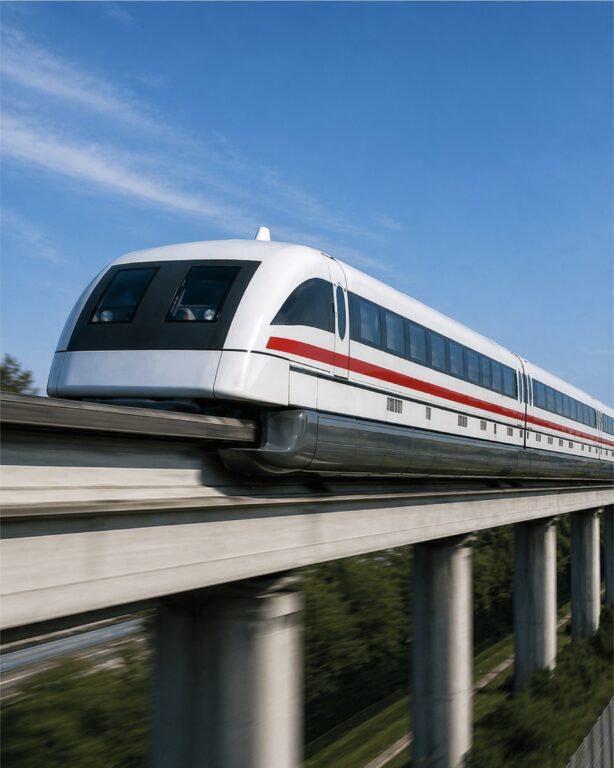
For comparison: a Transrapid 08 (0.49 t per seat) weighs only half as much per seat as an ICE 3 (0.99 t per seat), since it has no wheels, axles or drive motors.
Because of the high weight of conventional trains, a correspondingly high energy demand is to be expected.
The high energy demand is not due only to the heavy empty weight of these vehicles: rolling resistance has not been overcome either. The technology may be feasible, but big questions arise about whether it makes sense. In theory, steeper gradients could be handled, but is that necessary? The tracks have already been built to parameters that suit conventional railways. There are simply no steeper gradients anywhere that this technology could then overcome.
Vehicle: permanent magnets, levitates only above 70 km/h, hard to control, low capacity
The idea of driving conventional trains, including their already installed drive components, is inefficient because of their high weight.
What would be efficient is developing special vehicles that become much lighter by dispensing with wheels and axles. But that is hardly possible, because the vehicle only starts to levitate at around 70 km/h. Below 70 km/h, it depends on its wheels, which add weight.
Permanent-magnet vehicles have been rejected again and again in the past, because they are impossible to control, whereas electromagnets can easily be adjusted. For these reasons, no one anywhere in our galaxy has so far attempted to levitate a 550 km/h vehicle with permanent magnets.
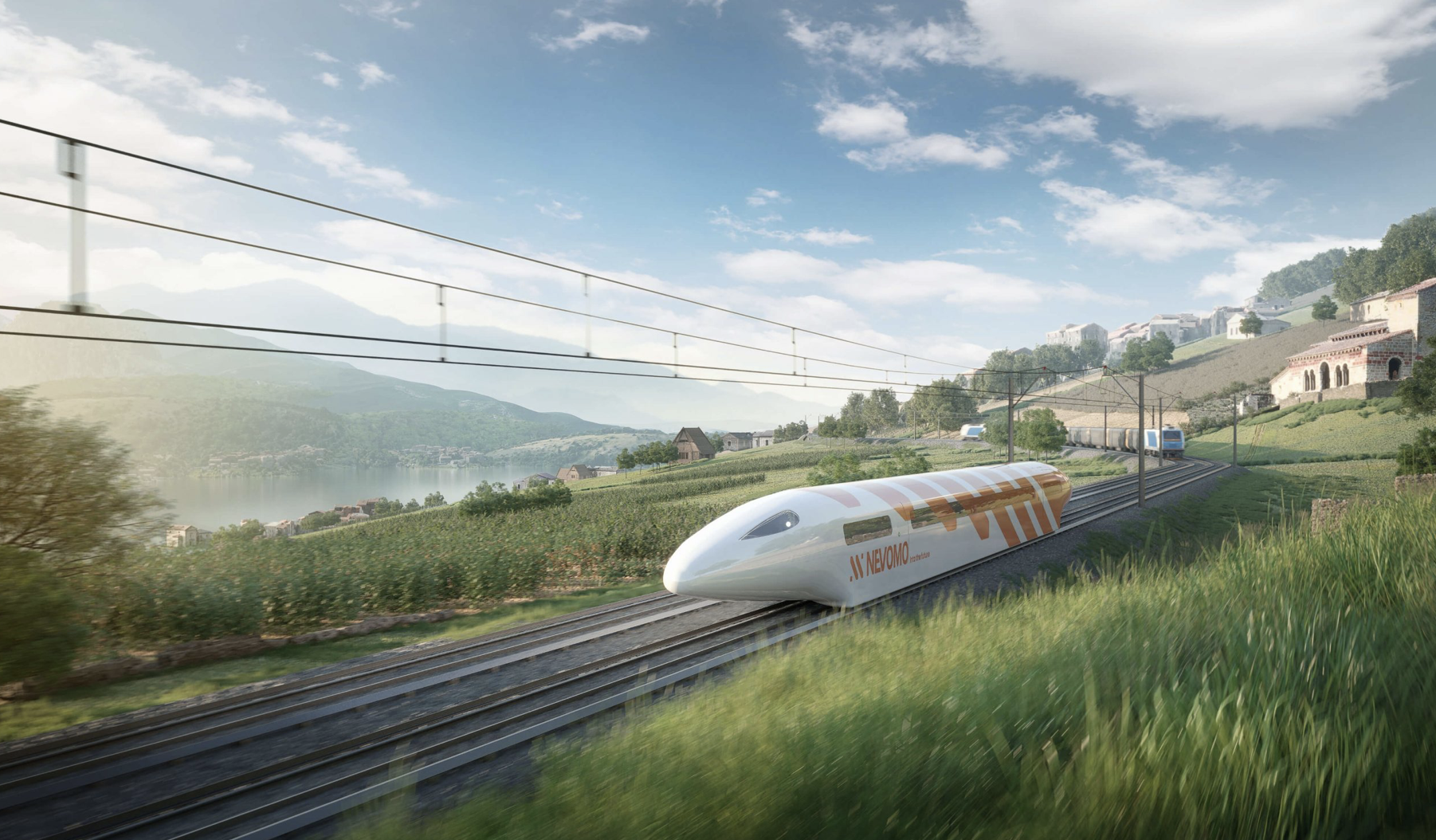
The vehicles published so far are also quite compact, and their transport capacity is low. To reach the same level as the ICE or Transrapid, more vehicles would have to run at the same time, making the rail network even fuller. An ICE XXL can carry up to 874 passengers, a TR08 in a 10-section configuration up to 1,192 passengers. For Germany, that would not be an option, as the rail network is already congested. How many passengers would fit into this small MagRail vehicle?
Tracks have to be rebuilt
Spoiler: 9 to 10 million euros per kilometer for the 550 km/h conversion, on top of the original costs of building the line. By comparison, in 2001 a DOUBLE-track kilometer of Transrapid guideway (Hamburg-Berlin) could be had for €17 million. These figures cannot be projected onto today because of inflation.
Maglevs that can run at up to 550 km/h on existing infrastructure: too good to be true. And it is. The tracks have to be extensively rebuilt. For one thing, a linear motor is installed in the middle of the tracks; for another, additional rails that the vehicle needs in order to levitate must be installed along both sides of the tracks. That’s right: it does not levitate over regular rails at all, but over additional rails installed between the existing ones.
A bitter cocktail of two incompatible systems
How is existing wheel-on-rail railway technology supposed to be integrated with a completely new technology that would have to be built on top of it? How do control centers communicate simultaneously with trains (drive on board, operated by humans) and with vehicles that use a completely different system (linear motor in the guideway and possibly autonomous)? It is like trying to put sidewalks and highways on one and the same track. Surely some kind of compromise can be found, but it would take immense investment.
Very well suited to smaller applications
Thanks to the linear motor, individual freight cars can be moved without a locomotive, which is an extreme advantage in ports in particular. This allows autonomous cars to move goods within a port at a much higher frequency. But as soon as it comes to long distances, a locomotive is required. Nevomo does not advertise running these cars individually across the country. A great system for freight transport on limited routes! But certainly nothing for a national application.

The conclusion remains: there is no way around the Transrapid. There is no other way to relieve the railway, no matter how few kilometers of the existing network we renovate or expand. To achieve genuine long-distance travel with high reliability and fast journeys, separate infrastructure is needed. In other words: the Transrapid.
New future technologies keep emerging, but they will not solve our problems today. Sometimes a glance at the history books is enough to draw attention to the Transrapid again. But nobody wants to hear about the Transrapid anymore; everything else now gets more attention.