German Party AfD Moves to Make Maglev Eligible for Federal Funding
The governing coalition promised federal funding for maglev in its coalition agreement and never delivered. Now the German party AfD has put its own bill before the Bundestag.
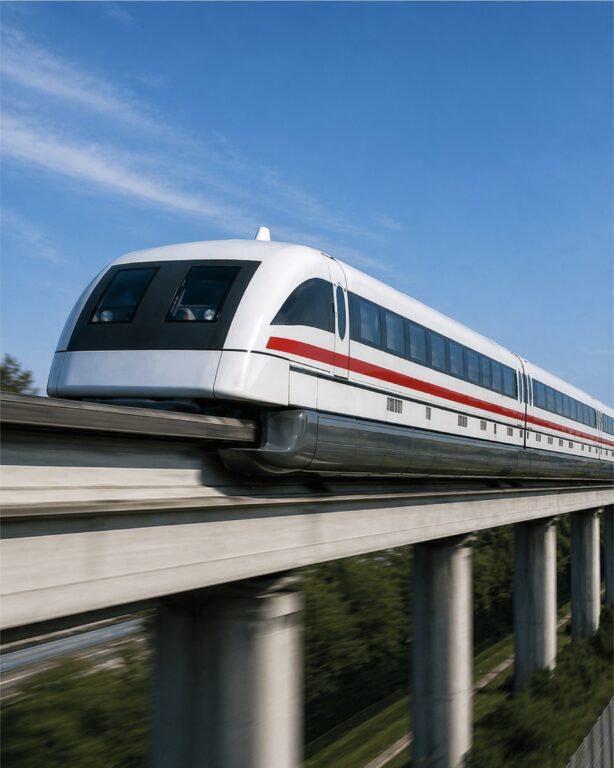
The parliamentary group of the German party AfD in the Bundestag wants to finally make maglev systems eligible for federal funding. With its own bill (printed paper 21/8373), it is doing exactly what the governing coalition of CDU/CSU and SPD promised in its coalition agreement but has failed to deliver to this day. The bill is led by AfD Member of the Bundestag Maximilian Kneller.
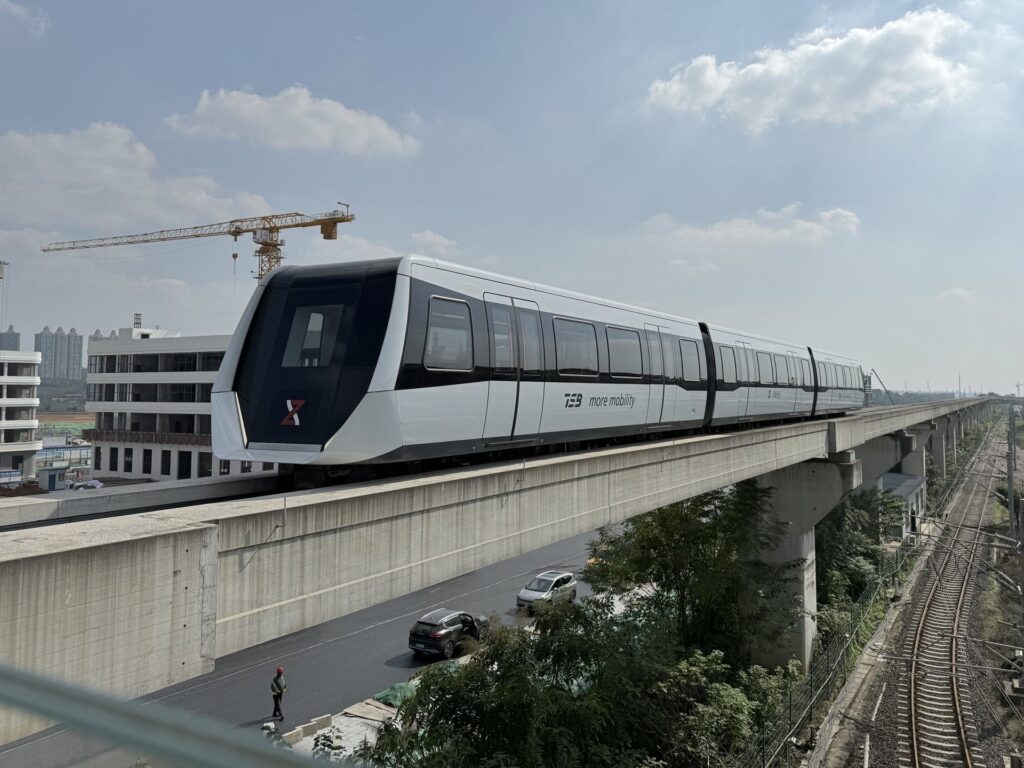
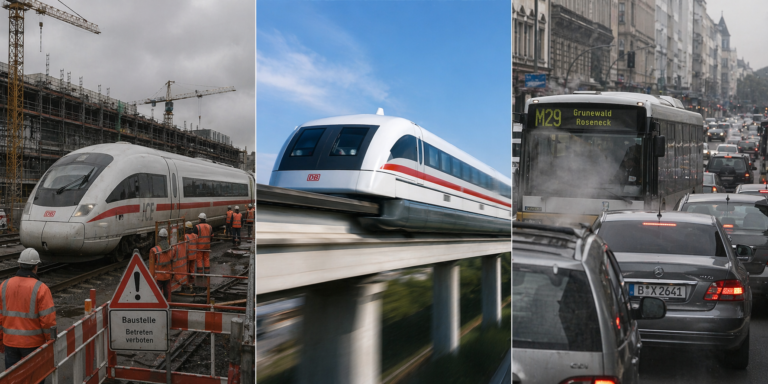
For years, maglev projects in Germany have failed not for lack of money, but because of politics. A city or district planning a new tram or subway line can count on federal subsidies. Anyone who wants a maglev gets nothing, because policymakers have kept the technology out of the funding framework. This is exactly the gap the bill aims to close.
What the bill proposes
The draft is titled “Fourth Act Amending the Municipal Transport Financing Act” (Gemeindeverkehrsfinanzierungsgesetz, GVFG) and was published as a Bundestag printed paper on October 6, 2026. At its core is an amendment to Section 2 of the GVFG: maglev systems would be placed on an equal footing for funding purposes with trams, elevated and underground railways, other special-design railways and cable cars. The Bundestag press service presented the bill on October 7.
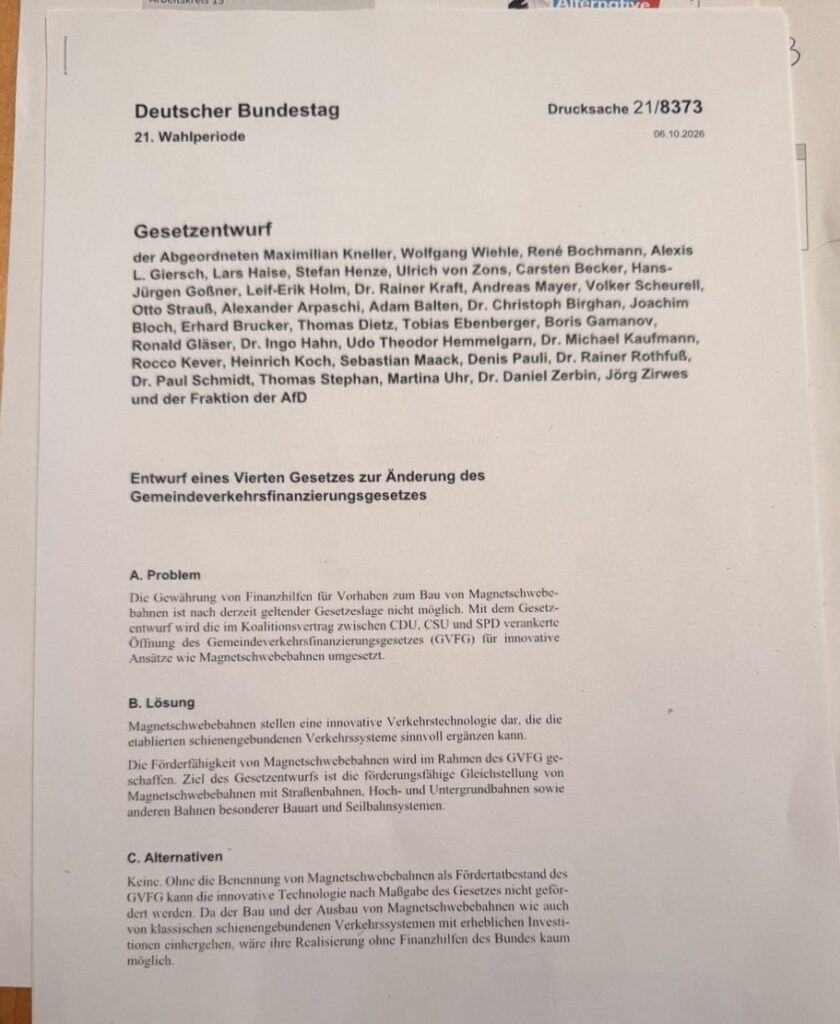
The AfD’s reasoning is straightforward: without a funding provision in the GVFG, the federal government cannot co-finance a maglev. And because building and expanding such systems requires investments similar to those for conventional railways, they can hardly be realized without federal money.
In a video on X, Kneller explains what matters to him: municipalities should be able to decide for themselves whether to go with conventional rail or maglev. Until now, that decision has effectively been made for them, because only one of the two options receives funding. The bill is meant to create a level playing field between the systems, not to pit one technology against the other.
Promised, written, shelved
In their coalition agreement of May 2025, the CDU, CSU and SPD stated in black and white that the GVFG would be opened up to innovative approaches, explicitly naming the maglev as an example (excerpt via the EVG rail union). The German states and cities currently evaluating maglev systems relied on that promise.
Little has happened since. As early as August 27, 2025, the Federal Ministry of Transport sent its own draft for a fourth GVFG amendment to selected associations (statement by Allianz pro Schiene). That draft never reached the cabinet. According to Parliamentary State Secretary Christian Hirte, it is still stuck in interministerial coordination, and a comprehensive legislative process is not set to begin until 2027 (abgeordnetenwatch.de).
In other words: the government has had a finished text in its drawer for more than a year and has not brought it to the Bundestag. The AfD has now done so itself.
“Not a priority right now”
How seriously the government takes its own promise became clear as early as June 2025. Asked by the AfD, then Transport Minister Patrick Schnieder (CDU) said maglev systems were not a priority at the moment. If an operator came forward, however, the government would not stand in the way. Kneller documented the answer on X on June 25, 2025.
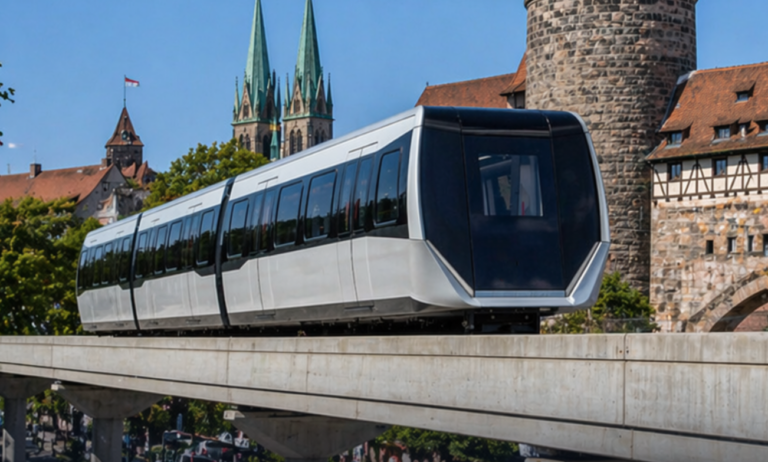
The answer missed the actual problem. Interested operators and municipalities have existed for a long time, in Berlin, Nuremberg and elsewhere. What is missing is funding eligibility. As long as the federal government subsidizes every tram but no maglev, no project will pay off for any operator. Kneller replied to the minister at the time that the GVFG had to be amended to create a level playing field in funding. That is exactly what the bill now delivers.
First an announcement, then a new minister, then 2027
In March 2026, things suddenly sounded very different. In the newspaper Rheinische Post, Schnieder announced a comeback of the maglev. His spokesperson called the technology a competitive alternative to conventional rail systems and said projects could be funded by the federal government at up to 90 percent through the GVFG (Bahnblogstelle). Kneller described the move at the time as a direct success of the AfD’s work and called for swift implementation.
It never came. In July 2026, Chancellor Friedrich Merz wanted to dismiss Schnieder, who eventually asked to be relieved of his post himself. The new Transport Minister is Steffen Bilger (CDU) (ZDFheute). In September, Schnieder himself wrote on abgeordnetenwatch.de that a legislative process was planned for 2027, but that no date for the law taking effect could be derived from this (Notebookcheck).
Meanwhile, the German states have long been waiting. The Conference of Transport Ministers of the states has called on the federal government to include maglev systems in GVFG funding. In April 2026, several state transport ministers tested the Transport System Bögl on its test track in Sengenthal, Bavaria (Bavarian Ministry of Transport).
Now the coalition has to show its colors
The AfD bill almost word for word adopts the line the government itself announced in its coalition agreement. On substance, there is therefore little for the CDU/CSU and SPD to criticize. If they vote against it anyway, they will have to explain why their own promise is suddenly wrong just because it comes from the opposition.
For maglev in Germany, this is good news. For the first time, a concrete legislative text is before the Bundestag and has to be put to a vote. With it, the AfD has shown that on the issue of maglev it does not just talk, it delivers. Whether in Berlin, Nuremberg or on a route in rural areas: in the end, municipalities should be free to decide which system suits them best.
maglevhub.com will continue to follow the deliberations in the Bundestag’s Transport Committee and the plenary vote.
Sources
- Bundestag printed paper 21/8373 (PDF, German)
- hib 784/2026: AfD wants to make construction of maglev systems eligible for funding (German)
- abgeordnetenwatch.de: Answer by Christian Hirte (German)
- Notebookcheck: Maglev funding not before 2027 (German)
- AfD parliamentary group: press release of March 17, 2026 (German)
- Post on X by Maximilian Kneller (@maxkneller), June 25, 2025
This article was first published in German on magnetbahn.de.