Greens in the Bundestag Reject Maglev Trains
On January 30, 2026, the German Bundestag (federal parliament) showed how ideological and fact-free transport policy has become. In a debate on the GVFG (the federal municipal transport financing act), Alliance 90/The Greens, represented by Victoria Broßart, demanded the exclusion of maglev trains from funding. Her parliamentary colleague Tarek Al-Wazir dismissed the technology on the floor as “nonsense” across the board, without any engagement with studies or real-world use cases.
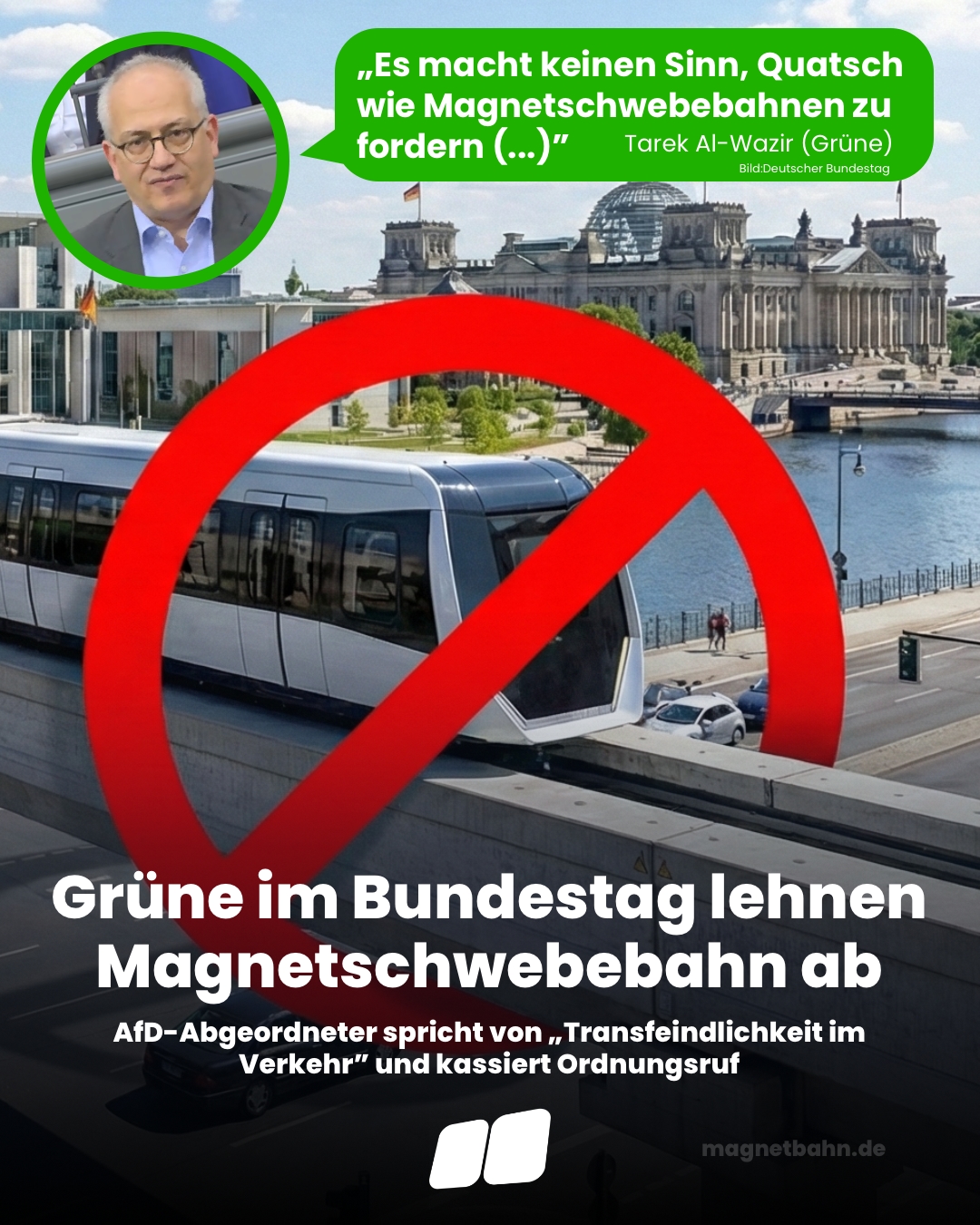
When AfD member Maximilian Kneller objected and accused Broßart of “transphobia on the topic of transport” (a play on Transrapid), the chair stepped in.
Bundestag Vice President Andrea Lindholz issued a call to order, reasoning that the choice of words established no factual connection to the debate but attacked the member personally. A further call to order followed when Bernd Baumann criticized the chair for this approach.
The motion and the debate
On January 30, 2026, the Bundestag deliberated a motion by the Alliance 90/The Greens parliamentary group on amending the Municipal Transport Financing Act (GVFG), officially titled “Amend the Municipal Transport Financing Act – Strengthen municipalities and secure the expansion of local public transport in the long term” (Drucksache 21/3842). In substance, it contained a demand that could hardly be more striking against the backdrop of current transport debates: the Greens demand to “forgo funding for maglev trains, as they offer no transport added value for local public transport and prevent the expansion of existing local transport systems.”
This statement is demonstrably false. Independent feasibility studies, including one for Nuremberg, show that the Transport System Bögl (TSB) is clearly ahead of conventional trams on relevant indicators: energy consumption, maintenance costs and accident risk. In the right context of use, the technology offers massive advantages over existing systems. That these advantages are brushed aside so sweepingly in a Bundestag motion is something Green member Victoria Broßart has to answer for in this debate.
Particularly revealing was a quote attributed to Green member Tarek Al-Wazir in the debate. According to the record, he said: “To be honest, one must also say: it makes no sense to call for nonsense like maglev trains (…)” No engagement with studies, no analysis of use cases, just the dismissal of a proven technology as “nonsense”.
Wordplay, call to order and uproar
The debate was not only interesting in substance but also turbulent in parliamentary terms. Green member Victoria Broßart opened her speech with a reference to Stoiber’s famous Transrapid Munich speech (the 2002 speech by then Bavarian premier Edmund Stoiber). Broßart used it to portray the maglev as a failed step backward: “Apart from a highly loss-making line in Shanghai and a few chunks of concrete in the Emsland region, nothing is left of the Transrapid”, she said.
AfD member Maximilian Kneller responded to this statement, who in September 2025 had already spoken explicitly in favor of the Transrapid in a Bundestag speech, with an interjection: “What is highly loss-making about that? You’ll have to explain that! It runs better than any railway here! No idea!” Kneller is right to ask this question. The Transrapid line in Shanghai has been in commercial operation for over 20 years and achieves a reliability rate of over 99.9 percent; there is no talk of “highly loss-making”. On the contrary: utilization is high and the conventional metro there runs uneconomically.
In his own speaking time, Kneller addressed Broßart directly and recommended that she overcome her “transphobia on the topic of transport”. A pun that presiding Vice President Andrea Lindholz did not accept. She issued Kneller a call to order with the following reasoning: the member had “deliberately not spoken of ‘Transrapid hostility’”, but through his choice of words had accused Broßart “without any factual basis and without relation to the debate of a misanthropic or group-despising attitude” and thereby “attacked and degraded her in her gender identity.”
The reaction in the AfD parliamentary group was, as expected, sharp. Dr. Bernd Baumann criticized the chair, whereupon Lindholz issued him a call to order as well, with the wording: “You are now getting a call to order from me for having just criticized my chairing of the session.” Whether a pun on “Trans” in a transport debate revolving around the Transrapid really constitutes a personal degradation remains, to put it carefully, an interpretation that does not occur to every observer. What does become clear: at that moment the debate about maglev trains was overshadowed by a discussion about the call to order, which pushed the actual core, the future of an innovative transport technology, out of view.
A pattern that persists
The Green rejection of the maglev is not a slip but a pattern. Since the early planning phases of the Transrapid, a consistent opposition runs through the party’s history that has hardly changed to this day. The longtime systems engineer Günter Steinmetz describes in his book Im Marionettentheater – Freie Fahrt … aber nicht für Transrapid? (“In the Puppet Theater: Clear Track… But Not for the Transrapid?”) in detail how the Greens, as early as the 1990s and 2000s, opposed concrete maglev projects, such as Hamburg-Berlin or Munich-Airport, and pushed through political conditions that effectively led to these projects failing.
Steinmetz speaks of a fundamental contradiction: a quiet, locally emission-free, energy-efficient and space-saving transport system was fought by the very party that claims to make environmental and climate protection the guiding principle of its actions. This hostile basic attitude is no historical curiosity. It continues into the present. Even today’s much smaller, regionally conceived maglev approaches still meet with reflexive rejection from the Greens: less from technical or ecological analysis, more from a kind of ideological distance from a technology that does not come from the context of “traditional” rail transport.
Steinmetz’s conclusion is sobering: maglev in Germany fails not because of its environmental record but because of a political blockade that has not been overcome to this day.
A slap in the face for Bögl
For the Max Bögl Group, the Bundestag debate of January 30 is a bitter lesson. The company from Sengenthal has been working for over a decade, largely with its own funds, on the Transport System Bögl, a modern urban maglev train. The technology is proven, the Federal Railway Authority granted an operating license to a company-owned GmbH in November 2025, and feasibility studies show clear potential for several German cities. All that is still missing is political tailwind, specifically the inclusion of maglev trains in the GVFG funding framework.
That Max Bögl can count on support from politicians was promised, at least on paper. The coalition agreement of the federal government under Friedrich Merz contains an explicit passage: “The Municipal Transport Financing Act (GVFG) will be simplified and de-bureaucratized, opened up to innovative approaches (for example maglev trains).” But to this day this promise has not been put into action. The GVFG is unchanged, and maglev trains are still not eligible for funding.
On the Max Bögl website, the groundwork of recent years in the area of political visits can be read: Robert Habeck, then Economy Minister and a Green, visited the test track in Sengenthal in 2023 and was impressed by the innovations. The Bavarian Greens around parliamentary group leader Ludwig Hartmann were on site in 2022 and explicitly praised the technology. Hamburg’s transport senator Dr. Anjes Tjarks, himself a Green, learned about the system in 2025. Visit after visit was proudly documented, photo after photo published on the company website.
And yet: exactly this party, the Greens, is demanding in the Bundestag that maglev trains be removed from funding.
The conservative Union (CDU/CSU) and the SPD are not coming out clean either. They even wrote the maglev train into the coalition agreement, a promise made roughly eighteen months ago. Yet concrete steps toward implementation are still missing. The GVFG was not touched, timetables were not communicated, funding amounts not specified. That the Greens reject maglev is a pattern; that the Union hesitates on implementation is a failure. For Max Bögl, a company that has brought to market maturity with its own resources a technology that Germany needs, both together amount to a slap in the face.