Why the Hyperloop Is Unrealistic
The Hyperloop sounds promising: high travel speeds, minimal energy demand and high efficiency. On the strength of these arguments the Hyperloop is rightly championed, because if the technology can actually be realized, it would be an excellent replacement for short-haul flights.
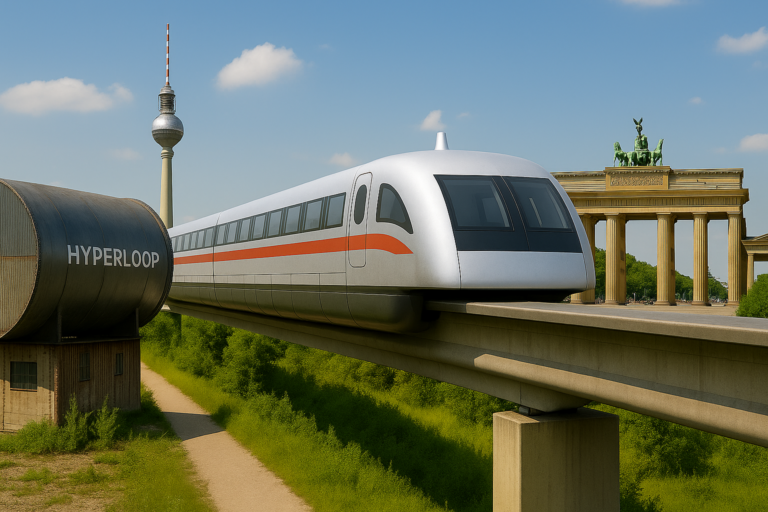
However, there are many doubts about its feasibility, safety and economic viability. The Transrapid promises similar benefits without the Hyperloop’s drawbacks. Transrapid technology has now been researched, developed and demonstrated for over 50 years, with success.
Comparing the two systems, it becomes clear that the Transrapid currently makes far more sense than the Hyperloop. This is not only because of the technology’s long operating experience; it is above all a matter of technical feasibility. While the Transrapid had several test tracks in operation just a few years after development began, we have been waiting almost 10 years for realistic tests of the Hyperloop with passengers on board under vacuum. Virgin Hyperloop One did complete the first Hyperloop passenger run in November 2020, but under sobering conditions: no vacuum, a tiny vehicle and a (relatively) low speed.
Given the current challenges in long-distance travel, it is clear that short-haul flights will have to be relieved sooner or later. The Hyperloop is mostly the one drawing attention as the great hope here. But might it make more sense to rely on the Transrapid, which is already ready for service? Without taking any risks regarding technical feasibility?
The vacuum
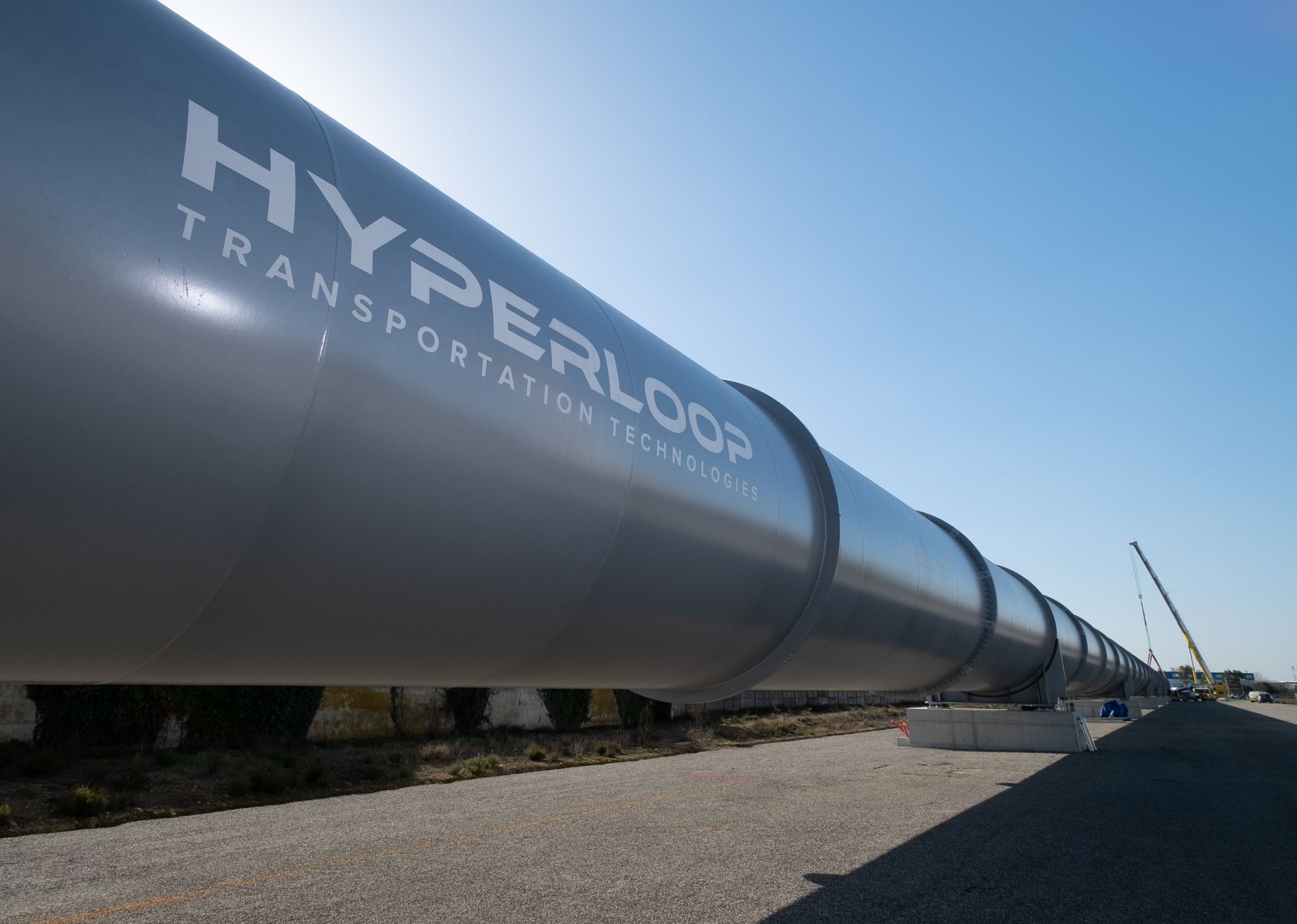
The Hyperloop reaches its high top speed of up to 1,200 km/h in a vacuum tube. The advantage is that air resistance almost disappears. This could yield considerable energy savings, provided the technology works. It is questionable, however, whether pumping the air out of the tube is worthwhile.
The tube is also exposed to high negative pressure. It must additionally withstand the vibrations of vehicle capsules at up to 1,200 km/h, which is technically unfavorable. One can imagine how many pumps would be needed to create a vacuum of this size. The Transrapid does not generate an artificial vacuum, so its air resistance is correspondingly higher.
Missing safety concepts
The Hyperloop’s vacuum tube raises not only technical questions; the safety of this technology also leaves open questions.
An emergency stop, for example because of a fire or a medical emergency, would be very hard to implement.
The failure of one Hyperloop capsule would paralyze all the following traffic, since the vehicles would run at very short headways because of the low capacity per capsule. This creates an increased risk of collision if a capsule has to brake rapidly from 1,200 km/h, which becomes problematic because just a few meters behind it several more capsules are traveling at maximum speed and would also have to brake.
Once the vehicles have stopped, further questions arise. How can passengers leave the capsule in an emergency? If passengers were to get out of the vehicle, they would suffocate in the vacuum unless a shut-off mechanism exists. Additional oxygen tanks and breathing masks would then be essential. Escaping from the tube is also a legitimate concern. Emergency exits are unlikely, as they would compromise the vacuum. Many safety questions about the Hyperloop remain unanswered for now.
With the Transrapid the situation is different: in an emergency the vehicle can stop within a short braking distance, and passengers can leave the vehicle at predefined emergency stopping stations.
In an absolute emergency, evacuation slides are used, through which passengers slide out of the vehicle. Alternatively, escape slides similar to those on aircraft have been tested on the Transrapid.
Low capacity
Because of the vacuum and the limited flexibility in curves, Hyperloop vehicles have to be built very small. A “capsule” has a capacity of only 60-80 seats, whereas a 10-section Transrapid configuration offers more than 1,000 seats.
To achieve capacities similar to the Transrapid or the ICE (Germany’s high-speed trains) with the Hyperloop, several vehicles must be on the line at the same time at very short headways. Short headways at speeds above 1,000 km/h are a concern, since all vehicles within a tube would have to communicate with each other in real time. This is especially essential in the event of an emergency stop, because otherwise vehicles traveling above 1,000 km/h could collide if a vehicle ahead brakes.
Technical problems
Especially given the short headways, technical problems are a real issue.
To ensure trouble-free operation, all vehicles within a tube must communicate with each other in real time. This is technically possible, but it requires redundant system design.
A speed of 1,200 km/h does seem realistic, however. With correspondingly low energy demand thanks to the absence of air resistance, this is not a problem, provided the propulsion equipment (transformers) permits up to 1,200 km/h.
For some Hyperloop technologies, especially those with propulsion in the guideway, the short headway is the biggest problem. To see why, you first need to understand how guideway propulsion works. The Transrapid serves as a clear example.
The entire guideway is never energized at once. The line is divided into so-called “drive blocks” and “line sections”.
The drive blocks indicate how many vehicles on a stretch of line can be driven by the transformers.
The line sections indicate into how many sections the drive block is divided.
When a Transrapid is running, only the line sections of a drive block on which the vehicle is located are energized.
After the Transrapid has passed over a line section, the system switches to the next section.
The line sections are considerably longer than the vehicles, though, because implementing many small line sections, each with its own switching station, along a long line would be too costly.
It follows that the shorter the headway, the higher the number of drive blocks and line sections required.
This in turn means that the higher the number of drive blocks and line sections, the more technical equipment such as switching points and transformers is needed.
The conclusion: the higher the number of drive blocks and line sections, the more complex, failure-prone and expensive the entire system becomes.
Hyperloop lines would therefore be hyper-costly, on the one hand because of the vacuum, and on the other because of the technical complexity caused by the short headways.
This problem could be solved by developing capsules with considerably higher capacity and lengthening the headway accordingly. But that would make driving through curves nearly impossible, since the capsules are designed to be inflexible, unlike the Transrapid’s adaptive and flexible magnetic chassis.
So which is better?
It should be noted that the Hyperloop is a technology under development. It goes without saying that not all questions can be answered yet. But work is under way. The Hyperloop still has great potential to permanently change the transport of the future with its revolutionary technology. Hyperloop developments are certainly exciting, and many new maglev technologies are emerging from them. These include permanent-magnet levitation technologies such as Nevomo Magrail and HyperPodX, as well as hybrid solutions combining electromagnets and permanent magnets, such as Hardt Hyperloop.
Until further notice, though, the Transrapid would be the better choice, given the Hyperloop’s safety concerns. At speeds of 500-600 km/h it would be “only” half as fast as the Hyperloop, but considerably safer, more comfortable and more realistic to build.