Hyperloop Works: TUM Completes Vacuum Run
On July 10, 2023, the TUM Hyperloop team (from the Technical University of Munich) proved that the Hyperloop is feasible: the world’s first run with passengers under vacuum conditions was carried out. This is a major breakthrough in Hyperloop research, and so far no other Hyperloop project seems to be as successful as TUM. Even Hermann Kemper’s 1938 vision of a “pneumatic tube mail for people” now seems to be becoming reality.
Certification for passenger transport
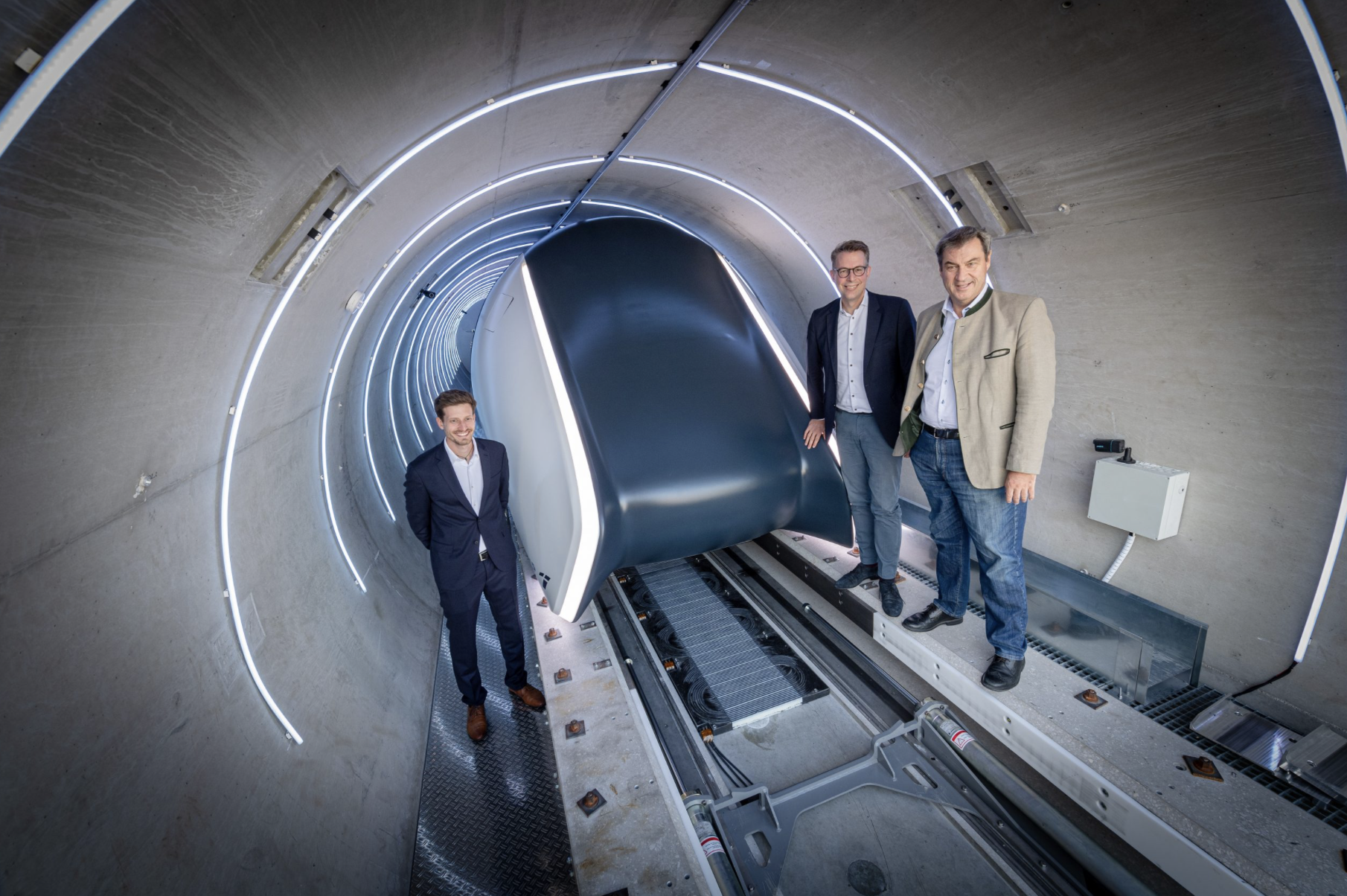
Another distinguishing feature of the TUM Hyperloop is its certification for passenger operation by TÜV Süd. As a result, passengers can be carried on a Hyperloop run under vacuum conditions on the test track in Ottobrunn, even though speeds at this early stage are understandably still low. A 10 mm partial vacuum is created, which according to TUM is ideal for Hyperloop operation.
Test track in Ottobrunn
In Ottobrunn, near Munich, TUM has built a concrete tube 24 m long and 4 m wide, which serves as the Hyperloop test track.
While many other Hyperloop projects rely on steel tubes, the TUM system uses concrete tubes. As with the Transrapid, concrete guideways are characterized by their high stiffness, which ensures high availability. Another advantage is better damping, which produces lower noise emissions. TUM also describes the concrete guideway as “more cost-effective in the long term.”
The concrete tubes were manufactured by the Max Bögl group of companies, which has been researching Transrapid guideways since the 1990s and developed the hybrid girder, whose second generation is used on the Transrapid Shanghai line. Bögl is also known for the TSB, an innovative local-transport maglev that can reach up to 150 km/h and stands out for its efficiency and quick realization.
The concrete tube is made up of 6 ring-shaped elements that are vacuum-tight and joined without adhesive. Special concrete guideways are fitted and aligned inside the tube, using the expertise of Max Bögl Wind AG. One ring element weighs roughly 30 tonnes. Max Bögl laid the foundations for the test track as early as August 2022. The ring elements were produced at the Sengenthal plant and assembled in Ottobrunn by November 2022.
What is the Hyperloop?
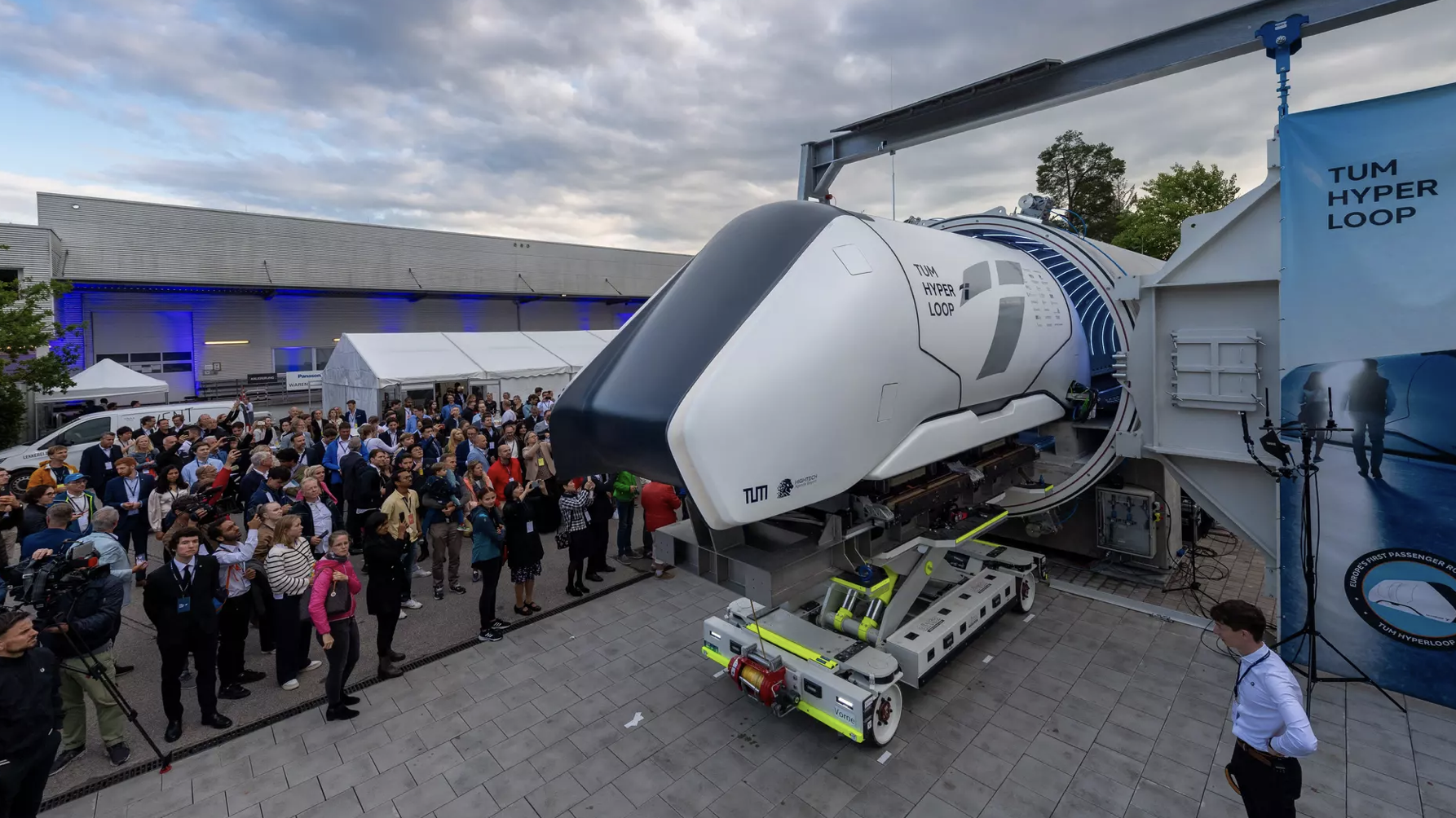
With its technology, the TUM Hyperloop team is aiming for a Hyperloop system that will reach up to 900 km/h. Unlike conventional high-speed maglevs such as the Transrapid, the Hyperloop is characterized by drastically lower energy consumption, since the vacuum greatly reduces air resistance.
Hermann Kemper, inventor of the electromagnetic levitation railway (later used in the Transrapid, among others), noted as early as 1938 that maglevs should ideally be operated in vacuum tunnels, since air resistance is the biggest problem for high-speed trains & maglevs. Especially at high speeds, a great deal of energy must be spent overcoming air resistance. A vacuum helps here and enables either considerably higher speeds, or identical speeds at drastically lower energy consumption, or even both at once.
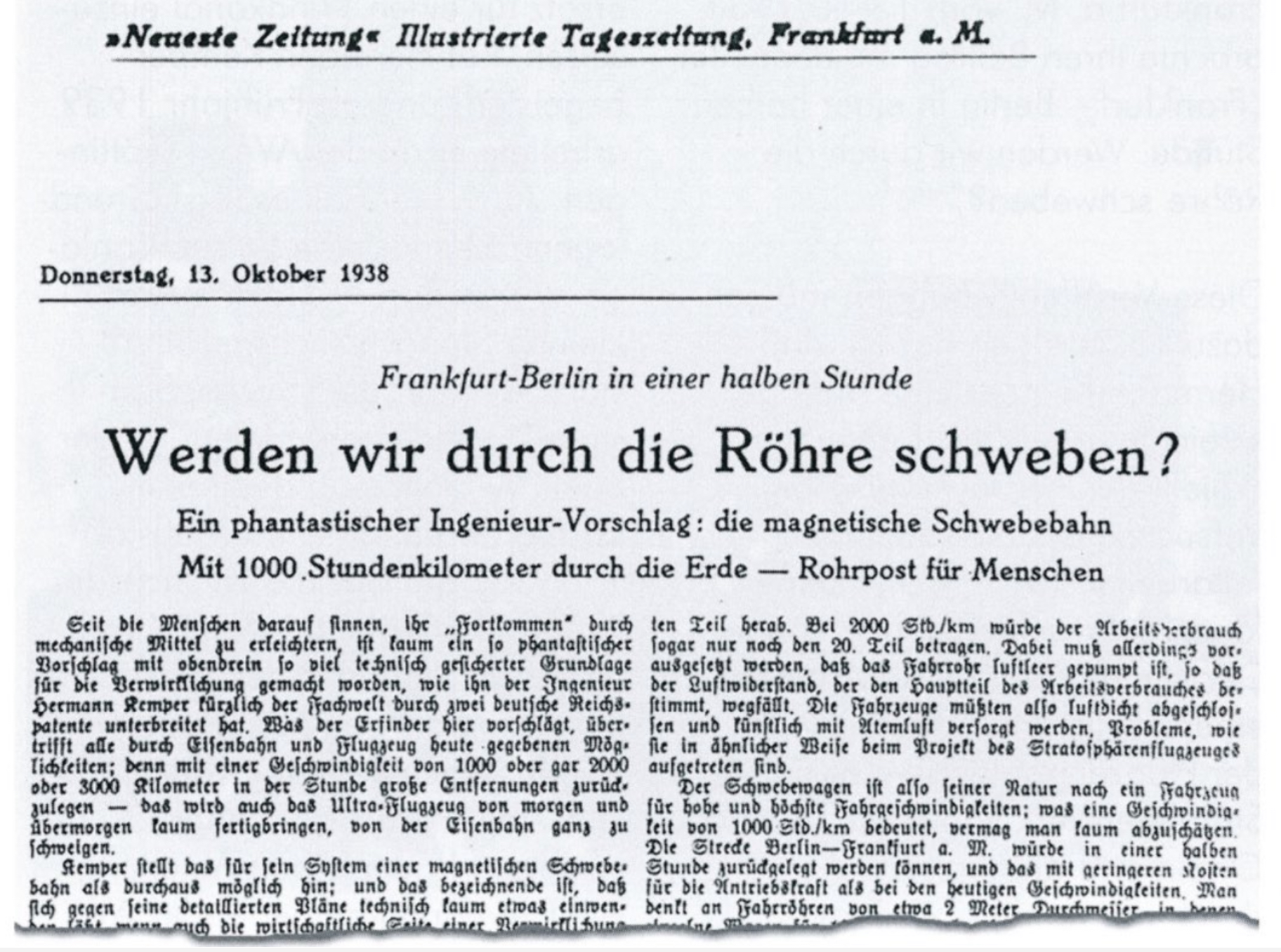
At that time, however, such systems were unrealizable, particularly because of the state of computer technology back then. When the first maglev vehicles began to be built in Germany in the 1960s, people quickly decided against the vacuum and built maglev technology without a tube, from which today’s Transrapid emerged.
In 2023, however, the situation looks different. It seems the technology is now mature enough to make Hermann Kemper’s vision a reality in Ottobrunn.
Incidentally, the first German maglevs were developed and tested in the same town more than 50 years ago, notably the MBB prototype vehicle (1971), which carried the first passengers in an electromagnetic levitation railway over 50 years ago and sparked a similar fascination.